

The Visuals are 4K, but the Audio is “Elevator”
You spend hours perfecting your craft. You color-grade your footage until the shadows are rich and the highlights gleam. You obsess over your script, refining every sentence until it punches with wit and clarity. You build a visual identity that is unmistakably yours.
And then, at the very end of the process, you ruin it.
You drag and drop a file named “Upbeat_Corporate_Ukulele_03.wav” onto your timeline. Instantly, your unique, handcrafted content feels like a generic pharmaceutical commercial.
This is the “Audio Gap.” For years, creators have had access to professional visual tools (like Canva and DaVinci Resolve), but audio has remained stuck in the era of stock libraries. You are forced to choose between music that sounds cheap or music that costs a fortune to license.
But the landscape is shifting. We are entering an era where audio is no longer something you find; it is something you forge.
The technology driving this shift is generative audio. It promises to do for your ears what filters did for your eyes—turn the complex into the accessible. AI Song Generator which allow you to bypass the “search bar” entirely and start designing soundscapes that actually match your vision.
The End of the “Search and Settle” Era
Why “Good Enough” is No Longer Enough
I want you to think about the last time you looked for background music.
You probably typed “Cinematic Epic” into a search bar. You listened to the first 10 seconds of thirty different tracks. You didn’t love any of them, but you picked the one that was the least annoying.
You settled.
In the creator economy, attention is the only currency. When you settle for generic audio, you are telling your audience, “I didn’t care enough about this part.”
Generative AI flips this dynamic.
In my recent experiments with AI music generation, the workflow felt less like browsing a store and more like directing a composer. I didn’t ask for “Rock Music.” I asked for a specific emotional trajectory.
- I need a track that starts with a lonely acoustic guitar, builds into a driving indie-rock chorus, and ends with a sudden silence.
The result wasn’t just a random song; it was a narrative device. It followed the arc of my story. This capability transforms music from a background filler into a storytelling asset.
Under the Hood: From Keywords to Waveforms
My “Cyberpunk Jazz” Experiment
To understand the capabilities of this technology, I decided to test it with a “Stress Test”—a prompt that combines conflicting genres to see if the AI could handle nuance.
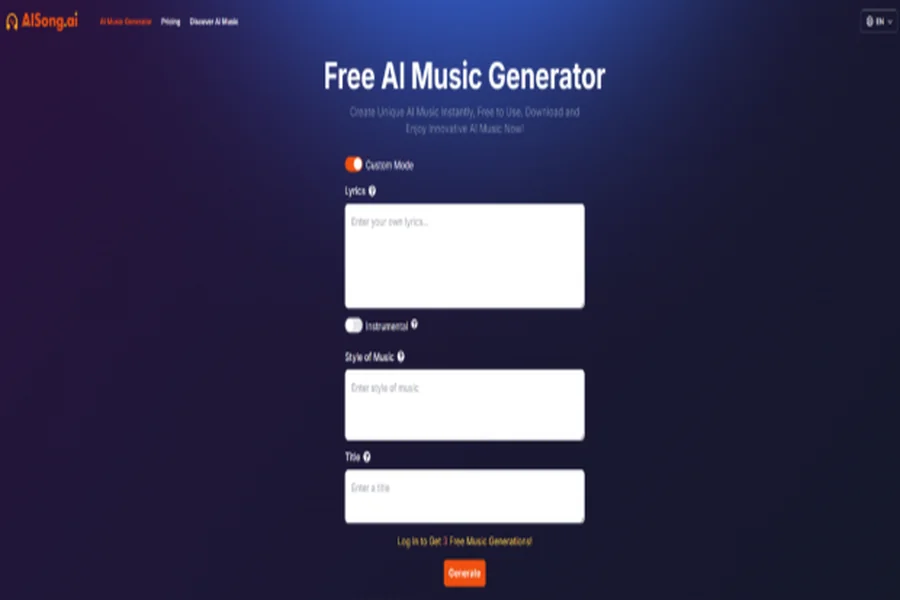
I went to AISong and input a prompt designed to break a standard algorithm:
“Smoky jazz club ambiance, saxophone solo, but with a heavy, distorted 808 bassline and glitchy electronic drums. Dark, futuristic, noir.”
The Observation:
A traditional loop-based system would have failed here. It would have just layered a jazz loop over a trap beat, resulting in a chaotic mess.
However, the generative model did something fascinating. It fused the elements. The saxophone played with a slightly robotic, processed timbre that matched the electronic drums. The bassline didn’t clash with the piano; it supported it. The AI understood the context—that this was “Future Noir,” not just “Jazz + Trap.”
This is the difference between mixing and synthesis. The AI isn’t pasting sounds together; it is dreaming up a new sound that fits your specific description.
The Economics of Originality
Why does this matter for your strategy? Because in a world of infinite content, uniqueness is the ultimate leverage.
Below is a comparison of how generative audio stacks up against the traditional methods of acquiring music.
| Metric | Stock Music Libraries | Hiring a Composer | AISong.ai Generation |
| Originality | Low. Thousands of other creators use the exact same track. | High. Bespoke to your project. | High. Unique generation based on your prompt. |
| Speed | Slow. Hours spent searching and auditing. | Very Slow. Weeks for delivery. | Instant. Seconds to generate and iterate. |
| Adaptability | Rigid. You cannot change the tempo or lyrics of a WAV file. | Flexible. But revisions cost money. | Fluid. Re-roll or tweak prompts instantly. |
| Licensing | Complex. specific usage rights (e.g., “Web only”). | Expensive. Buyout fees are high. | Simplified. Ownership of the generated asset. |
| Emotional Fit | “Close Enough.” You edit your video to fit the music. | Perfect. | Tailored. You generate music to fit your video. |
The “Copyright Minefield” Solution
We cannot ignore the elephant in the room: Copyright.
Every creator lives in fear of the “Content ID” claim. You might license a track legally, but if the artist sells the rights to a conglomerate later, you could still get flagged.
Generative audio offers a “Clean Slate.” Because the music is generated pixel-by-pixel (or sample-by-sample) at the moment of request, it has no history. It doesn’t exist in a database until you create it. For brands and high-volume publishers, this safety is invaluable.
The Learning Curve: It’s Not Magic, It’s a Skill
While the potential is immense, I believe in setting realistic expectations. Moving from stock music to generative music requires a shift in mindset.
-
You Must Learn to “Speak Music”
The AI is only as good as your prompt. If you type “good song,” you will get a mediocre result. You need to learn descriptive vocabulary.
- Instead of “Sad,” try “Melancholic, minor key, slow tempo, sparse piano.”
- Instead of “Fast,” try “160 BPM, drum and bass rhythm, high energy.”
The tool rewards those who can articulate what they hear in their heads.
-
The “Hallucination” Factor
In my testing, there were moments where the AI struggled. Occasionally, a generated vocalist might sing a word that sounds slightly slurred, or a drum fill might sound physically impossible. These are the “hallucinations” of audio. They are becoming rarer with every model update, but they exist. You have to be willing to hit “Generate” a few times to get the perfect take.
-
Audio Resolution
For 99% of use cases—YouTube, TikTok, Podcasts, Instagram—the audio quality is stellar. However, if you are mixing a feature film for an IMAX theater, you might still want a live orchestra. Generative audio is currently the champion of the digital screen.
Strategic Applications: Where to Start?
If you are ready to integrate this into your workflow, here are three high-impact starting points:
- The “Signature” Intro: Stop using the same royalty-free intro as five other podcasts. Generate a 10-second sonic logo that is uniquely yours.
- Dynamic Backgrounds: For long-form video essays, you need music that loops without becoming annoying. You can prompt for “Lo-fi hip hop, repetitive, ambient, study beats” to create endless beds of non-intrusive audio.
- Trend Jacking: A new meme format takes off on TikTok involving a specific style of song (e.g., “1920s Swing”). Instead of hunting for a copyright-free vintage track, you generate one in seconds to ride the wave immediately.
The Future is Bespoke
We are moving away from the “One Size Fits All” economy. We customize our avatars, our interfaces, and our algorithms. Why should our audio be any different?
Tools like AISong.ai are not replacing musicians; they are unlocking the musician inside the non-musician. They are removing the technical friction that stands between your idea and its execution.
The next time you are editing a video or launching a project, don’t ask, “What is available?”
Ask, “What does this sound like in my head?”
And then, simply type it.