

You have a melody in your head, but the moment you sit down to capture it, the friction begins. You wait for the heavy DAW to load, search for a plugin that isn’t expired, and troubleshoot a MIDI controller that refused to sync. By the time the first track is armed, the inspiration has already started its half-life decay. This technical barrier turns what should be a creative spark into an exhausting chore. For creators facing a ticking clock, this delay isn’t just annoying; it’s a project killer. When you have exactly fifteen minutes to show a client a “listenable direction,” you cannot afford to get lost in the weeds of sound design. This is why professionals are integrating an AI Music Maker into their workflow to bypass the mechanical grind and get straight to the sound. By utilizing Musick AI, the focus shifts from managing software to making immediate creative decisions.
I. What Is Musick AI?
Musick AI is a specialized tool designed to solve the “Communication Void”—the frustrating moment when you can describe a sound in words but cannot produce it yourself. It serves as a practical bridge between a creative brief and a real audio track. Instead of spending hours searching through generic stock libraries or trying to learn complex music production software, creators use this tool to generate original music from simple text descriptions.
The primary role of Musick AI is to intervene during the “initial spark” phase of a project. It is not meant to be a final, high-end studio replacement, but rather a way to quickly test if an idea works. It answers the question: “What would this scene sound like with a fast-paced electronic beat?” within seconds. By providing a tangible audio track immediately, it allows teams to align their creative direction before any significant time or budget is invested in professional production. It turns abstract thoughts into a concrete hearing anchor that everyone can evaluate at once.
II. What Musick AI Can Do
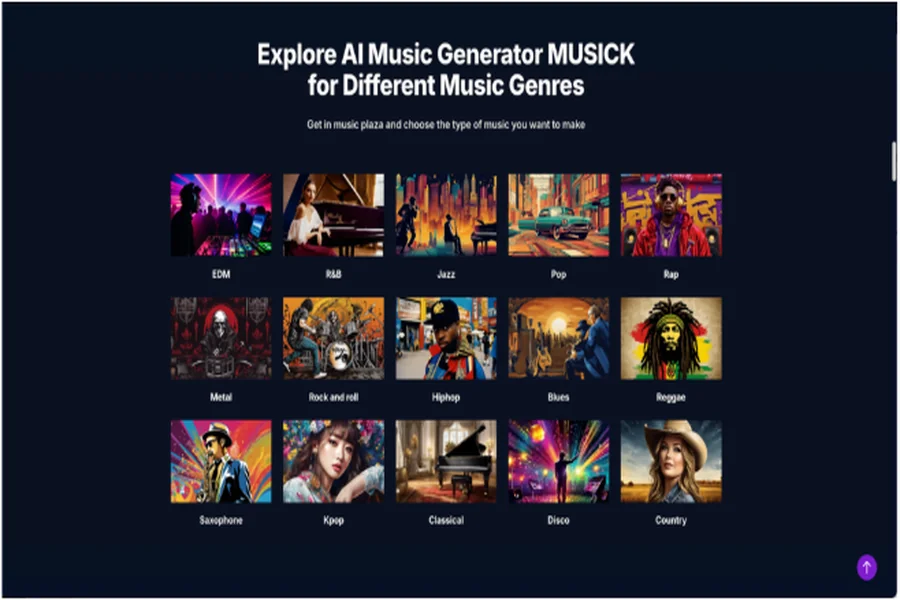
The utility of Musick AI lies in its ability to translate intent into multi-genre audio outputs. Users can define the trajectory of a track by inputting specific mood and structural requirements.
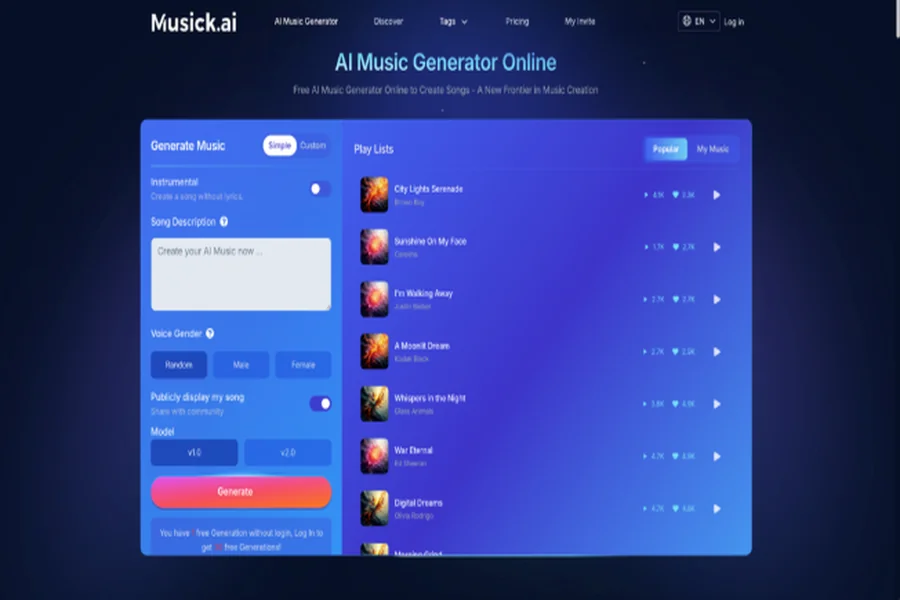
- Generation of Instrumental Backgrounds: It features an “Instrumental” toggle to create songs without lyrics.
- Text-to-Music Capabilities: Users can describe their desired sound in the “Song Description” or “Style of Music” fields.
- Vocal Customization: For non-instrumental tracks, creators can select a “Voice Gender,” including Male, Female, or Random options.
- Lyric Integration: The custom interface allows for the input of specific lyrics, supporting up to 3,000 characters.
III. How to Navigate the Creation Process
Starting a project requires a few deliberate steps to move from silence to a functional track. By visiting the AI Song Generator, creators can follow a streamlined path to audio generation.
- Select Mode: Choose between “Simple” for quick descriptions or “Custom” for granular control.
- Define Content: Toggle the “Instrumental” switch if no vocals are needed.
- Set the Style: Input the desired musical characteristics into the “Style of Music” field.
- Configure Specifics: Assign a “Voice Gender” and select the preferred “Model” version.
- Generate: Click the “Generate” button to produce the track and view it within the “Play Lists”.
IV. Who Benefits From Musick AI?
This methodology is tailored for those who operate in high-pressure environments where the cost of delay is high.
- Video Editors: For the professional facing a “narrative mismatch,” this tool provides a track that hits visual beats instantly.
- Content Strategists: For teams needing to unify a group’s aesthetic during a pitch, it eliminates the vagueness of verbal descriptions.
- Indie Developers: For creators who have the intuition for a vibe but lack the formal training for a DAW, it removes the physical barrier of music theory.
- Marketing Agencies: Facing “The 15-Minute Deadline,” it allows for the rapid delivery of a “listenable sample” to a client for immediate feedback.
V. Conclusion
Using AI for music isn’t about being lazy or replacing artists; it’s about getting your time back. Musick AI takes away all the boring technical stuff—like waiting for software to load or worrying about copyright — so you can get back to your real job. It turns a scary deadline into something you can actually handle by giving you a professional sound in minutes. When you stop struggling with the “how” and start focusing on the “what,” you’ll find that you can finish more projects and have more fun doing it.