

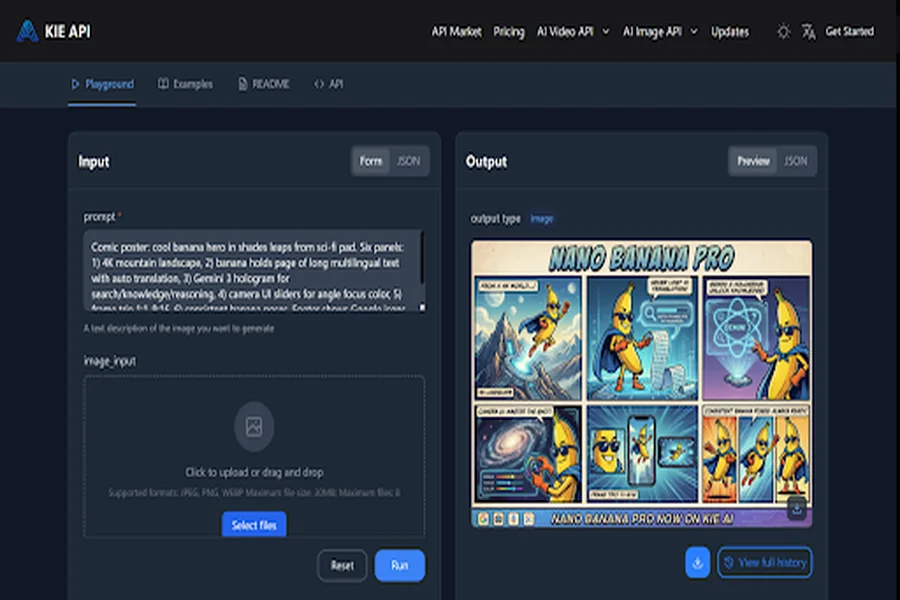
Modern enterprise infrastructure is rapidly shifting toward programmatic content pipelines. For development teams, selecting a generative interface like the Nano Banana Pro API is a strategic decision that directly impacts technical agility and brand authority. Built on the Gemini 3.0 Pro Image API framework, this interface provides the reasoning power necessary for professional-grade output that respects physical logic and design hierarchies, allowing organizations to move away from manual creative bottlenecks.
Strategic Advantages of the Nano Banana Pro API Infrastructure
Selecting a generative interface for an enterprise stack requires evaluating how the underlying infrastructure handles high-volume production without sacrificing quality. The Nano Banana Pro API distinguishes itself by providing a combination of advanced physical reasoning and professional resolution standards engineered for seamless backend integration.
Professional Fidelity and Native 4K Standardization
In professional content environments, visual quality is inextricably linked to perceived reliability. Standard generative outputs often struggle with pixel density, resulting in softer textures that fail to meet the requirements of high-density digital displays. The Nano Banana Pro 4k standard addresses this by providing native high-resolution output directly through the API. Unlike upscaled visuals, which often introduce noise and artifacts, native 4K generation ensures that every micro-detail and edge is rendered with surgical precision. This level of fidelity is essential for technical teams who need to produce high-impact assets that maintain their clarity across various formats, from industrial documentation to corporate marketing visuals.
Advanced Semantic Reasoning with the Gemini 3.0 Pro Image API
The core intelligence of the interface is driven by the Gemini 3.0 Pro Image API framework. This professional-tier logic provides a level of physical world grounding that standard models often lack. It understands the nuances of material physics, the behavior of light on complex surfaces, and the structural hierarchy of a scene. For an enterprise content pipeline, this means the API can interpret complex, intent-driven prompts as a structured visual concept rather than a random collection of keywords. This advanced reasoning minimizes visual hallucinations and ensures that the output is logically sound, even when dealing with abstract cultural metaphors or intricate industrial components.
Technical Implementation Protocols for Enterprise Workflows
Successful integration requires a structured approach to interface protocols and data management. The Nano Banana Pro API utilizes standardized JSON request structures to ensure compatibility across a wide range of development environments, from Python-based automation scripts to enterprise-level Java applications.
Standardizing JSON Payloads for Automated Production
The foundation of the integration is the standardization of JSON payloads to automate image production. Developers must define specific parameters within the request body, including target resolution, aspect ratio control, and reasoning intensity. By programmatically adjusting these variables based on the source data, teams can create a dynamic pipeline that automatically selects the most efficient generation path for each asset. For example, a system can be configured to use standard reasoning for high-volume drafting while reserving high-intensity logic for hero images that require the utmost physical accuracy. This granular control allows for a more efficient use of computational resources and ensures that the pipeline remains responsive under heavy load.
Functional Control with Image Editing Protocols
Beyond initial generation, a truly integrated visual engine must support iterative updates. The Nano Banana Pro AI image editing interface allows development teams to perform surgical refinements on existing assets via code. Instead of re-generating an entire composition when a single detail changes, developers can use scene-aware editing calls to modify specific zones while maintaining the structural coherence of the original image. This is achieved through coordinate-based calls that allow the API to blend updates seamlessly into the existing lighting and perspective. This capability is vital for maintaining the longevity of an asset library, as visuals can be updated and repurposed for different regions or product specifications without starting the creative process from scratch.
Integration Precautions and Engineering Best Practices
Building an enterprise-ready pipeline requires more than just establishing a connection; it requires the implementation of defensive coding and governance protocols to ensure long-term system reliability and security.
Error Handling and Response Code Management
One of the most critical precautions during implementation is the implementation of comprehensive error handling logic. Developers must account for various response codes, such as 429 for rate limiting or 500-series codes for server-side issues. Building a robust retry mechanism with exponential backoff ensures that the pipeline can recover from transient network errors without manual intervention. Additionally, validating input prompts before making an API call can significantly reduce the number of failed requests and optimize resource usage, preventing the system from processing incoherent or unsupported requests.
Latency Optimization and Rate Limiting Strategies
To maintain an efficient system, technical teams should monitor and optimize request latency. This involves implementing caching layers for frequently requested assets and selecting the appropriate reasoning intensity for each specific task to avoid unnecessary computational overhead. Furthermore, implementing a local rate-limiter on the application side can prevent unexpected surges in requests. This strategy ensures a more predictable throughput and helps manage the total cost of ownership (TCO) for the visual engine, which is a primary concern for organizational leaders managing technical infrastructure.
Safety Filters and Content Governance Protocols
When integrating a generative API at scale, it is essential to implement secondary validation layers for prompts and outputs. While the Nano Banana Pro API includes built-in safety filters and grounding logic, enterprise teams should add their own governance protocols to ensure that all generated assets comply with internal brand guidelines and regional regulations. Validating input prompts before they are sent to the API ensures that the generative engine is only used for its intended purpose. This dual-layer approach to content safety is vital for protecting the organization’s reputation in a high-volume, globalized production environment.
Streamlining Deployment and Governance
Successful deployment requires a focus on security and the rapid implementation of technical protocols to ensure a smooth transition from testing to a live production environment.
Secure Management of the Nano Banana Pro API Key
Integration begins with the acquisition of a dedicated Nano Banana Pro API key from the management console. This key acts as the central credential for tracking usage and expenditure across different projects or departments. Developers must utilize secret management tools and environment variables to ensure the key is never exposed in public repositories or client-side code. Centralized management of the key enables better auditing and cost allocation, providing technical leads with the visibility needed to manage operational spend effectively.
Accelerating the Development Cycle with a Nano Banana Pro API Tutorial
To minimize technical debt, development teams can utilize a structured Nano Banana Pro API tutorial provided in the product documentation. By following standardized JSON request formats for aspect ratio control, consistency logic, and editing parameters, developers can implement a fully automated 4K production pipeline in a single sprint. This streamlined deployment reduces the learning curve for the engineering team and ensures that the organization can start realizing the benefits of automated content generation immediately.
Final Perspective on Technical Integration Efficiency
The shift toward API-driven visual production is a transformative step for any digital enterprise. By prioritizing a deep integration with the Gemini 3.0 Pro Image API and leveraging the robust infrastructure provided by the interface, organizations can build visual engines that are technically advanced and highly reliable. As the industry demand for high-resolution, logically grounded visual storytelling grows, mastering the integration of Nano Banana Pro AI will be the definitive step toward achieving scalable creative excellence and long-term infrastructure efficiency.