

Most ABA practices don’t struggle because they lack good clinicians. They struggle because their software can’t keep up. The best ABA software platforms should handle real-time session data, coordinate scheduling across large teams, and process insurance billing without creating more work than they save. After reviewing platforms built for behavioral health, the gaps become clear fast. Poorly timed session notes, denied claims, and HIPAA risks all trace back to the wrong tools. This guide covers six platforms worth a serious look.
How this ranking was put together
Options were reviewed using publicly available information from user reviews, case studies, feature breakdowns, and official websites, with only platforms showing a real track record in behavioral health software making the cut.
→ See the full research breakdown
- Theralytics – Best for clinical management and practice management for behavioral health providers
- CentralReach – Best for autism and IDD care practices, ABA therapy providers, special education providers
- ABA Matrix – Best for ABA clinics and behavioral health practices of all sizes
- Passage Health – Best for ABA clinics and autism treatment providers
- Raven Health – Best for ABA therapy practice management and billing
- Rethink Behavioral Health – Best for ABA therapy providers and pediatric behavioral health practices
Why ABA Software Platforms Are Worth a Closer Look
Running an ABA practice without purpose-built software means your team is constantly patching together workarounds. Coordinating session data across multiple RBTs, BCBAs, and locations is hard enough without a system that lags or loses sync.
And when you add complex prior authorization workflows and HIPAA-compliant record storage for minor patients, the administrative load gets serious fast. The right platform keeps session note completion rates high, shortens reimbursement turnaround, and gives clinicians real visibility into client goal mastery over time.
-
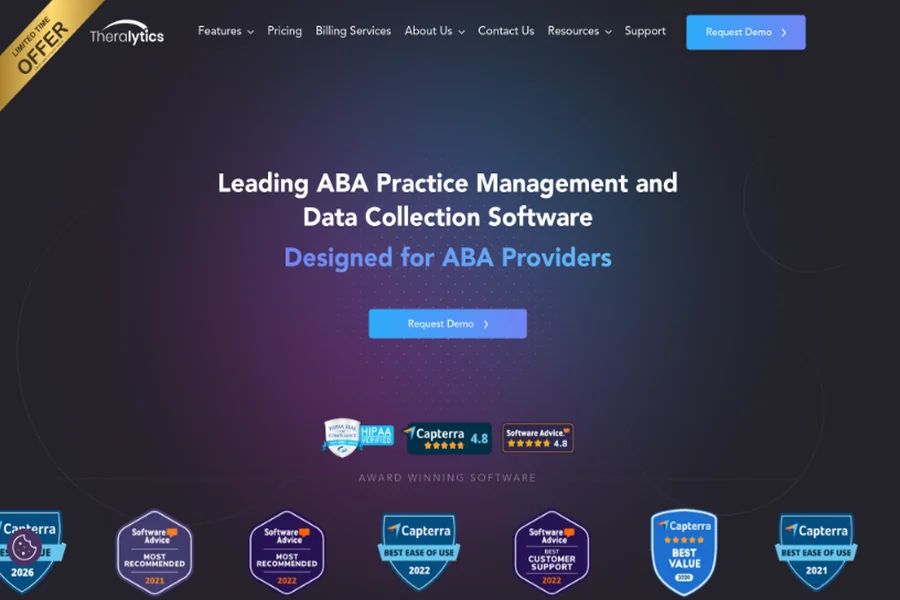
Theralytics – Best Overall for Clinic Management
How Does Theralytics Operate?
Theralytics, ABA practice management software, brings clinical and operational data into one place and coordinates without requiring workarounds. The platform supports real-time data synchronization across BCBAs, supervisors, and clinicians, while automated graphing removes the manual work of tracking progress. Offline-capable data entry keeps sessions running even without a connection, and built-in scheduling and billing tie directly to session-level data. Enterprise-grade security with mandatory MFA meets HHS technical safeguard requirements.
Why Does Theralytics Stand Out for ABA Software Platforms?
Clinical data silos are one of the most common reasons treatment decisions get delayed. Theralytics directly addresses that by keeping all session data synchronized across every role in real time. That kind of tight connection between scheduling, billing, and clinical records is genuinely hard to match at an affordable price point.
What Users Are Actually Saying:
From what the reviews show, users consistently point to how quickly they can pull clinical insights without waiting for manual reports to be compiled. The reduction in back-and-forth between administrative and clinical workflows gets mentioned often. And that matters when you’re managing a growing caseload.
-
CentralReach – Best for Autism and IDD Care Practices
How Does CentralReach Operate?
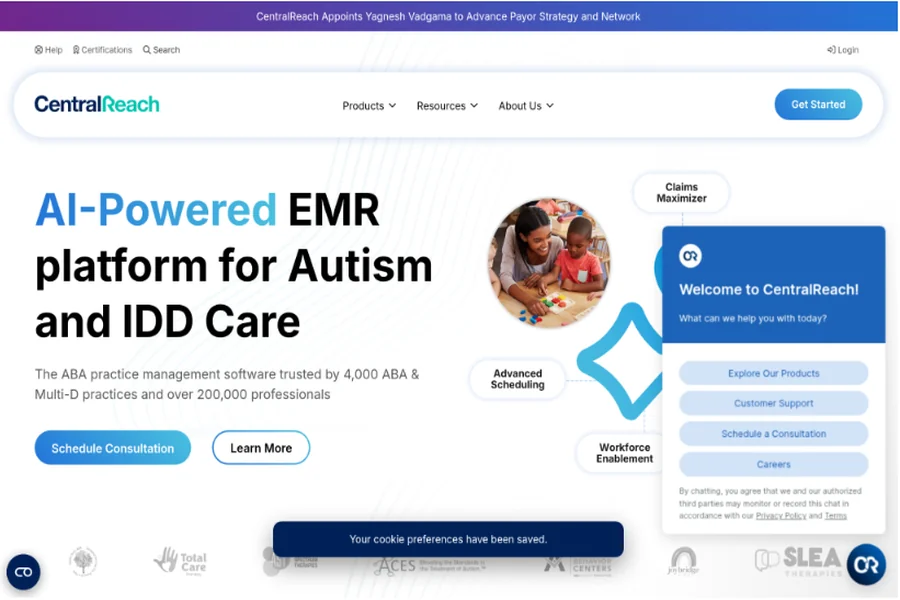
CentralReach serves over 4,000 ABA practices and 200,000 professionals with a platform that covers practice management, clinical data collection, AI-assisted scheduling, and billing in one place. Their AI technology was trained on over a billion data points in partnership with 40+ BCBAs, which gives it real clinical grounding rather than generic automation. The platform also includes IEP data collection and behavior tracking built for autism and IDD care. Honestly, that kind of specialized depth is rare at this scale.
Why Does CentralReach Stand Out for ABA Software Platforms?
Managing clinical, operational, and marketplace functions across a large ABA practice usually means juggling multiple disconnected tools. CentralReach consolidates all of that into one system. Their BCBA-informed AI layer means the automation actually fits real clinical workflows rather than forcing clinicians to adapt to generic logic.
What Users Are Actually Saying:
Users frequently highlight the breadth of CentralReach’s features as both its biggest strength and, occasionally, its steepest learning curve. From what the reviews show, larger practices tend to get the most value from it, while smaller teams sometimes find the full feature set more than they need on day one.
-
ABA Matrix – Best for ABA Clinics of All Sizes
How Does ABA Matrix Operate?
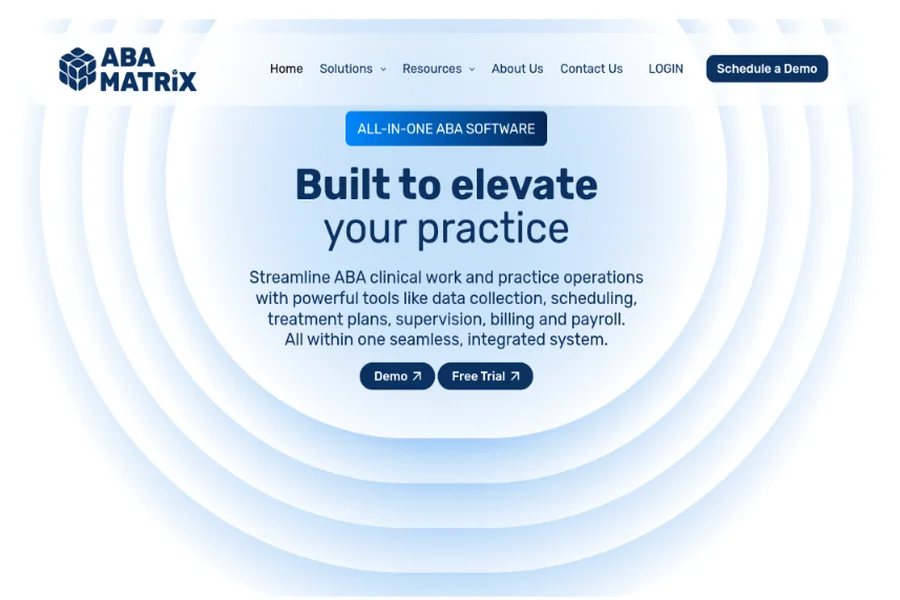
ABA Matrix covers data collection, scheduling, billing, progress notes, assessments, graphing, compliance alerts, and payroll in one platform built for behavioral health practitioners. It’s designed to serve solo practitioners, startup clinics, and larger private practices without forcing them into feature sets that don’t fit their size. Built with HIPAA compliance and CASP Guidelines baked in, the platform takes a reliability-first approach. A published case study with Better Future Behavioral Therapy Center shows measurable gains in assessment accuracy and intervention planning (not a small thing to document publicly).
Why Does ABA Matrix Stand Out for ABA Software Platforms?
Small and mid-sized ABA clinics often get priced or feature-locked out of platforms built for enterprise-level organizations. ABA Matrix’s unit-based pricing addresses that directly. The bootstrapped, independence-focused approach also means product decisions stay close to what practitioners actually need rather than what investors want to scale.
What Users Are Actually Saying:
Reviews point to the compliance alerts and graphing tools as standout features, particularly for clinicians who previously tracked those elements manually. From what the feedback shows, practices transitioning from paper-based or patchwork systems tend to report the biggest workflow improvements after switching.
-
Passage Health – Best for ABA Clinics and Autism Treatment Providers
How Does Passage Health Operate?
Passage Health is a clinical and practice management platform built with direct input from 100+ practices and advisors, which shows in how the product feels to use. The platform covers data collection, treatment plan building, supervision tools, and real-time progress monitoring with a design that reportedly takes minutes to learn rather than months. Real-time syncing with offline capability means session data stays current even in low-connectivity environments. Backed by $10.2M in funding, the company has the runway to keep building without cutting corners on reliability.
Why Does Passage Health Stand Out for ABA Software Platforms?
Building software with ongoing clinician feedback sounds like a standard claim, but the result here is a platform where the interface doesn’t fight the clinical workflow. For practices where high therapist turnover means constant training and setup, a system that new staff can learn quickly is a real operational advantage.
What Users Are Actually Saying:
The most consistent theme in user reviews is how fast new staff get up to speed, which directly cuts training time and reduces errors during staff setup. From what reviews indicate, the real-time sync and offline reliability also come up regularly as reasons teams stick with the platform long-term.
-
Raven Health – Best for ABA Therapy Practice Management and Billing
How Does Raven Health Operate?
Raven Health builds its platform around the actual day-to-day requirements of ABA therapy providers rather than adapting a general-purpose system after the fact. The platform includes data synchronization, offline data collection, treatment plans, progress tracking, and billing, with a mobile- and tablet-first design that clinicians reportedly learn in under 15 minutes. Their Managed Billing Bundle charges a percentage of collected claims rather than a flat fee, which ties the platform’s revenue to the practice’s own cash flow. Clients like Crescent Bloom and Pair Tree Autism Services have reported meaningful time savings and better revenue cycle performance.
Why Does Raven Health Stand Out for ABA Software Platforms?
Revenue cycle problems in ABA billing often come from software that wasn’t built with payer-specific workflows in mind. Raven Health’s percentage-based billing model creates a shared incentive to get claims right. That kind of connection between vendor pricing and practice outcomes is genuinely uncommon in this space.
What Users Are Actually Saying:
Feedback from Raven Health’s client base points toward strong results in billing accuracy and faster reimbursement cycles. From what the available case data shows, practices that previously struggled with claim denials report meaningful improvement after moving to the platform’s billing tools.
-
Rethink Behavioral Health – Best for ABA Therapy Providers and Pediatric Behavioral Health Practices
How Does Rethink Behavioral Health Operate?
Rethink Behavioral Health has been serving behavioral health providers since 2007, which means nearly two decades of refinement on what ABA practices actually need. The platform combines clinical tools, billing, scheduling, data collection, compliance features, and staff training in one system, and it includes a library of over 1,500 customizable care plans. Their Medical Necessity Assessment tool has reached 87% agreement with clinicians across more than 23,000 assessments (that kind of validation data is rare and worth paying attention to). The company serves over 2,000 customers across clinics, agencies, and schools.
Why Does Rethink Behavioral Health Stand Out for ABA Software Platforms?
Pediatric behavioral health practices carry a particularly high compliance burden given the sensitivity of minor patient data. Rethink’s built-in compliance features, combined with their published ASD dataset, address that directly. Backed by K1 Investment Management and serving a customer base of over 2,000 organizations, the platform has a level of market validation that newer entrants can’t yet match.
What Users Are Actually Saying:
Users consistently point to the care plan library and built-in staff training as major time-savers, especially for practices managing large teams of RBTs who need ongoing competency support. From what the reviews show, the depth of clinical content built into the platform is what keeps long-term customers from looking elsewhere.
Methodology Behind These Picks
Gathering the Raw Data
The research process started by pulling together a broad list of ABA software platforms through directories, professional community mentions, review aggregator platforms, and published case studies. Sources spanned multiple behavioral health forums, software review sites, and vendor-produced documentation. The goal at this stage was coverage, not filtering. Any platform with a credible presence in the ABA therapy space was added to the initial pool before any evaluation began.
The Shortlist Cut
Platforms with thin or unverifiable track records were removed early. Review patterns were analyzed across multiple sources to distinguish genuine customer sentiment from surface-level ratings. Options showing inconsistent feature claims, a lack of documented real-world use cases, or sparse reviews across behavioral health-specific contexts were excluded from further consideration. What remained was a tighter group of platforms with demonstrable use in actual ABA practice settings.
Fact-Checking the Picks
Each shortlisted platform’s claims were cross-referenced against available user reviews and publicly documented outcomes. Where vendors described specific capabilities like offline sync, billing automation, or clinical reporting, those claims were checked against what users reported experiencing. Discrepancies between marketing language and real-world performance were flagged and weighed in the final assessment of each platform.
Authority Signals and Industry Standing
Platforms were evaluated for recognition signals including industry awards, mentions in behavioral health publications, and citations in professional community discussions. Longevity in the market, partnership announcements with clinically credible organizations, and any published original research were also factored in. These signals don’t replace performance data, but they do indicate which platforms have earned standing in the behavioral health community over time.
ABA Software Platforms Track Record
The final filter focused on evidence of sustained performance in ABA software contexts. Platforms needed dedicated service coverage for ABA-specific workflows, verified reviews from BCBAs, RBTs, or clinical directors, and at least one documented case study or outcome report tied to behavioral health use. Platforms that only partially addressed ABA requirements, or that positioned themselves as general-purpose tools with ABA as an add-on, did not make the final list.
Picking the Right ABA Software Platforms for You
Choosing the right ABA software comes down to matching the platform’s actual strengths to your practice’s current needs and growth stage. Not every platform fits every practice size or workflow model, so the evaluation needs to go beyond feature checklists.
- Industry and Domain Experience: Look for platforms built for ABA therapy, not general health software with ABA features layered on. Clinical depth matters when your team is managing complex behavior programs.
- Features and Service Options: Prioritize platforms that cover data collection, scheduling, billing, and progress reporting in one place. Disconnected tools create the data silos that slow down treatment decisions.
- Pricing Structure: Understand whether the pricing model fits your billing volume. Flat-fee models work well for stable practices, while percentage-based billing models can reduce financial risk during growth phases.
- Results Measurement: Check whether the platform makes it easy to track session note completion rates, client goal mastery percentages, and clean claims rates. Reporting that requires manual exports is a bottleneck.
- Industry Knowledge and Compliance: Confirm the platform meets HIPAA and BACB compliance requirements and handles Medicaid and insurance billing standards specific to ABA services. This is non-negotiable for pediatric behavioral health practices.
The Verdict
Picking the right platform from the best ABA software platforms available means getting specific about where your practice actually loses time. Theralytics and CentralReach both deliver strong clinical and operational coverage, while ABA Matrix and Passage Health suit practices that want focused tools without enterprise-level scope. Raven Health’s billing model and Rethink’s clinical depth round out the options well. As ABA practices scale, software that keeps pace with that growth will separate the high-performing practices from the rest.