
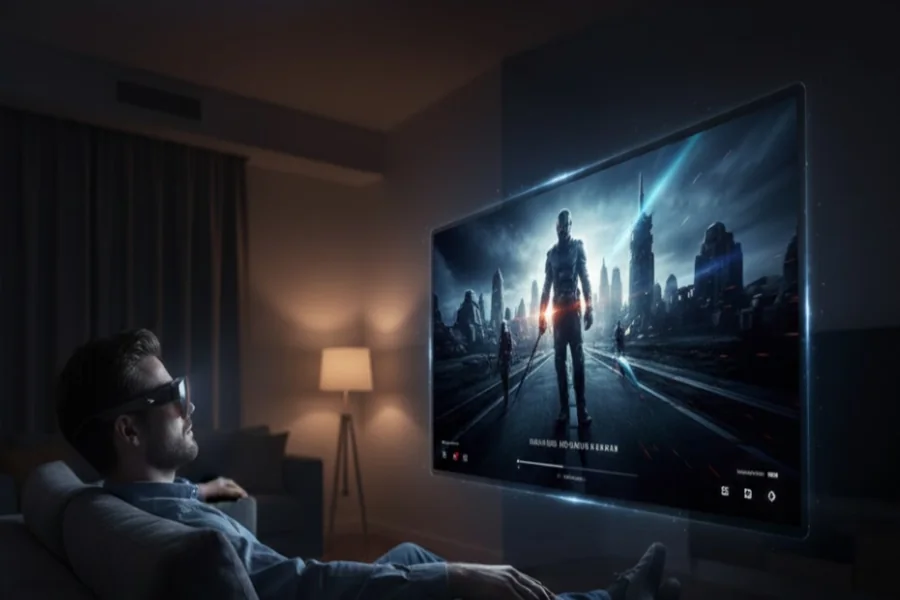

It’s 11:47 p.m. The room is dark, your partner is asleep, and you still have one episode left. Cast the show to the bedroom TV and the room glows. Watch on your phone and the small, bright screen can feel harsh after a long day.
This is the kind of use case that display-focused AR glasses fit well. The new RayNeo Air 4 Pro was tuned around this exact moment — keeping the room dark, the sound contained, and the screen easier on tired eyes.
The Bedtime Watching Problem
A bedside tablet lights the room, and nighttime screen light can interfere with melatonin and sleep timing. Open-ear earbuds leak across the bed; in-ears feel awkward on a pillow. Bone conduction leaks and runs thin on bass. None of these solve the simple goal.
This is where consumer AR Glasses found their niche. Birdbath-style optics create the perception of a personal screen at eye level while leaving the bedroom dark — the closest thing to a private cinema you can wear in bed without disturbing anyone next to you.
The trade-offs — limited field of view, possible eye strain, sound leak, and neck comfort — are real. AR glasses in this category were never about gaming or productivity. They were about a dark, controlled view at the end of the day.
Whisper Mode, in Plain Terms
Whisper Mode is the headline acoustic feature on the Air 4 Pro. It’s RayNeo’s name for the speaker tuning and routing that pushes audio toward your ear and away from the room. Among AR glasses features, it’s one of the few designed around bystanders, not just the wearer.
Tuned by Bang & Olufsen
The audio system inside the RayNeo Air 4 pro uses four built-in speakers tuned in partnership with Audio by Bang & Olufsen. RayNeo also offers a SoundTube accessory, sold separately, which routes more sound toward the ears for users wanting lower leakage.
How Much Sound Escapes
At low-to-medium volume in a quiet bedroom, leakage should be lower than what you’d expect from typical open-ear speakers. It will not match sealed in-ear earbuds for privacy. For many viewers, that’s an easier trade-off than putting buds inside your ears at night.
Surround Mode for Solo Sessions
Surround Mode uses the same four speakers but widens the soundstage for solo viewing. Whisper for late-night episodes; Surround when the house is empty. The toggle lives in the on-glasses menu and switches in under a second.
3840Hz PWM Dimming and the Eye-Care Story
The other half of the late-night equation is the display itself. Bright micro-OLED panels common to AR glasses can trigger eye fatigue in a dark room. The Air 4 Pro addresses that through dimming method, certification, and color tuning rather than one marketing claim.
What PWM Dimming Actually Is
Most OLED panels control brightness by flicking pixels on and off many times a second. The speed of that flicker is what reviewers call PWM dimming. Low-frequency PWM — often under 480Hz — can cause headaches or eye fatigue in sensitive viewers, especially in a dark room.
Why 3840Hz Matters at Night
The Air 4 Pro runs PWM dimming at 3840Hz. That’s well above the threshold most monitor reviewers cite as essentially flicker-free. In a dark bedroom — where pupils dilate and small artifacts become easier to spot — that headroom matters more, not less.
TÜV SÜD Low Blue Light
RayNeo lists TÜV SÜD certification for low blue light on the product page. Blue-light filtering does not replace sleep hygiene and is not a guarantee against eye fatigue, which comes mostly from prolonged close-range viewing and reduced blinking. It may still feel easier than a bare phone screen for some users.
Color That Doesn’t Push
The panel is rated at 145% sRGB, 98% DCI-P3, and ΔE under 2 color accuracy. Accurate color means the picture isn’t oversaturated to look impressive on a showroom floor — the kind of tuning that grates over a long movie.
HDR10 in a Dark Room
Contrast is what makes a dark scene readable. The Air 4 Pro is marketed as the first AR glasses with HDR10 support, paired with a panel contrast ratio of 200,000:1 and a to-eye brightness rating of 1,200 nits.
Why HDR10 Counts More in the Dark
HDR10 uses static mastering metadata, so the visible improvement depends on source, connected device, and tone mapping. In a dark bedroom — where pupils dilate and contrast does the most work — the combination favors the panel’s 200,000:1 native contrast more than it would in a lit room.
Vision 4000 Chip and SDR-to-HDR
Plenty of Netflix and YouTube viewing is still SDR, especially older titles and casual uploads. The Vision 4000 chip applies real-time SDR-to-HDR conversion so the panel’s contrast range doesn’t sit unused. Actual gains depend on source; the chip also supports AI 2D-to-3D conversion where the device and content path allow it.
Headroom for Off-Bed Use
Beyond bedtime, the same panel carries a 1,200-nit to-eye brightness rating — useful on a flight or in a bright indoor room, though glare and ambient light still matter. The HDR pipeline isn’t reserved for dark scenarios; it just lands hardest there.
Comfort When You’re Lying Down
Headset weight feels different when you’re horizontal. A frame that’s fine for an hour at a desk can pinch after twenty minutes lying on your side. The Air 4 Pro’s 76-gram body is light enough that the load split — not absolute weight — usually decides whether you notice it by the credits.
76 Grams and a Balanced Counterweight
RayNeo lists a 46.7% front to 53.3% rear weight distribution, with nine nose-pad positions adjustable on the frame. The point isn’t the precise ratio. It’s that the load shifts off the bridge of your nose — the spot most birdbath glasses fail when you turn on your side.
Prescription Frame Support
The frame supports magnetic prescription inserts, ordered separately through partner Lensology, with reported correction up to roughly −1000 degrees of myopia. For glasses wearers, that removes a dealbreaker most AR glasses still ship with — and matters more once you’re already reading your phone in bed.
How It Compares to Other Picks
A few other personal-screen AR glasses target the same job — Switch on the train, Steam Deck in bed, Netflix in flight. Among the compared models, none of them publicly combine HDR10, high-frequency PWM dimming, and a dedicated low-leakage audio mode in one frame.
The table below sets the specs that matter most for late-night use side by side. Prices come from official product pages as of writing; weights come from official pages where available and published spec references where not clearly listed.
| Spec | RayNeo Air 4 Pro | XREAL One Pro | VITURE Luma Pro | Rokid Max 2 |
| HDR10 panel | Yes | No | No | No |
| PWM dimming rate | 3840 Hz | Not published | Not published | Not published |
| Audio tuning | B&O + Whisper Mode | Sound by Bose | HARMAN AudioEFX | HiFi audio |
| Frame weight | 76 g | 87 g | 79–81 g | ~75 g |
| Price | $299 | $599 | $379 | $309 |
The takeaway isn’t that the others are bad. XREAL leans on X1 spatial software, VITURE brings electrochromic dimming and a wider field of view, and Rokid keeps the form factor compact. The Air 4 Pro stacks the AR glasses specs that matter most for late-night viewing.
The Bottom Line
For late-night personal viewing, RayNeo Air 4 Pro has a strong spec mix at its $299 MSRP: HDR10 for darker scenes, 3840Hz PWM plus TÜV SÜD certification for flicker and blue-light control, B&O-tuned audio with Whisper Mode, and a 76g frame. It is not a replacement for sealed earbuds or perfect sleep hygiene, but among display-focused AR glasses, it is one of the clearest budget-friendly choices for private bedtime viewing.