


An “own goal” happens when a defender sends the ball into the wrong net. It can also describe almost any action or decision that harms the person responsible for it. That demonstrates how soccer idioms have moved into everyday English. Not all soccer terminology makes the jump. Some expressions stay tied to the match, while others become everyday metaphors. Knowing the origins of a phrase can make it easier to understand and use naturally.
Context helps because idioms rarely reveal their meaning word by word. A small Frontiers in Psychology study followed 34 Vietnamese learners who watched short videos explaining English idioms. Both groups retained the target expressions similarly well over a three-week period, and participants responded positively to the method. The sample was fairly small, so it should not be extended too far, but it does support a practical point: a phrase is easier to remember when it arrives with a scene, voice, and usable example.
Three Distances from the Field
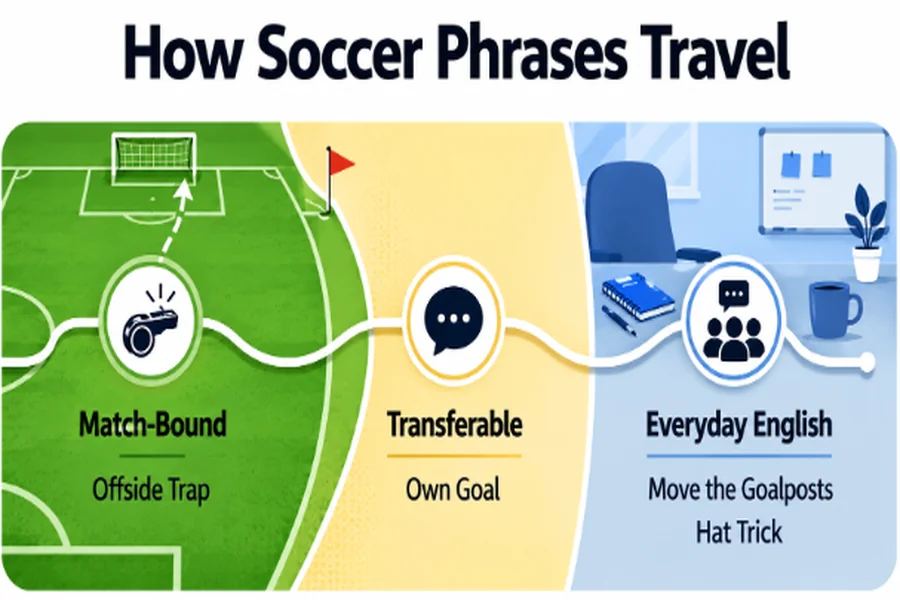
Phrases can be sorted into one of three groups: match-bound, transferable, and fully detached. Match-bound language still depends on the rules of the sport. Transferable language keeps a visible connection to play but works elsewhere. Fully detached language is commonly understood without any match context, even when its image remains sporting.
Lucky Rebel offers a useful snapshot of how soccer wording moves into a wider entertainment setting. Its broad sportsbook-and-casino homepage includes Sports, Casino, and Live Casino sections, alongside a current group of soccer-themed titles. Names such as Football 7s, Reel Goals!, 777 Kickoff, Beach Penalty, and Hat Trick Hero use terms that a casual viewer can recognize before knowing anything about the individual games.
Words like “penalty” remain closely attached to a specific rule and a moment of judgment, while “kickoff” can also signal the beginning of almost any event. “Hat trick” names a three-goal feat in soccer, yet it now works for three successes in many settings and originally came from cricket. On Lucky Rebel, these expressions function mainly as themed naming rather than complete idioms. The distinction matters because familiar soccer vocabulary can create instant recognition. The words carry cultural memory, but their grammatical job changes with the setting.
A Rebel Cocktail Hour conversation gives that movement a spoken form. The speakers discuss childhood soccer, “love for the game,” World Cup attention, and the familiar halftime orange slice before turning the memory into an adult drink. The clip shows how soccer language gains meaning from conversation, humor, memory, and ritual rather than from a glossary alone.
Four Phrases at Different Distances
| Phrase | Field meaning | Everyday use | Origin note |
| Offside trap | A coordinated defensive move intended to leave an attacker offside | No settled everyday meaning; it usually needs soccer context | Match-bound |
| Own goal | A goal scored against the player’s own team | A self-defeating action: “Deleting the backup was an own goal” | Used in soccer and other goal sports |
| Move the goalposts | A literal image of changing the target | Changing requirements after work has begun | Do not claim a soccer-only origin |
| Hat trick | Three goals by one player in a game | Any set of three notable successes | Originated in cricket before spreading to soccer |
Those are some of the most famous examples to demonstrate the point, but there are plenty more. For a larger collection, 33 Idioms for Soccer provides additional phrases and examples. The safest way to use any entry is to ask two questions: does the expression have an established non-sport meaning, and does a reliable word history support the origin being claimed?
Why Some Phrases Travel Further
Soccer gives language repeated scenes: a referee signals, a striker misses, supporters react, and commentators describe the moment again. Repetition teaches the literal picture. Emotion helps the picture remain available later. A PLOS One study of British football supporters found that feeling personally shaped by important club wins and losses was associated with stronger identity fusion and reported lifelong loyalty. It did not study idiom learning, but it helps explain why match language can become culturally durable. Words attached to memorable events are repeated in stories, headlines, jokes, and family conversations.
That still does not make every ball-related expression a soccer idiom. Current use and historical origin answer different questions.
A practical test is to remove the match. If the sentence remains clear, the phrase has probably become transferable or fully detached. Then check whether the history supports the sporting source you have in mind. Learning one literal scene, one everyday meaning, and one natural non-sport example gives the expression somewhere to live beyond the definition. That is how soccer phrases leave the field without losing the image that made them memorable.