
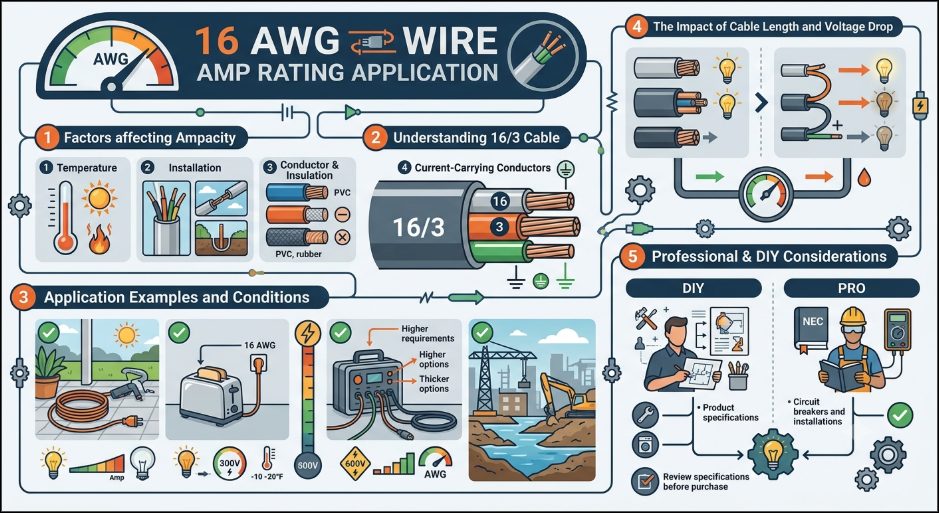

Wire ampacity is one of the most important factors in choosing the right cable for an electrical project. Gauge is a starting point for most DIYers, contractors, and electricians when determining the ability of a conductor to pass a given amount of electricity. But ampacity is also sensitive to conductor material, insulation, ambient temperature and conditions, and construction or installation of the cable.
The American Wire Gauge (AWG) system follows a simple rule: the lower the number, the larger the wire.
Suppliers such as Americord provide 16 AWG wire with three conductors, typically used for portable devices, extension cords and appliances. By understanding the relationship between gauge and ampacity, it is easier to compare and choose. Investing in a cable based on its gauge alone is not the best option, so it is worth checking the complete spec sheet before purchase.
What is the amp rating of 16-gauge wire?
The short answer is that it depends on the construction and operations. The 13-ampere rating pertains to some of the 16/3 bulk wire products but not all, depending entirely on the cable’s build. Moreover, there are many factors that affect the suitability of a product for a certain application and installation, encompassing both insulation and temperature ratings.
That is why, when you ask how many amps 16-gauge wire will support, you are not completely answering the question, since it depends on the type of cable. Ampacity is the amount of current a conductor can carry safely at a specific level, depending on the installation method, conductor material, insulation rating, ambient temperatures and number of conductors carrying current. That is also why professional electricians prefer manufacturer specifications and code requirements to a generic wire-size chart to validate a particular cable’s true rating.
The term “16/3” describes construction, not just size. The “16” indicates the cross-sectional area of the conductors, and the “3” is the number of conductors that are combined in a common cord. This is usually hot, neutral, and ground, although it depends on the cable and use. After learning this shorthand, it is much easier to compare the prices of various product suppliers.
Jacket and insulation materials stretch from PVC thermoplastic to rubber and thermoplastic elastomer options, and cover various voltage and temperature ratings, between the 16/3 cable products. Some products can withstand 300 volts, while others can withstand 600 volts. However, specs can differ per manufacturer and product line, so it is best to check individual listings for an exact match of the ideal specs and construction prior to ordering.
Choosing the right gauge starts with the project’s actual electrical requirements. Compare expected current draw against the cable’s stated rating, then factor in voltage, cable length, insulation type, and environmental conditions. A cable that handles a portable tool just fine may not hold up under a heavier load or a different environment, which is why most suppliers offer multiple constructions within the same gauge and conductor count rather than a single one-size-fits-all product.
Flexibility matters most in applications involving repeated movement or frequent handling — think portable equipment, temporary power connections, or any setup where the cable gets repositioned often. Jacket material and construction both shape how well a cable holds up under mechanical and environmental stress, which is why flexible 16/3 cable is often built differently than standard bulk wire.
Extension cords are another common use case where cable choice matters. Products built as 16/3 wire extension cords generally pack three 16-gauge conductors into a single outer jacket, but the right pick still comes down to the connected equipment, current demand, cable length, voltage, and environment. Options like Americord’s 16/3 line span multiple constructions, giving buyers room to match a cable to the specific job rather than defaulting to gauge alone.
Cable length deserves particular attention, since resistance increases as a run gets longer. That added resistance can cause voltage drop, reducing the voltage that actually reaches equipment at the end of the circuit. For longer runs or higher-demand setups, checking voltage drop matters just as much as checking ampacity — and a larger conductor may be needed to reduce resistance and keep voltage steady at the load.
For electricians and other professionals, wire selection also means reviewing applicable electrical codes and manufacturer specifications. The National Electrical Code (NEC) sets baseline requirements for electrical installations, and local jurisdictions may add their own. Circuit protection should always match conductor capacity and the broader installation so that protective devices work as intended.
The same principle applies to DIY projects: base cable selection on the full application, not just one factor. Before buying 16 AWG wire, verify the equipment’s current requirements, cable length, voltage, environmental conditions, cable construction, and applicable ratings. If the project’s demands exceed the cable’s rating, a larger conductor or different construction may be the better call.
Ultimately, understanding the 16 AWG wire amp rating takes more than memorizing a single number. Ampacity depends on the conductor, the cable’s construction, and the conditions it operates under. Weigh current requirements, cable length, insulation, voltage, environment, and code requirements together, and you’ll land on a far more informed choice — whether you’re sourcing from Americord or another supplier.
About Americord
Americord specializes in electrical cable and wire products for residential, commercial, industrial, and specialized applications. The company’s product range includes bulk wire and flexible cable configurations designed for equipment connections, portable power applications, extension cord assemblies, and custom electrical projects. With multiple conductor, jacket, insulation, and voltage options, Americord provides cable choices suited to a variety of wiring requirements.