
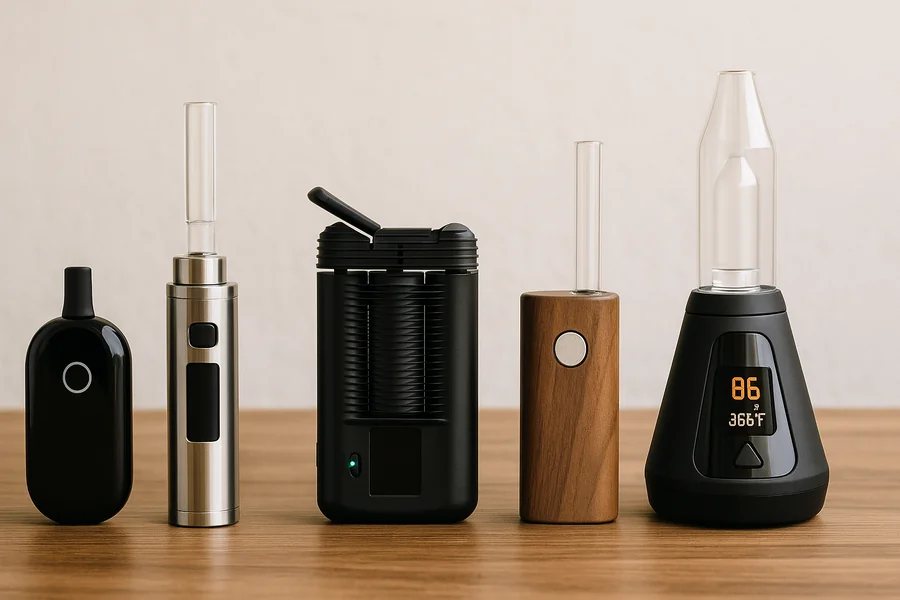

The Australian dry herb vaporizer market is no longer a simple matter of comparing brands, battery sizes, and flashy product descriptions. Modern vaporisers are compact pieces of thermal and electronic engineering, and the differences between models often come down to details that are almost invisible from the outside: heating architecture, temperature regulation, chamber construction, airflow design, battery management, and the quality of the materials used throughout the vapour path. For Australian buyers, there is another layer that cannot be ignored—regulatory status. The Therapeutic Goods Administration (TGA) currently regulates vaping devices under a national framework, while medicinal-cannabis vaporising devices have specific medical-device requirements.
That makes the keyword dry herb vaporizer Australia considerably more interesting than it may initially appear. A good buying guide should not simply repeat the usual claims about portability, “premium vapour,” or long battery life. Instead, it should help readers understand what separates a thoughtfully engineered device from an average one, how to assess technical specifications, why Australian regulations matter, and what questions should be answered before considering a product. For medicinal-cannabis patients, the distinction becomes even more important because the TGA maintains a specific list of approved medicinal-cannabis vaping devices and explains how these products are regulated.
The Technology Behind Modern Dry Herb Vaporizers
The most important development in vaporiser technology has been the move toward controlled electrical heating. Instead of depending on an uncontrolled external heat source, an electronic device can regulate energy delivered to a heating element. That sounds straightforward, but maintaining consistent thermal behaviour inside a tiny portable enclosure is surprisingly demanding. The heater, temperature sensor, battery, firmware, chamber, insulation, and airflow system all influence one another.
A device may display a precise temperature on its screen, but the displayed figure is only one part of the story. The actual thermal environment can change according to airflow, battery voltage, chamber geometry, sensor location, and how efficiently the heater transfers energy. This is why two products advertising similar temperature ranges can behave very differently.
The best way to assess a vaporiser is therefore to think about it as a complete thermal system, rather than a collection of individual features. A large battery cannot compensate for poor heating control. An expensive chamber material cannot fix badly designed airflow. Likewise, a sophisticated display does not necessarily indicate superior thermal performance.
Conduction vs. Convection: More Than a Marketing Term
Heating architecture is one of the clearest ways to differentiate vaporiser designs. Conduction heating transfers heat through contact with a heated surface, whereas convection heating relies more heavily on heated air moving through the chamber. Hybrid systems combine characteristics of both.
Conduction designs can be compact and relatively straightforward to engineer because the heating surface sits close to the chamber. Their challenge is achieving consistent heat distribution. If one section of the chamber becomes significantly hotter than another, the thermal environment may become uneven.
Convection systems approach the problem differently. Instead of relying primarily on direct surface contact, they use heated airflow to transfer thermal energy. This requires careful coordination between the heater, airflow pathway, sensors, and control software. The architecture can be more complex, but the engineering objective is to achieve controlled heat distribution.
Hybrid systems attempt to combine the two approaches. However, “hybrid” should not automatically be interpreted as “better.” The implementation matters more than the label. A well-engineered conduction vaporiser can be considerably more sophisticated than a poorly engineered convection model.
Temperature Control Is About Stability, Not Numbers
One of the easiest ways for manufacturers to make a vaporiser look advanced is to advertise a wide temperature range. Yet a device offering dozens of temperature settings is not necessarily more precise than one offering fewer settings.
The real question is how consistently the device manages heat.
Temperature sensors need to collect meaningful information, while control electronics must respond appropriately to changes in thermal conditions. When airflow changes, the heater may need to compensate. When the battery charge drops, power delivery may change. As the internal components warm up, heat transfer can behave differently from when the device is cold.
This is why experienced buyers should look beyond a simple temperature range. Ask whether the manufacturer provides meaningful technical information about its heating system. Look at the construction of the chamber and heater. Consider whether the device has a reputation for reliability and whether the manufacturer provides proper documentation.
Precision is valuable, but only when the hardware can deliver it consistently.
Chamber Design Can Make a Bigger Difference Than Expected
The chamber is where the vaporiser’s heating system meets the botanical material, making its design central to the device’s overall architecture. Chamber size, geometry, material, insulation, and heater placement can all affect thermal behaviour.
Ceramic and stainless-steel components are commonly used in vaporiser construction because they offer different combinations of thermal and mechanical characteristics. The choice of material itself, however, should not be treated as a shortcut for determining quality. A ceramic chamber does not automatically make a device superior, just as stainless steel does not automatically mean a product is basic.
What matters is how the material is incorporated into the overall design.
A well-designed chamber should work in harmony with the heater and airflow system. It should also be practical to maintain. If the chamber or surrounding components are difficult to access, routine cleaning can become unnecessarily frustrating.
For a long-term purchase, chamber design should therefore be assessed from both performance and maintenance perspectives.
Airflow Is an Underappreciated Part of Vaporizer Design
When shoppers compare devices, they often concentrate on battery capacity and temperature settings while giving very little attention to airflow. That is a mistake.
Airflow is an essential part of the thermal system. It influences how heat moves through the chamber and how efficiently the device manages its internal temperature. The geometry of the airflow pathway, the diameter of internal passages, the position of the heater, and the length of the vapour path all contribute to the final design.
A poorly designed pathway can create unnecessary resistance or make cleaning difficult. A carefully engineered pathway can improve consistency while allowing the manufacturer to manage heat more effectively.
The vapour path material also deserves attention. Glass, stainless steel, ceramic, and engineered polymers can all appear in different designs. Rather than assuming one material is universally superior, buyers should investigate exactly where each material is used and why.
Battery Engineering Matters More Than Capacity Alone
Portable vaporisers depend heavily on rechargeable batteries, which means battery engineering is an important part of overall product quality. A manufacturer must balance capacity, current delivery, physical size, charging speed, heat management, and protection circuitry.
A large battery capacity may look impressive on a product page, but it does not automatically translate into better practical performance. Heating efficiency and power management can have a major influence on battery endurance.
The charging system matters too. Buyers should look for clear manufacturer information about charging requirements and compatible charging equipment. Products with vague battery specifications deserve more scrutiny, particularly when the device combines a high-power heating system with a compact lithium-ion battery.
The broader principle is simple: battery capacity is only one measurement of a much larger electrical system.
Portability Creates Engineering Trade-Offs
Everyone likes the idea of a compact device. But making a vaporiser smaller does not make the engineering challenge disappear.
Inside a portable vaporiser, manufacturers have to fit the battery, heater, chamber, sensors, electronics, controls, airflow system, and insulation into a limited amount of space. Shrinking the enclosure can reduce room for batteries and thermal management components.
That creates a familiar engineering compromise.
A very compact device may be easier to carry but provide less battery capacity. A larger model may have more room for thermal management and a larger power system but become less convenient to transport.
Neither approach is automatically correct. The right choice depends on what the buyer values most.
Build Quality Should Be Evaluated for the Entire Ownership Period
A product can feel excellent when it comes out of the box and still become frustrating after several months. That’s why long-term build quality matters more than first impressions.
Look at the quality of buttons, charging connections, mouthpiece fittings, chamber construction, seals, housing materials, and moving components. Consider how easily parts can be replaced if they eventually wear out.
Warranty support is another useful indicator. A manufacturer that provides a clear warranty and replacement-part ecosystem gives buyers considerably more confidence than an unknown seller offering a device with no meaningful support.
The question should not simply be, “Does this vaporiser look good?”
A better question is:
“Will this still be a practical product after extended ownership?”
That change in perspective can eliminate many poor purchasing choices.
What Makes a Good Dry Herb Vaporizer Australia Listing?
Australian shoppers should be careful when evaluating online product descriptions. Marketing language can make almost any device sound impressive.
A strong product listing should provide specific information about:
- Heating technology
- Chamber materials
- Battery specifications
- Charging method
- Device dimensions
- Weight
- Warranty
- Replacement components
- Manufacturer information
- Intended use
- Regulatory status where applicable
Generic phrases such as “advanced technology,” “premium quality,” and “professional performance” are much less useful without supporting specifications.
For regulated products, regulatory claims should be independently verified. The TGA states that medicinal-cannabis vaping devices are medical devices and that manufacturers must maintain scientific, engineering, and clinical evidence demonstrating compliance with applicable safety and performance requirements.
That is a much stronger standard than simply calling a product “medical grade” on an online store.
Cleaning and Maintenance Should Influence the Buying Decision
Maintenance is often treated as an afterthought, but it can significantly influence the ownership experience. Components exposed to heated botanical material can accumulate residue over time, potentially affecting airflow and making parts more difficult to remove.
A well-designed device should make routine maintenance reasonably straightforward. Removable components can be advantageous, particularly when manufacturers make replacement parts available.
Before buying, check whether the manufacturer provides clear maintenance documentation. Also investigate whether mouthpieces, screens, seals, chambers, or other serviceable components can be replaced.
This is where a slightly more expensive device can sometimes offer better value. If its components are supported for years, it may be more practical than a cheaper model that becomes difficult to maintain after a relatively short period.
Australian Regulations Change the Buying Equation
For Australians, product quality cannot be separated completely from regulation.
The TGA states that Australia’s vaping reforms introduced a national framework governing the importation, domestic manufacture, supply, commercial possession, and advertising of vapes.
The situation is particularly specific for medicinal-cannabis vaping devices. The TGA says these devices generally need to be included in the Australian Register of Therapeutic Goods (ARTG) to be imported, manufactured, or supplied in Australia, although limited pathways exist for unapproved devices where registered products are not clinically appropriate.
This means Australian consumers should not assume that a product being available on an overseas website means it is automatically lawful to import or supply locally.
Regulatory status should be checked independently rather than inferred from product descriptions.
Medicinal Cannabis Devices Are a Separate Category
The distinction between general dry-herb terminology and medicinal-cannabis devices is particularly important.
The TGA explicitly states that a medicinal-cannabis vaping device must be represented as a device for administering medicinal cannabis and cannot be represented as a device for administering general dry herbs.
This is an important point for Australian websites publishing SEO content. A page targeting dry herb vaporizer Australia should not automatically describe every vaporiser as suitable for medicinal use or imply regulatory approval without evidence.
For patients prescribed medicinal cannabis, the TGA advises speaking with a doctor, nurse practitioner, or pharmacist about obtaining a compatible device.
That professional guidance is more reliable than generic advice from an online retailer.
Which Medicinal Cannabis Vaporisers Are Currently Approved?
The TGA’s current information, updated 5 June 2026, lists several medicinal-cannabis vaping devices approved for supply in Australia. These include SyqeAir Inhaler, Mighty+ Medic, Volcano Medic 2, and Grenco Medical Elite II. The TGA states that these devices are included in the ARTG and have been approved for quality, safety, and performance.
This list is useful because it demonstrates the difference between ordinary product marketing and verified regulatory information. It also shows why older articles can quickly become inaccurate in this category: the TGA’s approved-device information is updated as regulatory circumstances change.
For patients, compatibility and lawful access are more important than simply choosing the device with the most impressive specifications. The appropriate device should be determined in the context of the prescribed medicinal product and professional advice.
Don’t Confuse a Feature List With Product Quality
A long list of specifications can create the impression that a product is technologically advanced. But more features can also mean more components, more complexity, and more potential failure points.
A useful evaluation should consider how the features work together.
For example, advanced temperature control requires reliable sensors and suitable firmware. A powerful heater requires an appropriately engineered battery system. A compact design requires effective heat management. A sophisticated airflow system needs to remain practical to clean.
This is why system integration is often a better measure of product quality than the number of individual features.
The best products are not necessarily the ones with the longest specification sheet. They are the ones where the components have been designed to work together effectively.
How to Compare Vaporisers Without Getting Distracted by Marketing
A sensible comparison starts by establishing priorities.
If portability is important, compare dimensions and weight. If thermal consistency is important, investigate heating architecture and control technology. If long-term ownership matters, investigate battery replacement, warranty support, and availability of parts.
Then consider the manufacturer.
An established manufacturer with technical documentation and after-sales support generally provides more confidence than an anonymous brand with an attractive product page and limited information.
Finally, investigate Australian regulatory considerations where applicable. The TGA provides official resources for therapeutic vaping goods and medicinal-cannabis devices, making government information the appropriate reference point for regulatory claims.
The Future of the Australian Vaporizer Market
The Australian market is becoming increasingly shaped by regulation, medical-device standards, and technical quality. The TGA published updated guidance in July 2026 explaining that medicinal-cannabis vaping-device manufacturers need appropriate quality-management systems and technical documentation demonstrating compliance with the Essential Principles of safety and performance.
From a technology perspective, future products are likely to focus on better temperature regulation, improved sensors, more efficient battery systems, smaller electronics, and stronger materials.
But technological innovation will only be one side of the equation.
For regulated medicinal products, manufacturers will also need to demonstrate quality, safety, and performance through appropriate evidence. This could gradually push the Australian market toward products where engineering documentation and regulatory compliance matter just as much as consumer-facing design.
Conclusion
A professional approach to dry herb vaporizer Australia starts by moving beyond the usual beginner-level discussion of “what is a vaporizer.” The interesting questions are much more technical: How is heat generated? How stable is the thermal system? What materials are used in the chamber and vapour path? How has the battery been engineered? Is the device designed for long-term maintenance? Does the manufacturer provide meaningful support?
Then comes the Australian regulatory layer.
The TGA currently lists approved medicinal-cannabis vaping devices and states that these products have been assessed for quality, safety, and performance. It also makes clear that medicinal-cannabis vaping devices must be appropriately represented and generally included in the ARTG before lawful supply, subject to specific exceptions and pathways.
For Australian buyers, the smartest strategy is therefore not to chase the cheapest device or the longest feature list. Instead, evaluate engineering, materials, reliability, manufacturer support, intended purpose, and regulatory status together. That approach produces a far more informed buying decision and avoids many of the assumptions commonly repeated across low-quality vaporiser content.