
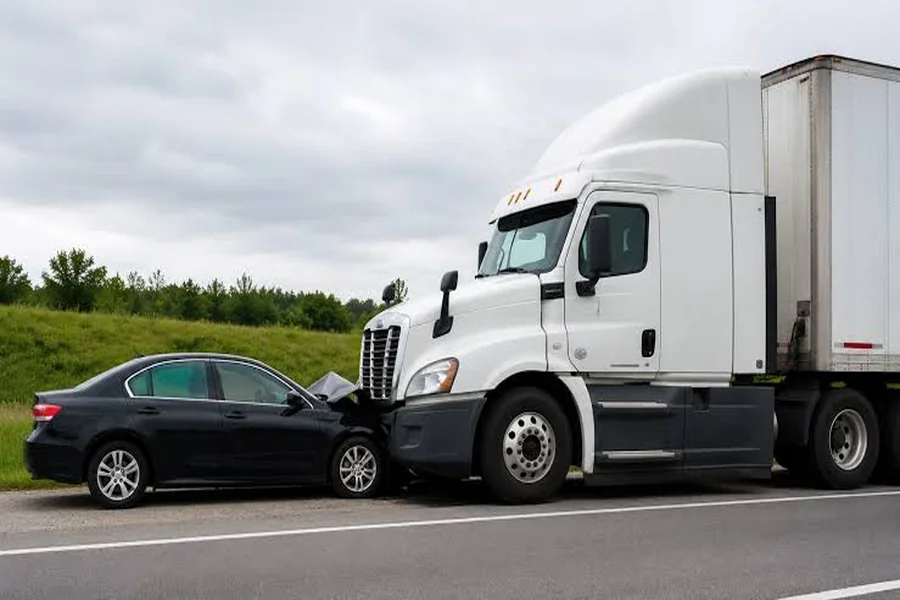

A truck crash does not have to occur at highway speed to cause serious harm. Large commercial vehicles differ from passenger cars in weight, height, length, visibility, and maneuverability. Those differences can make a relatively low-speed impact dangerous, particularly when the other road user is in a smaller vehicle, on a bicycle, or on foot.
Crash severity depends on more than speed alone. The point of contact, the size and position of the other vehicle, whether a person is struck directly, and how the body moves during impact can all affect the resulting injury. Federal safety agencies address these differences through rules and guidance on truck size, underride protection, blind spots, turning movements, and crashworthiness.
A Commercial Truck Can Carry Far More Mass Than a Passenger Vehicle
Federal Highway Administration standards allow gross vehicle weights of up to 80,000 pounds on the Interstate System, subject to the federal bridge formula and certain exceptions. FMCSA also defines many interstate vehicles weighing 10,001 pounds or more as commercial motor vehicles for safety-regulation purposes.
That weight difference is part of the crash environment investigators evaluate. Even when a truck is moving slowly, a much smaller vehicle may experience significant structural loading depending on how the vehicles meet. Vehicle weight alone does not predict the exact injury outcome, but it can help explain why two crashes at similar speeds may produce different consequences.
Height Differences Can Create Underride Risks
Truck height can create another problem that is not limited to highway-speed crashes. NHTSA explains that underride can occur when a passenger vehicle strikes a large truck and slides beneath the truck body because of the height difference between the vehicles.
In an underride event, the normal front structures of the passenger car may not engage the truck as they would another passenger vehicle. NHTSA notes that impact can reach the hood or windshield and produce passenger-compartment intrusion, creating the potential for severe head and neck injuries.
Rear underride guards are designed to provide a lower point of contact and help prevent a passenger vehicle from sliding beneath a trailer. Their existence and condition can therefore become relevant in some investigations.
Low-Speed Movement Can Still Produce Head and Neck Injuries
A person does not have to strike the dashboard or window to sustain every type of head injury. The Centers for Disease Control and Prevention explains that a mild traumatic brain injury or concussion can result from a hit to the body that causes the head and brain to move rapidly back and forth.
That sudden movement can make the brain bounce or twist within the skull. Symptoms can include headache, dizziness, nausea, balance problems, concentration difficulties, memory problems, and sleep changes.
Neck injuries can also follow abrupt movement of the head and torso. The medical question is not simply how fast the truck was traveling but what forces reached the occupant and what symptoms and findings followed.
Back Injuries Can Follow a Sudden Jolt
MedlinePlus identifies a sudden jolt such as a vehicle accident as one cause of back injury. Potential injuries include strains and sprains, herniated discs, and fractured vertebrae. These conditions can cause pain and limit movement.
For someone discussing the crash with an Oak Park semi-truck accident lawyer, medical evidence can help establish whether pain after a seemingly low-speed collision reflects temporary soreness or a diagnosed injury. Emergency records, imaging, therapy notes, specialist evaluations, and work restrictions can document how symptoms developed.
Visible vehicle damage does not itself provide a medical diagnosis. Injury assessment depends on clinical evaluation and the circumstances affecting the person involved.
Pedestrians and Bicyclists Have Little Physical Protection
Low-speed truck crashes can be especially dangerous when the person involved is outside a vehicle. A pedestrian or bicyclist does not have a passenger compartment, seat belt, airbag system, or vehicle structure surrounding the body.
FMCSA warns that pedestrians and bicyclists can be difficult for large-truck drivers to see because trucks have substantial blind spots in front, behind, and along the sides. The agency also notes that trucks make wide turns and that pedestrians near corners can be endangered when a large vehicle turns.
Those conditions are relevant in parking areas, intersections, loading zones, and other places where trucks may be moving slowly but operating close to people.
Wide Turns Can Create Side-Impact and Crushing Hazards
Large trucks do not turn like passenger cars. FMCSA guidance explains that trucks and buses need additional space for wide turns and may swing outward before completing a right turn.
At lower speeds, this geometry can place nearby vehicles, bicyclists, or pedestrians in a difficult position if they are beside the truck or near the curb. A person can be struck by the tractor, trailer, wheels, or another part of the vehicle even though the truck is not moving quickly.
Speed alone therefore cannot describe the risk of a truck turning through an intersection or maneuvering in a confined area. Visibility, vehicle path, clearance, and the position of nearby road users can all matter.
Low-Speed Backing Accidents Can Also Cause Severe Harm
Backing is another situation in which trucks may move slowly but still create serious risk. FMCSA advises pedestrians not to walk behind a truck that is backing because truck drivers cannot see directly behind the vehicle.
Loading docks, alleys, parking lots, construction areas, and delivery locations can place people near a reversing truck. Limited rear visibility, vehicle size, and close proximity can make even a short backing movement dangerous.
Evidence in these cases may include backup-camera footage, surveillance video, warning alarms, witness statements, driver observations, and information about whether a spotter was used.
The Full Crash Context Matters More Than Speed Alone
A low posted speed, modest vehicle movement, or limited exterior damage does not answer whether someone suffered a serious injury. Truck size, height mismatch, point of impact, occupant movement, blind spots, turning geometry, and the presence of pedestrians or bicyclists can all change the consequences of a collision.
A careful investigation therefore looks at both medical and crash evidence. Vehicle photographs, electronic data, scene measurements, witness statements, truck records, and medical documentation can help explain what happened and how the injury occurred. Focusing only on estimated speed can overlook other features that made the impact dangerous.