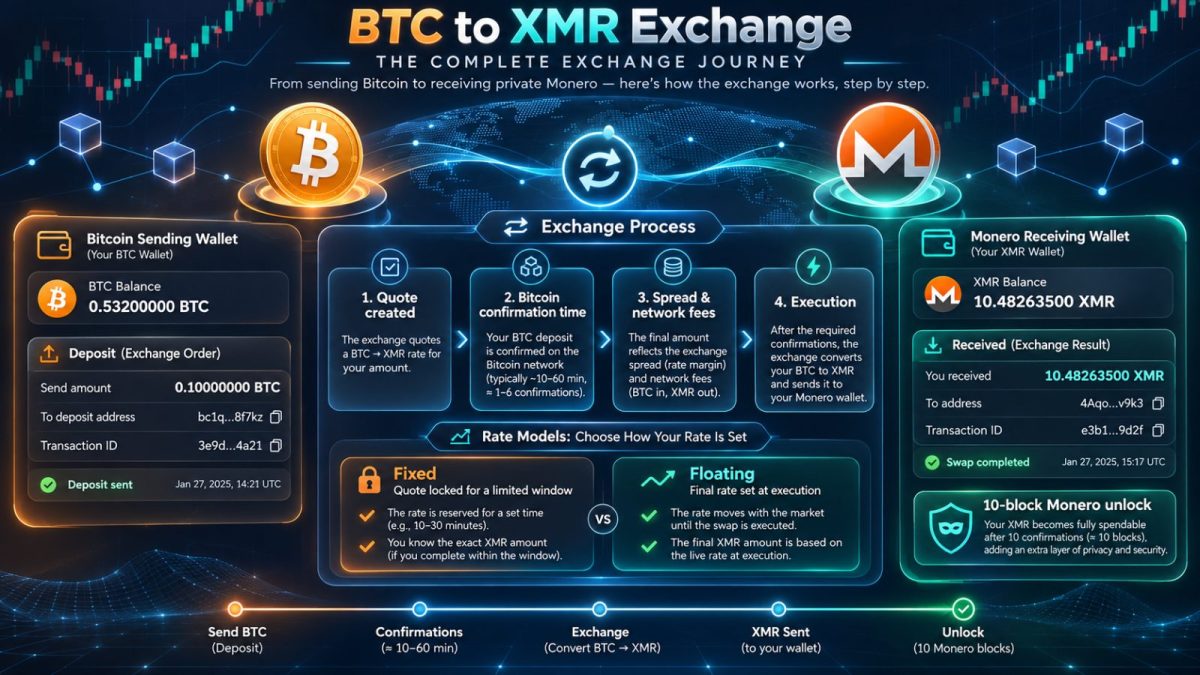
Key takeaways
- A fixed rate locks the XMR amount you will receive for a limited window, usually tens of minutes, provided your Bitcoin deposit arrives and meets the provider's conditions in time.
- A floating rate is priced when your deposit confirms, so the XMR amount can be higher or lower than the original estimate.
- At instant-swap services, the fixed-rate spread is commonly around twice the floating-rate spread. Published figures in this market cluster around 0.5% floating and 1% fixed, plus network fees.
- Neither model is cheaper by default. Fixed rates cost a premium and remove uncertainty; floating rates cost less upfront and leave you exposed until execution.
- The practical decision rule is the size of the trade and your tolerance for a different output. Below a few hundred dollars the difference is trivial; above a few thousand, a 2% adverse move exceeds the fixed-rate premium.
- Bitcoin confirmation time is the main risk to a fixed-rate quote. A low-fee deposit that waits several blocks can outlive the timer.
- Newly received Monero is locked for ten blocks, roughly twenty minutes, before it can be spent. This is normal Monero behaviour and not a delay by the exchange.
- Converting BTC to XMR does not retroactively privatise the Bitcoin you sent. The deposit remains visible on Bitcoin's public ledger.
A BTC to XMR exchange involves more than selecting two assets and confirming a transaction. The exchange rate determines how much XMR arrives in your wallet, and that figure can change between the moment you create an order and the moment the conversion executes.
Bitcoin and Monero run on separate blockchains with different block times, different fee markets and different market dynamics. A BTC deposit may wait ten minutes or an hour for confirmation depending on the fee you paid. During that window, the BTC/XMR ratio keeps moving.
Most exchange services therefore offer two pricing models: fixed and floating. The short answer: choose a fixed rate when you need a specific amount of XMR or when the trade is large enough that a 2% adverse move would matter more than the premium you pay for certainty. Choose a floating rate for small amounts in calm markets, where the premium is not worth paying.
The rest of this guide explains how each model is priced, what the real spreads and timings look like, and how to execute the swap without losing money to avoidable mistakes.
What is the BTC to XMR exchange rate?
The BTC to XMR exchange rate is the number of Monero coins obtainable for one Bitcoin. Unlike a dollar quotation, it is a ratio between two volatile assets, which means it moves when either side moves.
How the BTC/XMR ratio is calculated
Services derive the ratio from the dollar prices of both assets and then apply their own spread. Using round hypothetical figures:
- Bitcoin: $100,000 per BTC
- Monero: $200 per XMR
> 100,000 ÷ 200 = 500 XMR per BTC
At that reference ratio, 0.1 BTC would convert to 50 XMR before any spread or fee. The amount a service actually quotes will be lower, because the spread, the Bitcoin network fee and the Monero network fee all have to come from somewhere.
Why BTC/XMR moves even when the market looks flat
The ratio depends on the *relative* performance of the two assets, not on the direction of the broader market.
- If Bitcoin strengthens while Monero holds steady, one BTC buys more XMR.
- If Monero outperforms Bitcoin, the same BTC buys fewer XMR.
- If both rise or fall by the same percentage, the ratio does not change at all.
This is why a BTC-to-XMR conversion can produce a very different outcome from what a dollar-denominated view of the market would suggest. A day on which "crypto is up" can still be a day on which your BTC buys less Monero than yesterday.
BTC to XMR reference conversions
The table below shows how a given ratio scales across common amounts. It uses a hypothetical ratio of 1 BTC = 500 XMR to illustrate the arithmetic; always take the live figure from a converter before transacting, since the real ratio changes continuously.
|
BTC amount |
XMR at 1:500 (before fees) |
XMR after a 1% all-in cost |
|
0.01 BTC |
5.00 XMR |
4.95 XMR |
|
0.05 BTC |
25.00 XMR |
24.75 XMR |
|
0.1 BTC |
50.00 XMR |
49.50 XMR |
|
0.25 BTC |
125.00 XMR |
123.75 XMR |
|
0.5 BTC |
250.00 XMR |
247.50 XMR |
|
1 BTC |
500.00 XMR |
495.00 XMR |
|
5 BTC |
2,500.00 XMR |
2,475.00 XMR |
|
10 BTC |
5,000.00 XMR |
4,950.00 XMR |
Two things are worth noticing. The percentage cost is constant across sizes in this simplified model, but the absolute cost is not — the same 1% is 0.05 XMR on a small swap and 50 XMR on a large one. And at the larger sizes, the all-in cost in practice tends to exceed 1%, because liquidity in the BTC/XMR pair is thinner than in BTC/USDT.
Why most large exchanges no longer list XMR
A practical observation that shapes this entire route: the BTC-to-XMR pair is largely unavailable on the biggest centralised exchanges, which is why instant wallet-to-wallet swap services dominate it.
Binance delisted Monero on 20 February 2024, alongside several other tokens, and later converted remaining user balances to USDC. OKX delisted Monero together with Zcash and Dash in January 2024. Kraken removed XMR for UK users in 2021, and Huobi delisted it in 2022. The broad driver has been regulatory pressure on privacy-focused assets rather than anything specific to Monero's technology.
The consequence for anyone converting BTC to XMR:
- The deepest centralised order books for the pair are gone, so liquidity is more fragmented across instant-swap services, smaller exchanges and decentralised or peer-to-peer venues.
- Availability depends heavily on jurisdiction. A service that supports XMR in one country may not in another.
- Spreads on the pair tend to be wider than on a mainstream pair of comparable volume, because providers are sourcing liquidity from fewer places.
- Verifying that your chosen route currently supports the pair, at your amount, in your jurisdiction, matters more here than it would for BTC to USDT.
This is also why the fixed-versus-floating question carries more weight on this pair than on a deeply liquid one. When liquidity is fragmented, the price a provider can actually execute at is less certain, and that uncertainty is what the fixed-rate premium pays for.
What is a fixed-rate BTC to XMR exchange?
A fixed-rate exchange is one where the provider commits to a specific XMR output for a specific BTC input, for a limited period and subject to stated conditions. If your deposit arrives within the window and meets the requirements, you receive the quoted amount regardless of what the market did in the meantime.
How a fixed-rate conversion works, step by step
- You select Bitcoin as the sending asset and Monero as the receiving asset.
- The platform calculates a fixed-rate quotation, which includes a premium over its floating price.
- You enter a valid Monero receiving address.
- The platform provides a Bitcoin deposit address, the exact amount required, and a deadline.
- You send the required BTC in a single transaction with an adequate network fee.
- Once the deposit meets the provider's confirmation requirements, the service processes the conversion and sends the XMR.
How long a fixed quote stays valid
This is the detail that decides whether a fixed rate actually protects you. Validity windows at instant-swap services are commonly measured in tens of minutes — published figures in this market are frequently around 30 minutes from order creation.
Critically, providers differ on what has to happen inside that window. Some require the deposit to be *detected* in the mempool; others require it to be *confirmed* on-chain. The distinction matters enormously, because a confirmation requirement means the Bitcoin network's speed, not your own, determines whether you make the deadline.
Check the exact trigger before you rely on a fixed quote. Broadcasting a transaction is not always the same as satisfying the condition.
What happens if you miss the window also varies: the order may re-rate to the current floating price, be refunded to a refund address, or be held pending support review. Some providers additionally reserve the right to re-rate if the market moves beyond a stated threshold — a move of 3% or more before confirmation is a figure that appears in this market — even within the window.
Advantages of fixed rates
Predictability. You know the output quantity before you commit funds. If you need to pay a counterparty a specific amount of XMR, or you are working to a budget denominated in Monero, this is the only model that gives you that.
Protection during confirmation delays. Bitcoin confirmation times are not under your control once a transaction is broadcast. A fixed rate removes the market risk from that waiting period, which is the single largest source of unexpected outcomes on this pair.
Easier comparison. A fixed quote is a firm number. You can place two fixed quotes side by side and compare them directly, which is harder with two estimates.
Costs and limitations of fixed rates
You pay a premium. The provider is taking on price risk and will hedge or price for it. In this market, the fixed-rate spread is typically around double the floating-rate spread — the commonly published pattern is roughly 0.5% floating against 1% fixed, before network fees. On a 1 BTC swap, that difference is in the region of 2.5 XMR at a 1:500 ratio.
Deadlines are strict. A late deposit, a deposit sent in two transactions instead of one, or an amount that differs from the quoted figure can void the guarantee.
The initial quote looks worse. Because the premium is visible at quote time and the market risk is not, floating rates almost always appear more attractive on screen. That appearance is the point of the comparison, not a verdict on it.
Conditions are provider-specific. The rate lock is a contractual commitment under stated terms, not a property of the blockchain. Read what those terms are.
What is a floating-rate BTC to XMR exchange?
A floating-rate exchange prices the conversion at execution rather than at order creation. The amount shown when you create the order is an estimate, and the final XMR amount is determined by the market rate and liquidity available when the service actually converts.
How floating rates are priced
The provider quotes an estimate from its current pricing, then executes against whatever the market offers at the moment your deposit satisfies its confirmation requirements. The spread is applied to that execution price.
A worked illustration. You initiate a conversion of 0.2 BTC. At quotation, the service estimates 99 XMR. While your Bitcoin deposit confirms, the BTC/XMR ratio moves:
- If Bitcoin strengthens against Monero, you receive more than 99 XMR.
- If Bitcoin weakens against Monero, you receive less.
- If nothing much happens, you receive approximately the estimate, less any fee changes.
The estimate is a forecast under current conditions, not a commitment.
Advantages of floating rates
Lower upfront cost. You are not paying for a guarantee, so the spread is narrower — typically around half the fixed-rate spread at the same provider.
Upside exposure. If the ratio moves in your favour while the deposit confirms, you keep the benefit.
Fewer failure modes. There is no timer to miss, so a slow Bitcoin confirmation is an inconvenience rather than a problem. For deposits sent from an exchange withdrawal queue, where timing is genuinely unpredictable, this is a real advantage.
Costs and limitations of floating rates
No output certainty. You cannot know the final amount in advance, which rules this model out whenever the exact quantity matters.
Full downside exposure. During a volatile stretch, the gap between estimate and payout can be material. The exposure lasts as long as the confirmation takes, which you only partly control.
Compounding with Bitcoin congestion. The two risks interact badly. A congested network means a longer wait, and a longer wait means more exposure. The conditions that delay your deposit are often the same conditions that move the market.
Fixed vs floating: side-by-side comparison
|
Characteristic |
Fixed rate |
Floating rate |
|
When the price is set |
At order creation, locked for a window |
When the deposit confirms |
|
Output amount |
Known in advance, subject to conditions |
Estimated only |
|
Typical spread in this market |
Around 1%, plus network fees |
Around 0.5%, plus network fees |
|
Quote validity |
Limited window, commonly around 30 minutes |
Not applicable |
|
Exposure to BTC/XMR movement |
Removed during the valid window |
Present until execution |
|
Exposure to confirmation delay |
Removed, if you meet the deadline |
Present, and grows with the delay |
|
Upside if the market moves your way |
None |
Retained |
|
Risk of a voided or re-rated order |
Yes, on a late or incorrect deposit |
Minimal |
|
Suitable for an exact required amount |
Yes |
No |
|
Suitable for deposits with uncertain timing |
Only with a comfortable margin |
Yes |
|
Best fit |
Larger amounts, volatile markets, fixed targets |
Smaller amounts, calm markets, flexible targets |
Typical spread difference between the two models
The 0.5%-versus-1% pattern is worth translating into money, because the percentages feel small and the amounts sometimes are not.
|
BTC amount |
Approx. cost at 0.5% (floating) |
Approx. cost at 1% (fixed) |
Premium for certainty |
|
0.01 BTC |
0.025 XMR |
0.05 XMR |
~0.025 XMR |
|
0.1 BTC |
0.25 XMR |
0.5 XMR |
~0.25 XMR |
|
1 BTC |
2.5 XMR |
5 XMR |
~2.5 XMR |
|
5 BTC |
12.5 XMR |
25 XMR |
~12.5 XMR |
Figures use a hypothetical 1:500 ratio and exclude network fees. The premium is what you are comparing against the potential adverse move — which is the calculation the next section performs.
Fixed vs floating: three numerical scenarios
Consider a user exchanging 0.2 BTC into XMR. The reference ratio is 1 BTC = 500 XMR, so the frictionless conversion would be 100 XMR.
The service presents two options:
|
Transaction characteristic |
Fixed rate |
Floating rate |
|
BTC being exchanged |
0.2 BTC |
0.2 BTC |
|
Reference value before costs |
100 XMR |
100 XMR |
|
Initial quotation |
98.4 XMR |
99.1 XMR |
|
Implied all-in cost at quote |
1.6% |
0.9% |
|
Rate protection |
Conditional rate lock |
None |
|
Final amount |
98.4 XMR if conditions are met |
Determined at execution |
The floating quote looks better by 0.7 XMR. What happens next decides whether it is.
Scenario A — the market moves against you
The BTC/XMR ratio declines 2% while the deposit confirms. The floating execution reprices accordingly:
> 99.1 × 0.98 = 97.118 XMR
A valid fixed-rate order still delivers 98.4 XMR.
Difference: 1.282 XMR in favour of the fixed rate. The premium you paid was 0.7 XMR; the protection was worth 1.282 XMR. Net benefit of having chosen fixed: 0.582 XMR.
Scenario B — the market moves in your favour
The ratio improves 2%:
> 99.1 × 1.02 = 101.082 XMR
The fixed-rate order still delivers 98.4 XMR.
Difference: 2.682 XMR in favour of the floating rate. Here the premium bought protection you did not need, and the upside you gave up was larger than the downside you avoided in Scenario A — which is the structural asymmetry of insurance.
Scenario C — the market is flat but your deposit is late
The ratio is unchanged, but you paid a low Bitcoin fee and the deposit takes 50 minutes to confirm, outlasting a 30-minute fixed-rate window.
- The floating order executes normally at approximately the estimate: ~99.1 XMR.
- The fixed order has expired. Depending on the provider's terms, it re-rates to the current floating price, is refunded, or waits on support. In the re-rate case you end up at roughly the floating outcome anyway — having paid nothing extra, but also having gained nothing from the premium you were quoted.
Scenario C is the one people underestimate. The fixed rate's protection is conditional, and the condition is partly in the hands of the Bitcoin fee market.
Summary of scenarios
|
Fixed outcome |
Floating outcome |
Better model |
|
|
A: market −2% |
98.400 XMR |
97.118 XMR |
Fixed (+1.282 XMR) |
|
B: market +2% |
98.400 XMR |
101.082 XMR |
Floating (+2.682 XMR) |
|
C: flat, late deposit |
Re-rated or refunded |
~99.100 XMR |
Floating |
Methodology note
These calculations are illustrative. They assume a single deposit transaction, no change in network fees during processing, and no liquidity constraint at this size. They are not quotations from any provider. The point is not to predict which model wins — that depends on an unknowable future price — but to size the premium against the exposure so the choice is made deliberately.
Which should you choose? A threshold rule
The decision reduces to three questions: how much is at stake, how volatile is the market right now, and do you need an exact amount?
|
Trade size |
Market conditions |
Need an exact XMR amount? |
Suggested model |
|
Under ~$500 equivalent |
Any |
No |
Floating — the premium exceeds the practical benefit |
|
Under ~$500 equivalent |
Any |
Yes |
Fixed — certainty is the point, and the cost is small |
|
$500–$5,000 |
Calm |
No |
Floating |
|
$500–$5,000 |
Volatile |
No |
Either; fixed if you cannot monitor the order |
|
$500–$5,000 |
Any |
Yes |
Fixed |
|
Above ~$5,000 |
Calm |
No |
Either; fixed if confirmation may be slow |
|
Above ~$5,000 |
Volatile |
No |
Fixed — a 2% move now exceeds the premium in absolute terms |
|
Above ~$5,000 |
Any |
Yes |
Fixed, and confirm the provider's amount limits first |
|
Deposit coming from an exchange withdrawal |
Any |
No |
Floating — withdrawal timing is unpredictable and may outlast a timer |
The arithmetic behind the thresholds: the fixed premium is roughly 0.5% of the trade. A fixed rate is worth buying whenever you judge the probability-weighted adverse move during confirmation to exceed 0.5%. On a calm day with a well-fee'd deposit confirming in ten minutes, that is a stretch. On a volatile day with a congested mempool, it is not.
How to exchange BTC to XMR, step by step
Step 1 — Prepare a Monero wallet and get your receiving address
Use a wallet that gives you control of the keys and supports Monero natively. Monero addresses are long: standard addresses begin with 4, and subaddresses begin with 8. Monero does not use memos, tags or destination IDs the way some other assets do, so there is no extra field to fill in.
Copy the address directly from the wallet. Do not retype it.
Step 2 — Confirm the route supports your amount
Check the provider's minimum and maximum for the BTC/XMR pair specifically, not the platform's general limits. Minimums on major pairs at instant-swap services are usually small — in the region of a couple of dollars equivalent, calculated dynamically from current network fees — but pair-specific minimums on XMR routes can be higher.
If your amount is large, request an amount-specific quote rather than relying on the headline rate.
Step 3 — Choose fixed or floating
Apply the threshold table above. If you choose fixed, note the exact deadline and what has to happen before it — detection or confirmation.
Step 4 — Enter the details and provide a refund address
Enter the BTC amount and your XMR address. Where the provider offers a refund address field, fill it in with an address from a Bitcoin wallet you control. This is the mechanism by which a failed, late or under-funded order gets returned to you, and it is far easier to supply now than to arrange afterwards.
Step 5 — Send the exact BTC amount, in one transaction
Send the amount the provider specified, as a single transaction, with a network fee adequate for current conditions.
Three things to get right here. First, if your wallet deducts the network fee from the amount you entered rather than adding it on top, the service will receive less than required — enter the amount accordingly. Second, if you are funding from an exchange withdrawal, the exchange's own withdrawal fee comes out of the amount, so send a margin above the required figure. Third, do not split the payment across two transactions; most providers treat each deposit as a separate order.
Step 6 — Save the order ID and track the order
The order ID is the reference for tracking and for any support conversation. Save it before closing the page. If something goes wrong, it is the difference between a solvable problem and an unsolvable one.
Step 7 — Verify receipt and wait out the lock
Once the service sends the XMR, it appears in your wallet as an incoming transaction. It will show as locked initially — this is normal. Newly received Monero is locked for ten blocks, approximately twenty minutes at Monero's roughly two-minute block time, before it becomes spendable.
Do not treat this as a failed delivery. The funds are yours; they are simply not yet spendable.
How long does a BTC to XMR exchange take?
End to end, a BTC to XMR swap typically completes in roughly 25 to 60 minutes, with most of that time spent waiting for Bitcoin confirmations. Published ranges from services in this market cluster around 15 to 60 minutes, and some advertise under 10 minutes for the processing portion once the deposit is confirmed.
The total breaks down like this:
|
Stage |
Typical duration |
What can delay it |
|
Broadcasting your BTC deposit |
Seconds |
Wallet or node connectivity |
|
Bitcoin mempool wait |
0–30+ minutes |
A low fee relative to current demand |
|
Required Bitcoin confirmations |
~10 minutes per block; providers commonly require 1–3 |
Network congestion; empty-block variance |
|
Service processing and conversion |
1–5 minutes |
Liquidity sourcing on the XMR side; manual review |
|
Monero payout broadcast |
~2 minutes |
Monero network conditions |
|
Monero 10-block spend lock |
~20 minutes |
Nothing — this is protocol behaviour |
|
Total to spendable XMR |
~35–75 minutes |
Bitcoin confirmations and the fixed-rate timer
This is where the two topics of this article intersect. If your provider's fixed-rate window requires an on-chain confirmation and you paid a low fee, the Bitcoin fee market now controls whether your rate lock survives.
The practical mitigation is to pay an adequate fee on the deposit. Saving two dollars on the Bitcoin fee to lose a rate lock worth thirty is a poor trade. Check the current fee environment before sending rather than accepting a wallet's default.
The Monero 10-block lock
Monero locks newly received outputs for ten blocks before they can be spent. At roughly two minutes per block, that is about twenty minutes after the payout transaction confirms.
Every Monero transaction behaves this way regardless of which service sent it. If your wallet shows an incoming balance that is not yet available, this is almost always the explanation.
BTC to XMR fees: what you actually pay
Three separate costs apply, and only some of them appear in the quote.
|
Fee |
Who charges it |
Typical range |
Included in the quote? |
|
Bitcoin network fee (your deposit) |
Bitcoin miners |
Typically under $1 to a few dollars; $10–15 in heavy congestion |
No — paid from your own wallet |
|
Service spread |
The exchange service |
~0.5% floating, ~1% fixed on this pair |
Yes — embedded in the rate |
|
Monero network fee (the payout) |
Monero network |
A fraction of a cent to a few cents |
Usually yes |
|
Exchange withdrawal fee |
A CEX, if you fund from one |
Varies; often a flat BTC amount |
No — reduces what arrives |
Bitcoin network fee
Priced by transaction size in bytes and current demand for block space, not by the value you are sending. A 0.01 BTC deposit and a 10 BTC deposit of similar structure cost roughly the same to send.
The implication for small swaps is significant: a $3 Bitcoin fee on a $100 swap is 3% of the trade before any spread. On this pair, small conversions are disproportionately expensive, and that is a property of Bitcoin rather than of any exchange service.
Service spread
The provider's margin, built into the quoted rate rather than itemised. On the BTC/XMR pair, the published pattern across instant-swap services sits around 0.5% for floating and 1% for fixed, before network fees. Spreads on this pair tend to run wider than on mainstream pairs because XMR liquidity is more fragmented since the major delistings.
Monero network fee
Monero fees are small and largely independent of the amount sent — fractions of a cent to a few cents in normal conditions. In practice this is the least significant number in the entire transaction.
Minimum and maximum exchange amounts
Minimums exist so that network fees can be covered and the order can be processed. They are usually calculated dynamically from current fee conditions rather than fixed.
Maximums are more variable and more important to check. Some services advertise no general upper limit on standard swaps while applying separate, lower caps to fixed-rate orders. Others set caps per pair. A platform-wide "no limit" claim should never be read as guaranteed capacity on the BTC/XMR pair specifically.
For a large conversion, confirm three things before sending: that the full amount is supported on this pair, that it can execute as a single order at the quoted rate, and what happens if it cannot.
Does a BTC to XMR swap require KYC?
Usually not for a standard swap at an instant-swap service, but "usually not" is not the same as "never", and the distinction matters for planning.
Most wallet-to-wallet exchange services operate without account creation or identity verification for ordinary transactions. They do, however, apply risk-based controls, and they reserve the right to request verification when a transaction triggers them. Centralised exchanges are the opposite: verification is required at signup, before any trading.
When verification is typically triggered
Based on how providers describe their own policies, the common triggers are:
- Transaction value above an internal threshold, which varies by provider and jurisdiction.
- Cumulative volume across multiple transactions, including a series of smaller ones.
- Blockchain analytics flags on the deposit's history — funds associated with sanctioned addresses, known thefts, or mixing services.
- Privacy-asset routes attracting closer scrutiny at some providers than mainstream pairs.
- Behavioural signals such as mismatched device, IP or geography data.
- Velocity, meaning several transactions in a short period.
A flagged order is typically paused rather than rejected outright, pending either verification or a refund to the refund address.
What this means for your planning
Three practical consequences.
Supply a refund address. If an order is paused and you decline to verify, the refund address is how you get your Bitcoin back.
Do not assume a privacy route is an unverified route. Monero's protocol privacy and a service's compliance policy are separate things, and the second is unaffected by the first.
Expect policies to differ and to change. Regulatory requirements for virtual asset service providers vary by jurisdiction and have tightened over the past several years. Check the current terms of the specific service you intend to use rather than relying on what was true a year ago.
Liquidity and large BTC to XMR conversions
Liquidity describes how much of an asset can be traded without materially moving its price. On the BTC/XMR pair it deserves specific attention, because the major exchange delistings removed much of the deepest order-book liquidity for XMR.
For small conversions the effect is negligible. For larger ones it becomes the dominant cost.
Consider two conversions:
- A user converts $200 of BTC into XMR. The order is small relative to available liquidity and fills close to the quoted rate.
- A user converts $100,000 of BTC into XMR. The provider may need to source Monero from several counterparties or venues. If available depth is insufficient at the first price level, the effective rate deteriorates as the order fills.
This does not mean every large conversion gets a poor rate. It means transaction size has to be part of the quote request. A rate displayed for a nominal amount is not evidence of what a large amount will achieve.
For substantial conversions:
- Request an amount-specific quote rather than reading the headline rate.
- Request quotes at two sizes — your intended amount and a small one — and compare the effective rates. The gap between them is your price impact.
- Ask whether the full amount can execute as a single order, and what the provider does if it cannot.
- Consider whether a fixed rate is worth more here than it would be on a small trade. It usually is, because both the absolute exposure and the execution uncertainty are larger.
Privacy: what the swap does and does not hide
Monero is designed to provide stronger on-chain privacy than transparent blockchains. Its protocol conceals transaction amounts and obscures sender and recipient on the public ledger, using ring signatures, stealth addresses and confidential transactions.
Converting Bitcoin into Monero does not retroactively apply that privacy to the Bitcoin you sent. Three separate layers are involved, and they behave differently.
The Bitcoin side
Your deposit transaction is permanently visible on Bitcoin's public blockchain: the amount, the timing, the source address and the destination deposit address. Anyone examining the chain can see that an amount of BTC moved to an address that blockchain analytics firms may have labelled as belonging to an exchange service.
The conversion does not erase or alter that record. It is the starting point of the trail, not something the swap removes.
The Monero side
Once XMR arrives in your wallet, subsequent Monero transactions benefit from the protocol's privacy properties. Amounts are hidden, and the public ledger does not reveal the parties in the way Bitcoin's does.
The gain is forward-looking. It applies to what you do with the Monero afterwards, not to the history of the Bitcoin that funded it.
The service side
The exchange service sits between the two chains and therefore sees both. Depending on its policies and applicable law, it may retain records linking the Bitcoin deposit to the Monero payout address, apply transaction monitoring, and respond to lawful requests for information.
Monero's protocol-level privacy and a service's data practices are independent variables. A route can be technically private on-chain and fully logged at the provider.
Protecting your receiving wallet
Before initiating a conversion:
- Generate your Monero receiving address in a wallet where you hold the keys.
- Confirm the wallet supports Monero natively — not a wrapped or synthetic representation on another chain.
- Copy the address directly rather than retyping it, and verify the first and last several characters after pasting.
- Secure your wallet's recovery seed offline, before you have funds to lose.
- Supply a refund address you control, for the case where the order cannot complete.
- If the service and your amount allow it, consider a small test transaction when using an unfamiliar wallet or provider. Confirm it meets the minimum first.
BTC to XMR routes compared
Five route types exist for this conversion, with different trade-offs. The table describes execution models and general characteristics rather than live pricing, and availability varies by jurisdiction.
|
Route |
Rate models |
Account required |
Typical speed |
Typical cost |
Large amounts |
Main trade-off |
|
Instant swap service (wallet-to-wallet) |
Fixed and floating |
Usually none |
25–60 min |
~0.5%–1% plus network fees |
Pair-dependent; check caps |
Convenience and rate choice; provider holds funds in transit |
|
Centralised exchange with an XMR listing |
Order book: market or limit |
Yes, with verification |
Minutes once funded, plus deposit and withdrawal time |
Trading fee plus withdrawal fee |
Best where the listing is deep |
Verification required; XMR listings are limited since delistings |
|
DEX plus bridge (wrapped XMR) |
Floating only |
None |
Variable |
Multiple gas fees plus bridge cost |
Depends on pool depth |
You end up with a wrapped representation, not native XMR |
|
Atomic swap |
Market-negotiated |
None |
Variable, often slow |
Low protocol cost |
Limited by counterparty availability |
Strongest trust model; requires technical setup and a counterparty |
|
Peer-to-peer marketplace |
Negotiated per trade |
Varies |
Hours or longer |
Platform fee plus counterparty spread |
Depends on the counterparty |
Counterparty risk; slowest; most manual |
A note on the DEX route: a tokenised or wrapped representation of Monero on another chain is not native XMR and does not carry Monero's protocol privacy. If native XMR in a Monero wallet is the objective, the bridge route does not achieve it.
What can go wrong, and how to fix it
|
Problem |
Why it happens |
What to do |
|
Deposit stuck unconfirmed |
Fee too low for current demand |
If your wallet supports Replace-By-Fee, bump the fee. Otherwise wait. Never send a second payment to the same deposit address — it will be treated as a separate order |
|
Service received less than required |
Wallet deducted the fee from the entered amount, or an exchange withdrawal fee was applied |
Contact support with the order ID; most providers either top-up-and-process, re-rate, or refund |
|
Fixed-rate timer expired |
Deposit confirmed after the window |
Contact support with the order ID. Outcome depends on terms: re-rate to floating, or refund to your refund address |
|
Received less XMR than estimated |
Floating rate and the market moved; or a fee change |
Compare against the estimate and the timing of confirmation. On a floating order this is expected behaviour, not an error |
|
XMR shows as locked in the wallet |
Monero's standard 10-block spend lock |
Wait roughly twenty minutes. No action needed |
|
Wrong XMR address entered |
Copy error or address from an unsupported wallet |
Contact support immediately with the order ID. Recovery is sometimes possible before payout and generally impossible after |
|
Order paused for review |
Risk-based compliance trigger |
Either complete the requested verification or request a refund to your refund address |
|
Payment sent on the wrong network |
Confusing a wrapped asset with native BTC or XMR |
Contact support. Often unrecoverable |
Common BTC to XMR exchange mistakes
- Treating a floating estimate as a guaranteed payout. It is a forecast priced at execution.
- Letting the wallet deduct the fee from the amount entered. The service then receives less than the order requires.
- Forgetting the exchange withdrawal fee when funding from a centralised exchange. Send a margin above the required amount.
- Paying a low Bitcoin fee on a fixed-rate order. The confirmation delay can outlive the rate lock.
- Sending the deposit in two transactions. Each is typically treated as a separate order.
- Missing the fixed-rate deadline and assuming the quoted amount still applies.
- Not supplying a refund address. This removes the easiest route to recovery.
- Not saving the order ID. Support cannot locate an order without it.
- Overlooking pair-specific minimums and maximums and relying on platform-wide claims.
- Entering an incorrect Monero address. Blockchain transactions are irreversible once confirmed.
Converting XMR back to BTC
The reverse conversion works on the same principles, with the asymmetries reversed.
The main differences in practice. Monero's block time is roughly two minutes against Bitcoin's ten, so the deposit side confirms faster and fixed-rate timers are less likely to be the binding constraint. The ten-block lock applies to your XMR before you can send it, so if you have just received Monero you will wait around twenty minutes before you can deposit it. And the Bitcoin payout side carries a network fee that is larger and more variable than Monero's, so it shows up more visibly in the quote.
The fixed-versus-floating logic is unchanged: fixed when you need a specific BTC amount or the trade is large enough that an adverse move exceeds the premium, floating for small amounts in calm markets.
Frequently asked questions
Is a fixed BTC to XMR exchange rate always better?
No. A fixed rate produces a predictable outcome under stated conditions but costs a premium — typically around double the floating spread on this pair. A floating rate delivers more XMR whenever the market moves in your favour, and it has no deadline to miss. Fixed is better when you need a specific amount or when the trade is large enough that a plausible adverse move exceeds the premium.
Can I receive less XMR than I was quoted?
Yes, particularly on floating-rate conversions, where the rate is set at execution rather than at quotation. Market movement, liquidity conditions and network fee changes can all reduce the final amount. On a valid fixed-rate order that meets the provider's conditions, you should receive the quoted amount.
How long does a BTC to XMR exchange take?
Typically 25 to 60 minutes end to end, plus roughly twenty minutes before the received XMR becomes spendable. Most of the variability is in the Bitcoin confirmation stage, which depends on the fee you paid and current network demand. There is no guaranteed timeframe.
Can a fixed-rate BTC to XMR order expire?
Yes. Fixed quotes have validity windows — commonly around thirty minutes in this market — and deposit conditions attached. If the deposit arrives late or does not meet the stated requirement, the provider may re-rate the order to the current floating price, refund it, or hold it for review, according to its terms.
What is the minimum amount to exchange BTC to XMR?
It varies by provider and is usually calculated dynamically from current network fees, so that the fees can be covered. Minimums on major pairs at instant-swap services are often in the region of a couple of dollars equivalent, but XMR-specific minimums can be higher. Check the figure for the BTC/XMR pair rather than the platform's general minimum.
Do I need ID verification to swap BTC to XMR?
Usually not for a standard swap at an instant-swap service, which typically requires no account. However, providers apply risk-based controls and may request verification if a transaction triggers them — on value, cumulative volume, analytics flags or behavioural signals. Centralised exchanges require verification before any trading. Supply a refund address so a paused order can be returned if you decline.
Does exchanging BTC for XMR make my Bitcoin private?
No. The Bitcoin deposit remains permanently visible on Bitcoin's public blockchain, including the amount, timing and addresses. Monero's privacy applies to what you do with the XMR afterwards. The exchange service also sees both sides of the transaction and may retain records.
Why is XMR not available on most big exchanges?
Several major exchanges have delisted Monero under regulatory pressure on privacy-focused assets. Binance delisted XMR on 20 February 2024; OKX delisted it alongside Zcash and Dash in January 2024; Kraken removed it for UK users in 2021 and Huobi in 2022. This is why instant wallet-to-wallet swap services, decentralised venues and peer-to-peer markets now carry most of the BTC-to-XMR flow.
Why is my received Monero showing as locked?
Monero locks newly received outputs for ten blocks — roughly twenty minutes — before they can be spent. This is standard protocol behaviour on every Monero transaction and is not a restriction imposed by the exchange. The funds are yours; they simply are not yet spendable.
What should I do if my Bitcoin deposit is stuck?
Wait, or bump the fee if your wallet supports Replace-By-Fee. Do not send a second payment to the same deposit address, as it will typically be treated as a new order. If a fixed-rate timer has expired, contact support with the order ID.
Can I exchange a large amount of BTC to XMR in one transaction?
Sometimes, but it has to be verified rather than assumed. Some services advertise no general maximum on standard swaps while applying lower caps to fixed-rate orders, and liquidity on the BTC/XMR pair is more fragmented than on mainstream pairs since the major delistings. Request an amount-specific quote and confirm the order can execute as a single transaction at that rate.
Which is cheaper overall, a swap service or a centralised exchange?
It depends on the amount and on whether you already hold a verified account. A swap service charges a spread of roughly 0.5% to 1% with no account required. A centralised exchange may charge a lower trading fee but adds deposit and withdrawal costs and requires verification, and relatively few now list XMR. For a one-off conversion to a self-custodied Monero wallet, a swap service is usually simpler and often cheaper all-in. For repeated large trades where a deep XMR listing is available to you, the exchange route can win.
Conclusion
The choice between fixed and floating rates materially affects how much Monero arrives in your wallet, and the right answer depends on your circumstances rather than on which model is better.
Fixed rates buy certainty at a premium of roughly half a percent on this pair. That premium is worth paying when you need a specific XMR amount, when the market is volatile, or when the trade is large enough that a two percent move would exceed the cost of the insurance. The protection is conditional, though, and the condition is a deadline that a slow Bitcoin confirmation can defeat — so pay an adequate network fee on the deposit.
Floating rates cost less and have fewer failure modes. They suit small conversions, calm markets, and deposits whose timing you cannot control, such as a withdrawal queued at an exchange.
Whichever you choose, the mechanics matter as much as the rate: a correct Monero address, a single deposit of the exact amount, a refund address on file, a saved order ID, and the patience to let the ten-block lock expire before concluding that something has gone wrong.