

Markham is celebrated globally as one of Canada’s most vibrant, established, and successful multicultural hubs. A city defined by its rapid homeownership, entrepreneurial spirit, and deeply rooted multigenerational households, it is a place where diverse cultures, languages, and traditions seamlessly intersect. From the historic charm of Unionville to the bustling commercial corridors surrounding Pacific Mall and First Markham Place, the community thrives on its diversity. However, navigating life in a new neighborhood—especially for families where English or French may be a second language—comes with unique hidden anxieties. When a sudden medical emergency strikes inside the home, the panic of trying to translate complex physiological symptoms to a 911 dispatcher can cost critical, life-saving minutes. In June 2026, a profound cultural shift is taking place among Markham’s homeowners. They are realizing that while language can be a barrier, physical action translates perfectly across any dialect. Today, acquiring comprehensive first aid certification is becoming a non-negotiable step in setting up a safe, resilient, and protected household.
The Multigenerational Home: A Beautiful but Complex Risk Profile
To understand why first aid training has become such a massive priority in Markham, you have to look at the structure of the modern suburban household. Markham has one of the highest concentrations of multigenerational living arrangements in the Greater Toronto Area. It is incredibly common, and culturally cherished, for young children, their parents, and aging grandparents to all reside under the same roof.
While this interconnected family dynamic provides incredible emotional support and childcare, it creates a highly complex, dual-sided biological risk profile within the home. The “Sandwich Generation”—the adults caught in the middle—must be simultaneously hyper-vigilant against two entirely different spectrums of medical emergencies.
On one end, there are the hazards of early childhood: a toddler silently choking on a small toy or a piece of fruit, a child suffering a sudden febrile seizure from a high fever, or the terrifying onset of anaphylaxis (a severe allergic reaction) to a newly introduced food. On the other end of the spectrum are the severe, acute risks associated with aging: an elderly grandparent experiencing a sudden ischemic stroke, slipping and sustaining a severe hip fracture, or suffering a sudden cardiovascular event while resting in the living room.
When you blend these diverse risks into a single household, hoping that an emergency never happens is not a viable strategy. You must have a household protocol.
Lost in Translation: The 911 Communication Hurdle
In any medical crisis, time is the ultimate adversary. When you dial 911, the dispatcher relies entirely on the caller to provide an accurate, real-time assessment of the patient’s condition. Are they breathing? Is the airway completely obstructed? Is their face drooping on one side? Are they exhibiting agonal gasps?
For a family member who speaks English as a second language, or for an elderly grandparent trying to call for help while their adult child is incapacitated, the language barrier becomes a terrifying hurdle. Medical terminology is difficult enough to grasp under normal circumstances; under the sheer terror and adrenaline of a life-or-death emergency, translating these concepts can lead to devastating delays and miscommunications.
This is exactly why first aid training Markham is seeing record enrollment. First aid provides an algorithmic, physical script that bypasses the need for complex verbal translation. You do not need to explain the Heimlich maneuver to a dispatcher; you just need to know how to physically execute it. You do not need to struggle to describe a cardiac arrest; you need the muscle memory to immediately interlock your hands and begin deep chest compressions. Certification empowers families to act instantly as their own on-site first responders, securing the patient’s vitals while the ambulance is en route.
The Golden Window and Suburban Sprawl
The necessity of immediate physical action is compounded by the geographical realities of suburban living. Markham is a sprawling municipality. While York Region Paramedic Services are highly trained and efficient, navigating a heavy ambulance through the traffic on Highway 7, dealing with construction detours, and weaving through winding, expansive residential subdivisions takes time.
In the event of a sudden cardiac arrest, the electrical system of the heart misfires, and oxygenated blood stops flowing to the brain. The first four to six minutes following the collapse are medically defined as the “Golden Window.” Without oxygen, irreversible cellular brain death begins within this timeframe.
It is a mathematical improbability for an ambulance to receive a call, dispatch a unit, navigate Markham traffic, and arrive inside a patient’s living room within four minutes. The family members already inside the home cannot afford to wait helplessly for the sirens. By performing high-quality, continuous CPR, a trained relative acts as a manual, mechanical pump. They force residual oxygen into the brain, keeping their loved one’s neural pathways viable until advanced life support equipment arrives.
Smart Technology for a Multicultural City: The AED
When homeowners think of upgrading their property, they often invest in smart security cameras, biometric locks, and automated lighting. However, the most sophisticated, life-saving smart device you can bring into a modern Markham home in 2026 is an Automated External Defibrillator (AED).
Many people mistakenly believe that operating an AED requires medical training, but modern AEDs are highly sophisticated, algorithm-driven tools designed explicitly for the layperson. The moment the device is opened, an internal computer takes command. It uses a combination of loud voice prompts and bright visual indicators (LED screens or flashing diagrams) to guide the user on exactly where to place the electrode pads.
The machine runs an instant, real-time electrocardiogram (ECG) to analyze the heart rhythm and will physically lock out the shock button unless it definitively detects a fatal, chaotic arrhythmia. It is technologically foolproof. For multicultural homes, the visual cues of an AED transcend language barriers. First aid certification strips away the fear of using this vital piece of hardware, teaching families how to seamlessly integrate the AED’s instructions with chest compressions.
Bridging the Gap: Blended Learning for Busy Families
Historically, the biggest barrier preventing busy Markham families and professionals from acquiring these skills was the rigid, analog nature of the training schedule. Asking dual-income parents to sacrifice an entire weekend to sit in a brightly lit classroom was an enormous logistical ask.
The training industry has brilliantly adapted to the realities of 2026 by adopting the “Blended Learning” model. This format leverages Educational Technology (EdTech) to deliver the heavy cognitive components of the course entirely online.
Parents and grandparents can sit together in their living room and complete the theoretical reading—learning the F.A.S.T. signs of a stroke, understanding the physiology of a heart attack, and reviewing wound packing protocols—at their own pace. They can re-read complex sections, pause the interactive videos, and ensure everyone fully grasps the concepts without the pressure of a fast-paced classroom.
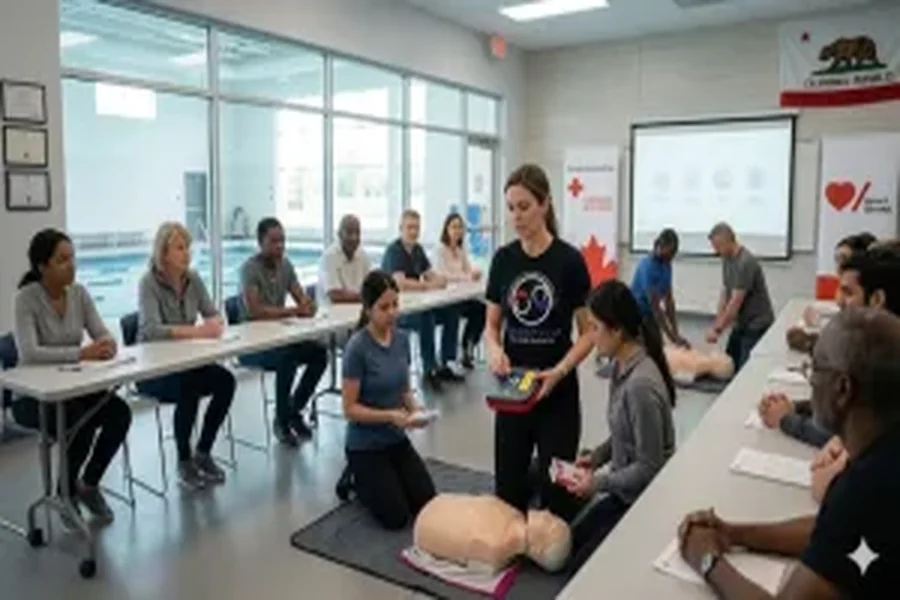
Once the asynchronous digital theory is complete, the family attends a single, highly condensed in-person session at a local Markham facility. This session skips the lectures and focuses purely on physical application. Guided by expert instructors, participants practice their mechanics on Bluetooth-enabled smart manikins that provide real-time digital feedback on compression depth and speed. It is an incredibly efficient, respectful educational model that allows diverse, busy families to upskill their household safety without losing their precious weekend.
Translating Love Into Action
Setting up a home in Markham is about creating a sanctuary for the people you love. We invest in top-tier school districts, beautiful neighborhood parks, and secure properties to ensure our families thrive. But true security is biological.
When the unexpected happens, panic is the universal language of the untrained, but competence is the universal language of the prepared. By investing a few hours to become certified in first aid and CPR, you are bridging any communication gap. You are ensuring that if a crisis strikes your multigenerational home, you possess the physical translation of love: the ability to step forward, take command, and save a life.
Frequently Asked Questions
- Can I use an AED on an infant or a small child in my home? Yes. Comprehensive first aid courses teach you the critical differences in pediatric emergency care. If an infant or child suffers a cardiac arrest, you can use an AED. Many modern devices come with a “pediatric key” or specific pediatric pads that lower the energy of the shock. If only adult pads are available, the course will teach you the proper anterior-posterior (front-and-back) placement to safely deliver a life-saving shock to a small child without the pads overlapping.
- How does the course address choking for different age groups in a multigenerational home? Standard First Aid provides specific, age-appropriate protocols for airway obstructions. You will learn the traditional abdominal thrusts (Heimlich maneuver) for adults and older children. Crucially, you will also learn the highly specific technique of alternating back blows and chest thrusts used to clear the airway of an infant, which requires a completely different physical posture to protect their fragile organs.
- Will the training help me recognize if my aging parent is having a stroke? Yes. Stroke recognition is a cornerstone of the medical emergencies module. You will learn the F.A.S.T. acronym (Face drooping, Arm weakness, Speech difficulty, Time to call 911). Recognizing these subtle, early warning signs is vital, as there is a strict, time-sensitive window for hospital staff to administer clot-busting medication to reverse the stroke’s effects.
- Are online-only first aid certificates legally recognized in Ontario? No. While there are many fully online courses available on the internet, they are not recognized by the Workplace Safety and Insurance Board (WSIB) of Ontario for workplace compliance, nor do they provide the hands-on practice needed for genuine muscle memory. The “Blended Learning” model is the only fully compliant hybrid option, as it pairs online cognitive theory with a mandatory, in-person physical skills assessment evaluated by a certified instructor.
- Does the Good Samaritan Act apply if I perform CPR on a stranger in a Markham grocery store? Absolutely. Ontario’s Good Samaritan Act, 2001 is designed specifically to protect well-meaning bystanders from civil liability. As long as you voluntarily provide emergency medical assistance in good faith and do not exhibit gross negligence, you are legally protected if you accidentally cause an injury, such as breaking a rib, while trying to save a life.