
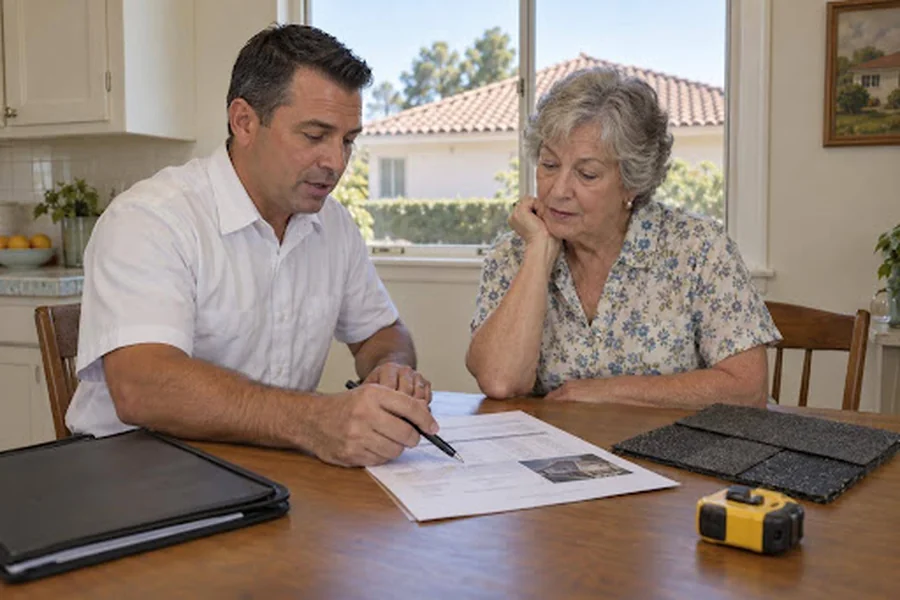

Three estimates arrive for the same leaking roof. One is from a roofer, one from a roofing contractor and one from a roofing company. The prices differ by thousands of dollars, and the homeowner assumes the difference is in the materials. Often it is in the words at the top of the page, because each of those terms describes a different kind of business with a different set of obligations.
Vocabulary in the trades is not decorative. It tells you who is licensed, who is insured, who will still exist when the warranty is needed, and who is actually going to be on the roof. Reading the words carefully is the cheapest protection a homeowner has.
Three words, three different promises
A roofer is a person with a trade. The word says nothing about licensing or insurance; it describes someone who installs or repairs roofs, whether as a company owner, an employee or a day laborer. Plenty of excellent roofers work for someone else, and plenty of unlicensed operators call themselves roofers for exactly that reason.
A roofing contractor is a business licensed to contract for roofing work. In California that means a license from the Contractors State License Board, and for roofing specifically the C-39 classification. The license carries a bond, requires workers’ compensation coverage for employees, and gives the homeowner a complaint process if something goes wrong.
A roofing company is simply a business entity. It may hold a license or it may be a sales operation that subcontracts the work to someone who does, or does not. The word company reassures, but it promises nothing on its own.
The words that belong on the paper
Whatever the business calls itself, a legitimate estimate in Santa Ana will carry a specific set of items:
- A license number you can check on the state board’s website in under a minute
- Proof of general liability insurance and workers’ compensation
- A scope that names the work: tear-off or overlay, underlayment type, flashing, ventilation, disposal
- The exact products by manufacturer and line, not a generic description
- Two warranties, one from the manufacturer on the materials and one from the contractor on the workmanship, each with its term stated
- A payment schedule that does not ask for most of the money up front
An estimate missing more than one of these is a sales document, not a construction document.
Estimate, quote, bid: not the same thing either
An estimate is an approximation and can change. A quote is a fixed price for a defined scope, valid for a stated period. A bid is a formal offer, usually in response to a specification the owner wrote. Homeowners tend to receive estimates and treat them as quotes, then feel ambushed when the price moves after the tear-off reveals rotten decking. Ask which of the three you are holding, and ask how the price changes if the deck or the framing turns out to need work.
What Santa Ana adds to the conversation
The city’s housing stock includes a great deal of early and mid-century construction, and many of those roofs have been layered or patched more than once. A roofing contractor in Santa Ana should be able to tell you from the attic and the eaves how many layers are up there and whether the city will allow another overlay, which it frequently will not.
The fall winds that give the region its name add a second local factor, lifting marginal roofs and leaving damage that only shows at the next rain, a sequence described in this guide to how to check your roof after the Santa Ana winds.
Permits are the final local word. A re-roof in the city requires one, the inspector will check the deck and the underlayment before the roofing goes on, and a contractor who proposes to skip that step is telling you something about the rest of the job.
Reading the warranty before you sign
The workmanship warranty is the part of the paper that reveals the business behind the words. A term of several years from an established local firm means something because the firm expects to be around to honor it. The manufacturer’s warranty on materials is often long but comes with conditions, including installation by a certified contractor and correct ventilation, and a careless installation can void it. Firms that explain these conditions in plain terms, as PWC Roofing does for the roofs it installs, are usually the ones that install to meet them.
Ask one last question before signing: who will physically be on my roof? If the answer is a subcontractor, the license, the insurance and the warranty should still run through the company whose name is on the contract.
Quick answers
Can I check a license number myself?
Yes, on the state license board’s website, where you can also see the bond and workers’ compensation status.
Is a roofer without a license always a bad choice?
For work above the state’s small-job threshold, hiring unlicensed is a risk you carry alone if something goes wrong.
Why do three estimates differ so much?
Usually scope: one includes tear-off, new underlayment and flashing, and another quietly does not.