
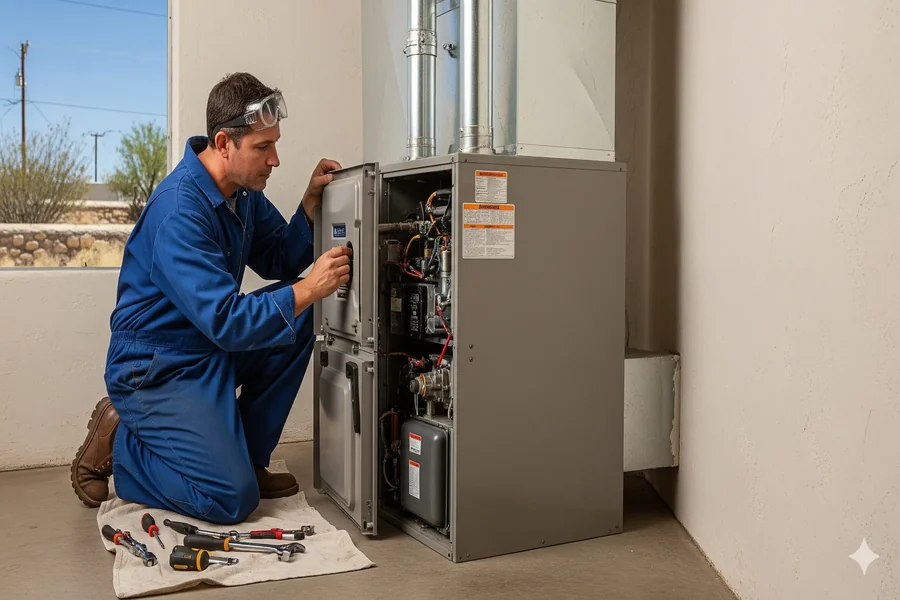

Two in the morning, twelve degrees outside, and your furnace starts banging like someone’s trapped in the basement. You lie there running through worst-case scenarios, most of them expensive. Here’s the truth: most furnace noises are talking to you, and they’re usually saying something specific. A whine isn’t a bang isn’t a rumble. Each one points to a different part, a different price tag, and a different level of urgency.
The skill worth learning is noise translation. If you can match the sound to the likely cause before you call anyone, you’ll know whether to schedule a visit this week or shut the system down and call tonight. You’ll also stop getting talked into parts you don’t need, which matters when you’re standing in a cold hallway nodding at whatever the technician says.
I’ve spent enough winters in older Midwest housing stock to have heard all of them, and I’ll tell you now: the sound you ignore is the one that turns into a four-figure bill. The good news is that most of these have a known cause and, when caught early, a reasonable fix. Working with a team that handles heating system repair for common issues means someone who’s heard your exact noise a hundred times before, not someone guessing at it over the phone.
Why Furnaces Announce Their Problems Before They Quit
Your furnace is a set of moving parts bolted into a metal box, and metal boxes amplify. A bearing that’s starting to wear doesn’t fail silently. It whines for weeks first. A blower wheel that’s picked up debris doesn’t just stop. It rattles against its housing until the imbalance gets bad enough to matter.
That’s the useful part of the deal. Mechanical systems almost never fail without warning, and heating equipment is unusually generous about broadcasting what’s wrong. The sound is the warning. Your job is to hear it early enough that a repair stays a repair. One caveat before you start diagnosing: if you ever smell gas, hear a boom rather than a bang, or see soot around the unit, stop reading and get out of the house. That’s not a noise problem. That’s a call-the-gas-company problem, and no amount of listening skill substitutes for leaving.
What Does Each Furnace Sound Actually Mean?
Match what you hear to the list below. These are the sounds homeowners describe most often, roughly in order of how often they turn out to be serious.
| Sound | Likely Cause | How Urgent
|
|---|---|---|
| Loud bang at startup | Delayed ignition, gas builds up before lighting | Call promptly, do not ignore |
| High-pitched whine | Failing blower or inducer motor bearing | Schedule within days |
| Low rumble or hum | Loose panel, unbalanced blower, or duct vibration | Worth a look, rarely urgent |
| Rattle or clatter | Debris in the blower wheel or a loose component | Schedule soon |
| Screech or squeal | Belt or bearing wear on older units | Schedule within days |
| Clicking that repeats | Ignition or control board cycling | Diagnose before it stops lighting |
The bang is the one people underestimate. A single boom at startup usually means the burners aren’t lighting on schedule and gas is pooling for a second or two before it catches. That’s a small controlled event, until it isn’t. Get it looked at rather than waiting for the season to end.
The whine is my personal least favorite, because it’s the sound of a motor on its way out. Motors rarely come back from that. You either replace the part now on a scheduled visit or you replace it later, on a holiday weekend, at emergency rates, with your family in coats.
A Five-Minute Check You Can Run Tonight
Before you call anyone, do these in order. You’ll either solve it yourself or hand the technician a much better description than “it’s making a weird noise.”
- Kill the power at the switch, then check the panels. A panel that’s not seated all the way will rattle or hum for the entire heating season. Press each one firmly and restart.
- Change the filter. A clogged filter starves the blower, and a starved blower gets loud. This is the single most common cause of new noise in a system that used to be quiet. Once a month during heavy use is a reasonable habit.
- Look at the blower through the access door if your unit has one. A wheel with visible dust buildup or a bent fin will wobble, and wobble is audible.
- Write down when the noise happens. At startup, mid-cycle, or at shutdown? Continuous or intermittent? That single detail tells a technician more than a ten-minute phone description.
- Check your vents. A closed or blocked register pushes pressure back through the ducts and can create a hum you’d swear was coming from the furnace itself.
If you get through all five and the noise is still there, you’ve done your part. The Department of Energy notes that regular maintenance keeps heating equipment running safely and efficiently, which is the whole point of catching these things before they compound.
The Fixes That Are Almost Never Worth Doing Yourself
Some repairs are genuinely homeowner territory. Filters, panels, vents, and thermostat batteries all fall into that bucket, and you should handle them without hesitation. Others are not, and the line is clearer than people think. Anything involving gas supply, ignition, the heat exchanger, or the control board belongs to a licensed technician. Not because you couldn’t watch a video, but because the failure modes include things that hurt people. Gas work and combustion are where I’d draw the line without exception, and I say that as someone who’s happy to open up most things in a house.
Older systems complicate this further. If your furnace is well past the typical service life, you’re weighing a repair against a replacement, and that math depends on parts availability and how often you’ve called already this year. Payback periods vary by climate and usage, and the National Institute of Standards and Technology publishes work on how equipment performance gets measured, which is a decent reminder that the numbers on a sales sheet deserve scrutiny.
When a Repair Stops Making Sense
Here’s the framework I actually use, and it’s served me well through three houses and one very stubborn furnace. I call it the three-strike rule, and it keeps the decision out of your gut at 11 p.m. One repair on a unit under ten years old: fix it, no debate. Two repairs in the same heating season: start pricing replacements so you’re not doing it under pressure. Three repairs, or any single repair costing a large fraction of a new unit: replace it on your schedule, in the shoulder season, when you have time to get three quotes.
The trap is doing it in January. Emergency replacement pricing is not the same as planned replacement pricing, and the difference is real money. One more thing worth knowing: the trades that handle this work are stable and in demand. According to the Bureau of Labor Statistics, heating, air conditioning, and refrigeration mechanics remain a sizable occupation with steady projected openings, which means a good technician is a long-term relationship, not a one-time transaction. Treat the good ones accordingly.
What To Say When You Finally Call
Lead with the sound, the timing, and the age of the unit. Something like: “There’s a high whine at startup on a fourteen-year-old furnace, worse in the morning.” That’s a technician’s dream call, because it narrows the parts list before anyone gets in a truck.
Every noise your furnace makes is information, and most of it is cheap information if you hear it early. The bang in February is the same problem as the bang in October, just at triple the cost and with a much colder house attached to it. So listen now, check the filter, and write down what you hear. Which sound has your house been making this season, and how long have you been telling yourself it’s nothing?