
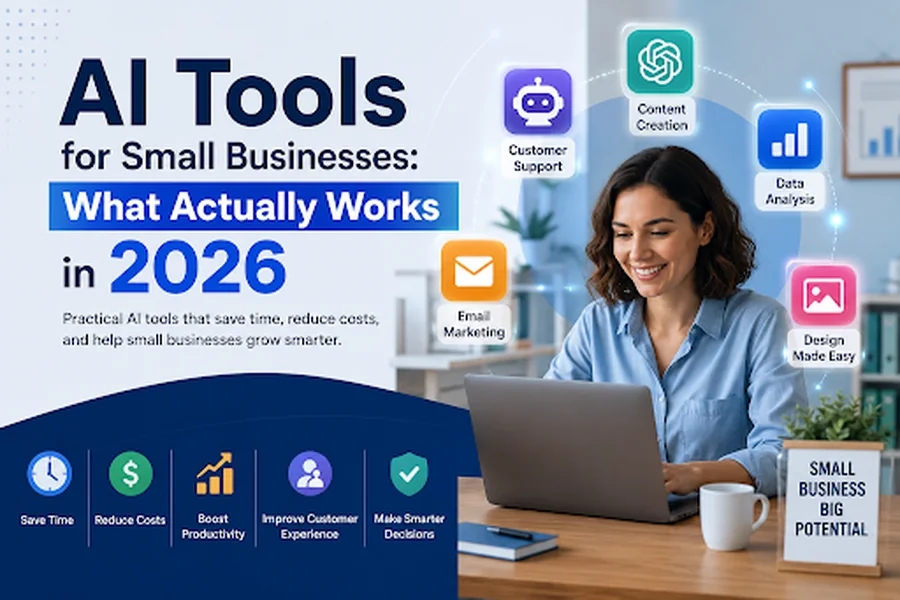

Artificial intelligence is no longer something reserved for large technology companies with huge budgets. In 2026, AI has become a practical business tool that small companies can use to save time, improve customer service, create marketing content, analyze information, and automate repetitive work. Research published by the Federal Reserve Bank of San Francisco shows that small businesses are already applying AI across productivity, marketing, communications, customer service, analytics, and other business functions.
However, having access to AI does not automatically make a business more efficient. There are hundreds of AI products available, and many offer similar features. For a small business, the important question is not how many AI tools it can use. The real question is which tools solve genuine business problems and provide enough value to justify the time and cost.
AI Assistants for Everyday Business Tasks
General-purpose AI assistants are among the most useful tools for small businesses because they can handle many different tasks from a single interface. A business owner can use an AI assistant to draft emails, summarize documents, brainstorm ideas, prepare proposals, research topics, organize information, create standard operating procedures, and improve existing content.
The biggest advantage is speed. Tasks that previously required an employee to spend an hour creating a first draft can often be started within minutes. The final result should still receive human review, particularly when it contains prices, legal information, financial figures, technical claims, or customer-specific details.
The best approach is to treat an AI assistant as a capable digital coworker rather than an automatic decision-maker. Give it clear instructions, useful context, examples, and the desired output format. Better input usually produces considerably better results.
AI for Marketing and Content Creation
Marketing remains one of the strongest practical applications of AI for small businesses. AI can help create blog outlines, social media posts, email campaigns, product descriptions, advertising concepts, landing-page copy, and SEO content.
This can be particularly valuable for businesses without a large marketing department. Instead of starting every campaign from a blank page, employees can use AI to create an initial version and then add the company’s expertise, examples, brand voice, and original perspective.
AI should not become a shortcut for publishing large amounts of generic content. Customers can quickly lose interest in repetitive or inaccurate material. The businesses getting the most value from AI use it to accelerate the creative process while keeping humans responsible for quality and strategy.
AI-Powered Customer Service
Customer support is another area where AI can produce measurable benefits. A small business may receive the same questions repeatedly about prices, shipping, availability, refunds, appointments, services, or account information. AI-powered support systems can answer common questions instantly and help organize incoming requests.
This does not mean every customer interaction should be automated. Complex complaints, unusual requests, payment disputes, and sensitive situations are usually better handled by a person. A more effective model is to let AI manage predictable questions while employees concentrate on conversations requiring judgment.
This combination can improve response times without sacrificing the personal service that often gives small businesses an advantage over larger competitors.
AI for Sales and Lead Management
Sales teams can also use AI to reduce administrative work. AI can summarize conversations, draft follow-up emails, organize prospect information, identify promising leads, and help personalize outreach.
For example, instead of manually reviewing a long customer inquiry and preparing a response from scratch, a salesperson can use AI to summarize the customer’s requirements and generate an initial reply. The employee can then verify the information and personalize the message before sending it.
The objective should be to make salespeople more productive rather than completely automate relationships. Customers still value conversations with people who understand their requirements and can make decisions.
AI Automation for Repetitive Work
One of the most valuable developments in 2026 is the combination of AI with workflow automation. For businesses looking to build more specialized automation, custom AI agent development can turn these capabilities into intelligent agents that understand context, make decisions, and execute multi-step workflows. Traditional automation generally follows fixed instructions: when one event happens, perform another action. Adding AI allows workflows to understand and process less structured information such as emails, documents, customer messages, and forms.
A company might use automation to categorize incoming inquiries, extract information from documents, prepare summaries, update internal records, or send information to the appropriate employee.
Businesses exploring these possibilities can visit https://evostai.com/ to learn more about AI-focused solutions and how artificial intelligence can fit into modern digital workflows.
Automation works best when businesses begin with repetitive, predictable processes. Trying to automate an entire operation immediately can create unnecessary complexity. Automating one high-volume task and measuring the result is usually a better starting point.
AI for Data Analysis and Business Decisions
Small businesses collect more information than they often realize. Sales records, website analytics, advertising results, customer inquiries, inventory data, and financial reports can all contain useful patterns.
AI tools can help summarize this information and make it easier to understand. An owner might ask AI to compare monthly sales, identify changes in customer behavior, summarize advertising performance, or highlight unusual patterns in a spreadsheet.
The technology is especially useful for turning complicated information into understandable explanations. However, important decisions should not rely entirely on an AI-generated interpretation. Source data and calculations should always be verified.
AI for Meetings and Internal Productivity
Meetings create another opportunity for practical AI use. AI meeting assistants can generate transcripts, summarize discussions, identify important decisions, and prepare action items.
For a small team, this can eliminate a surprising amount of administrative work. Employees no longer need to spend as much time taking notes or trying to remember who agreed to complete a particular task.
AI can also help create internal documentation and training materials. When a business develops a successful process, AI can assist in turning that process into clear documentation that future employees can follow.
What Does Not Work Well?
The least effective AI strategy is subscribing to many tools simply because they are popular. Small businesses can easily end up paying for several products that perform almost identical functions.
Another mistake is automating a broken process. If a workflow is already confusing, adding AI can make the problem faster rather than fixing it. Businesses should first understand the process, decide what outcome they want, and then determine whether AI can improve it.
Blind trust is equally risky. AI systems can generate incorrect information while presenting it confidently. Human review remains essential for important business outputs.
How Small Businesses Should Choose AI Tools
The best AI tool is not necessarily the product with the longest feature list. It is the one that solves a frequent and expensive problem.
Before paying for a platform, businesses should identify how much time a task currently consumes and what improvement they expect from automation. They should also consider ease of use, integration with existing software, security, privacy, reliability, and total subscription costs.
The strongest results tend to come when AI is connected to a clear business goal. Recent 2026 research on small-business AI adoption similarly emphasizes that companies gain more value when AI is tied to business objectives, employee skills, data readiness, and appropriate governance rather than treated as an isolated experiment.
The Future Is Human Plus AI
AI adoption among small businesses continues to grow, but the most important change is how the technology is being used. It is increasingly becoming a productivity layer inside everyday business operations rather than a separate experimental technology. U.S. Chamber research in 2026 found that half of small-business workers were already using AI at work, with productivity improvement being a major focus.
The companies that benefit most will not necessarily be those using the largest number of AI tools. They will be the businesses that identify repetitive work, introduce AI where it provides a measurable advantage, train employees to use it effectively, and maintain human oversight.
In 2026, the practical value of AI is straightforward: let technology handle more of the repetitive work while people focus on customers, creativity, relationships, strategy, and growth. That is where AI actually works for small businesses.