
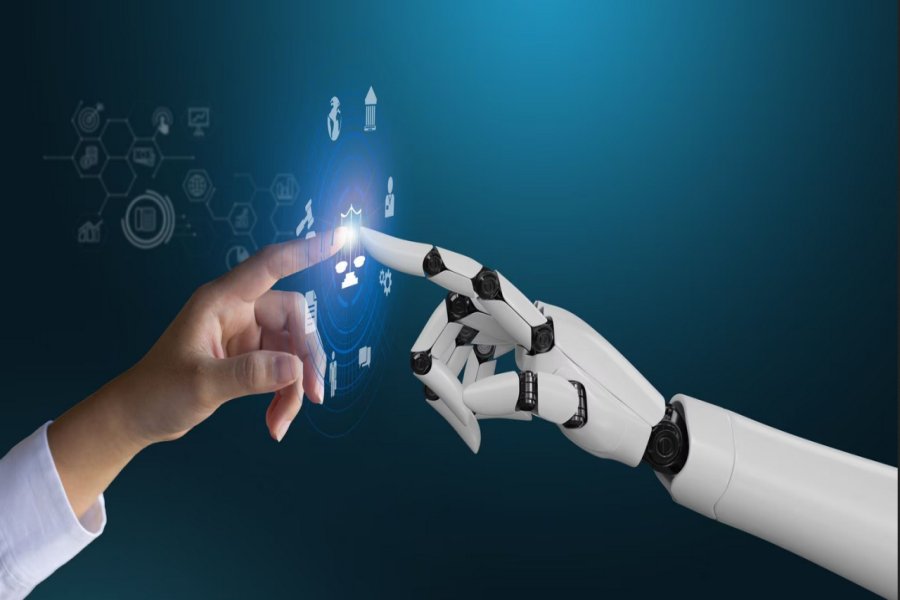

Artificial Intelligence (AI) is not another product of science fiction. It has become part and parcel of our everyday lives and has silently influenced our ways of life, work and our relationship with the world. There is no place where AI does not exist, starting with voice assistants or personalized recommendations, its power is ever-expanding at an accelerated pace. With the further development of technology, it is possible to say that the role of AI in daily life will become even deeper and elements will be easier, faster, as well as more efficient.
In this paper, we are going to discuss the ways in which AI is changing various spheres of our life and what the future might bring when this influential technology is developed.
AI in Smart Homes and Daily Convenience
Smart home appliances are one of the most visible examples of the introduction of AI into our lives. These are technologies that aim at making our daily activities more convenient. Since smart thermostats that regulate temperature automatically and voice controlling assistant that control the schedules, AI is making people save time and effort.
Smart speakers, home automation systems, etc. learn as they are used. They can eventually know what people prefer like when to switch on lights or reduce the temperatures of rooms. This amount of personalization makes living a smooth process.
The development of AI will make smart homes even more user-friendly. Envision a smart house making your morning coffee, lighting up when you are in a good mood, and reminding you of the things you need to do without you having to press a button.
To learn more about the changing technology trends, visit this useful source: techpora.
AI in Healthcare and Well-being
The field of healthcare is among the most promising fields where AI is being significant. The AI-driven systems are assisting physicians in diagnosing illnesses with greater accuracy and earlier diagnosis. Algorithms based on machine learning have the ability to process medical information, identify trends, insights, and information that can be overlooked when done by human analyzers. Increasingly, collaboration with an experienced AI development agency is enabling healthcare providers to implement these advanced solutions more effectively.
Wearable gadgets are also contributing significantly. The devices record heart rate, sleep, and physical activity, giving real-time responses to the users. One possibility is that, in the future, AI will be able to foresee potential health problems even before such problems are manifested and preventive care is taken.
Also, AI chatbots and virtual health assistants are also increasing. They are capable of medical consultation, reminding patients to take medication, and even mental health care. This enhances accessibility besides decreasing the strain on healthcare systems.
AI in Education and Learning
AI is changing the face of education. Conventional learners are undergoing improvement through smart learning tools designed to meet the needs of the students. AI will be able to assess the strengths and weaknesses of a student and provide individual learning trajectories that enhance the knowledge and memorization.
AI is being used online learning platforms to recommend courses, monitor progress and give real-time feedback. This contributes to flexible and accessible learning by persons of all ages.
In the future, the use of AI tutors may become the norm, as it will provide students with personalized help 24 hours a day. Such systems will be capable of responding to questions, describing difficult issues, and even changing the manner in which a student should be taught, depending on the way he or she learns best.
AI in Transportation and Mobility
The other field in which AI is causing a massive difference is transportation. Self-driving cars are now being tested and developed by large companies despite being viewed as a futuristic one. These cars are driven by AI surveys of the environment, decision making and maneuvering.
AI is also enhancing the traffic management systems. AI can streamline traffic and minimize accidents by utilizing sensor and camera data to reduce congestion and optimize traffic flow. AI can also be applied in the field of navigation apps that already update routes in real time and recommend the quickest paths.
Even further on, we might have the completely autonomous means of public transport, which will make the traveling process safer and efficient. This may go a long way in minimizing the human error, which is the most common cause of accidents in the contemporary world.
AI in Work and Business
AI is transforming the workplace at a rapid pace. Most of the monotonous and repetitive work is now being automated, leaving employees to devote more time to work of creativity and strategy. AI applications can do data analysis, support services, and even generation of content.
Companies are applying AI to get a better idea about customer behavior. Through data analysis, companies are able to provide personalized recommendations, enhance customer experiences and also improve efficiency.
Nevertheless, the emergence of AI is associated with difficulties as well. Jobs are becoming more dynamic and new skills are on demand. Although there is a risk of job replacement, numerous new vacancies will also appear, in particular, those related to AI development and management.
Ethical Considerations and Challenges
With the increasing use of AI in everyday life, one more significant ethical issue is brought up. Such aspects as privacy of the data and its security, as well as algorithm bias, should be approached cautiously.
The use of AI systems entirely depends on the data, and it is important to make sure that this data is applied responsibly. Another issue is transparency, people must know how the AI systems make their decisions, particularly in such important fields as healthcare and finance.
The other difficulty is to make AI a good thing to all. There should be attempts to avoid bias and discrimination in AI systems, which may happen when data to train it is not diverse or representative.
Developers, governments, and organizations should collaborate to develop rules and regulations that would make AI apply in a responsible and ethical way.
Final Thought
The future of artificial intelligence in normal life is promising and radical. AI is also continuing to develop and will transform our lifestyles, workplaces, and relationships with the world in a new form. There is no limit as to how smarter the homes will be, how sophisticated the healthcare will be and how better the education will be.
There is, however, great responsibility that comes with great power. The challenges and ethical issues related to AI should be discussed to make it useful to the society.
Finally, AI is not a technology per se but a matter of human potential. With an emphasis on ethics and inclusivity coupled with embracing innovation, we can shape a world where artificial intelligence can be used to make the lives of people meaningful and lasting.