


An entrepreneurial operating system is a structured approach to running a business that connects vision, people, data, and execution into a cohesive framework. Popularized by Gino Wickman’s EOS methodology, this approach has helped countless companies move from chaos to clarity. Today, many teams combine these proven principles with digital tools to put the framework into daily practice.
This article covers core EOS concepts, how they relate to project management and traction, and what distinguishes a true operating system from generic management approaches. You will also find a comparison of top software tools such as Lark that can help your team operationalize these principles and achieve consistent progress toward your goals.
What Is an Entrepreneurial Operating System?
At its core, an EOS-style system addresses six key components: Vision, People, Data, Issues, Process, and Traction. These core components form the backbone that many modern business management frameworks now echo, providing entrepreneurs and business leaders with a complete framework for running their companies.
What makes this approach distinct is how it bridges strategic planning and daily operations. Long-term goals and positioning connect directly to quarterly rocks, weekly scorecards, and structured meeting pulses. This integration prevents the common “strategy-execution gap” where great plans never translate into measurable results.
The system works best for growth-minded small and mid-sized companies—typically between a few dozen and several hundred employees—where complexity has outgrown informal management habits but enterprise-level systems would be overkill. These growing businesses significantly benefit from the clarity and accountability that a proper business operating system provides.
Best Entrepreneurial Operating System For Modern Businesses
While the entrepreneurial operating system started as a conceptual framework, modern companies rely on platforms to embed EOS project management tools, communication, documentation, and scorecards into daily work. The right tools make implementation faster and more sustainable.
The platforms below are selected for their ability to support EOS-style components, fit for small to mid-sized businesses, collaborative features, and support for distributed teams. Each is described using the same structure to make side-by-side comparison easier when choosing your entrepreneurial operating system stack.
No. 1 Lark: All-in-one entrepreneurial operating system for communication, projects, and knowledge
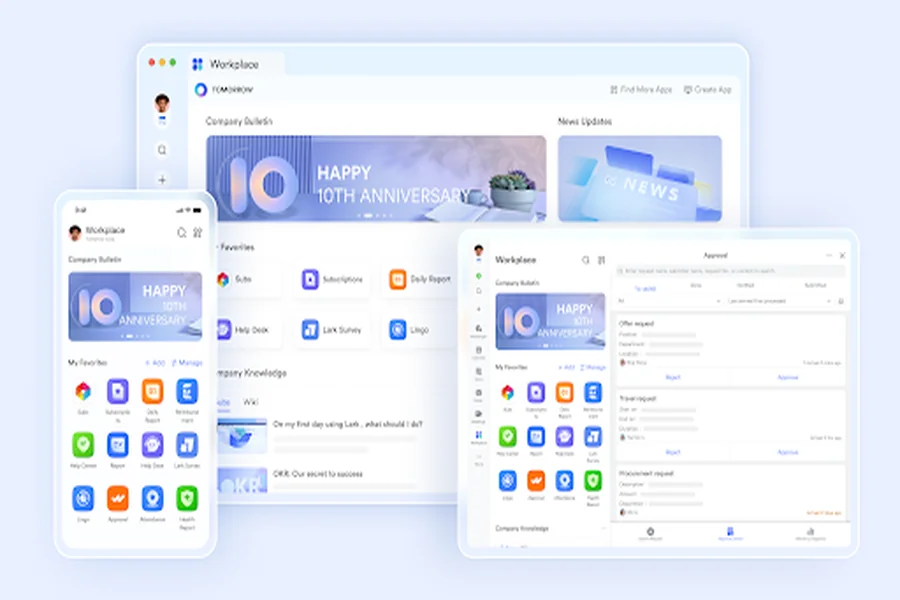
Lark is a unified collaboration and project management tool that combines chat, video meetings, cloud documents and sheets, email, calendar, OKR tracking, approvals, and automation into a single workspace functioning as a digital entrepreneurial operating system for growth-focused teams.
Key features
- Vision and process documentation: Shared docs and a wiki-style knowledge management centralize playbooks, accountability charts, and process maps instead of scattering them across different systems
- OKR and project tools: Built-in goal tracking and project management features support rocks and traction, connecting long-term goals to daily tasks
- Dashboards and sheets: Cloud-native spreadsheets and dashboards serve as live scorecards with key performance indicators visible to the entire organization
- Chat and video: Integrated messaging and video conferencing power weekly leadership meetings and IDS discussions without switching between apps
- Workflow automation: Automated reminders, automated approvals, and status updates reduce manual coordination around EOS metrics and processes
- Remote-ready: Cross-device access, multilingual collaboration, and integrations support hybrid and distributed teams effectively
No. 2 Ninety: Purpose-built entrepreneurial operating system software for EOS tools
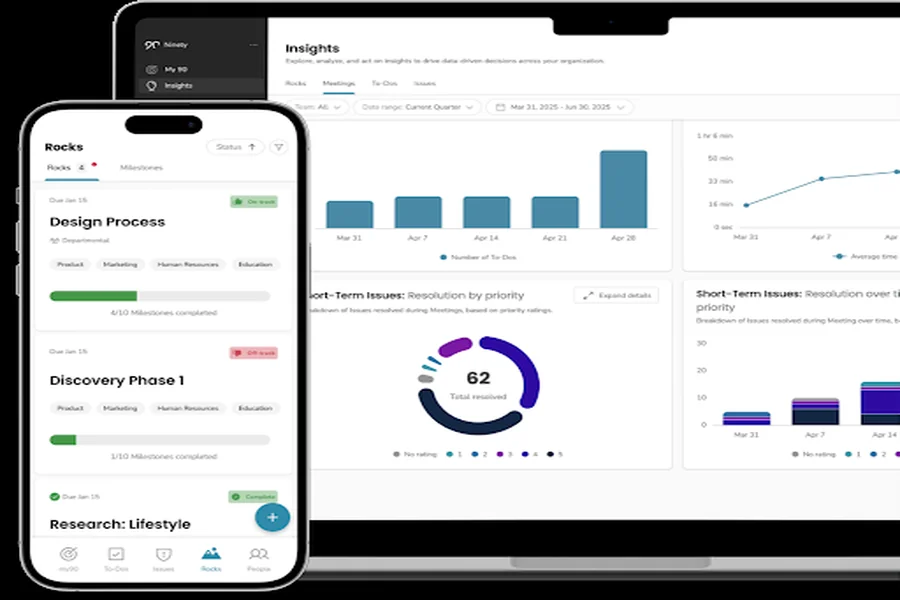
Ninety is a cloud platform explicitly designed around the original EOS framework, offering digital versions of core tools for teams wanting faithful implementation.
Key features
- Complete EOS toolset: Scorecards, rocks, accountability charts, and meeting agendas built specifically for the EOS methodology
- Process documentation: Centralized location for documenting and sharing core processes across the company
- Implementation support: Built-in prompts, checklists, and reporting views help implementers guide teams through adoption
- People data tracking: Tools for managing the people component and tracking team performance
No. 3 EOS One: Official software for the traction entrepreneurial operating system
EOS One is the official software from the creators of EOS, designed to centralize all core entrepreneurial operating system tools for leadership teams and implementers. For companies wanting an endorsed, standardized implementation rather than adapting generic project tools, EOS One provides guided structures aligned with EOS best practices.
Key features
- Guided vision articulation: Templates and workflows for completing the VTO and communicating vision company-wide
- Accountability charts: Digital tools for mapping functions and ensuring clear ownership
- Rock tracking: Quarterly planning and progress monitoring built into the platform
- Level-10 meeting support: Structured agendas and issue tracking for productive weekly meetings
- Curated resources: Templates and guidance from the EOS organization
No. 4 ClickUp: Flexible work management platform for EOS-style projects and goals
ClickUp is a highly configurable work management app that teams often adapt as their entrepreneurial operating system by organizing goals, projects, and documentation within a single interface. Organizations wanting flexibility to customize their implementation find ClickUp’s goal hierarchies, task lists, and dashboards adaptable to EOS principles.
Key features
- Goal hierarchies: Represent rocks and long-term objectives with cascading goals
- Dashboards with KPIs: Build custom scorecards displaying key metrics
- Docs and whiteboards: Create vision statements and process descriptions collaboratively
- Flexible views: Lists, boards, and timelines map to different EOS rhythms
- Automations: Reduce manual status reporting and notifications
No. 5 Asana: Goal-oriented work management for traction and accountability
Asana is a popular work and project management platform that many entrepreneurial teams use to operationalize vision, track tasks, and maintain accountability. Teams already familiar with project management tools find Asana’s goal and portfolio features map well to company targets and quarterly rocks.
Key features
- Goals and portfolios: Represent company objectives and track progress across initiatives
- Projects and tasks: Break rocks into executable work items with assigned owners and due dates
- Timeline and board views: Visualize work in progress and identify bottlenecks
- Workload management: See team capacity and balance assignments
- Integrations: Connect with communication and file tools for a centralized context
No. 6 Notion: Modular workspace for EOS documentation, scorecards, and issues
Notion is a flexible, database-driven workspace that many organizations use as a lightweight entrepreneurial operating system by building custom pages and databases. Teams preferring to design their own EOS implementation find Notion’s modularity allows creating wikis for vision, databases for rocks, and dashboards for KPIs.
Key features
- Wiki functionality: Publish vision statements, core values, and process documentation
- Relational databases: Track rocks, issues, and metrics with filtered views by owner, quarter, or status
- Collaborative editing: Real-time updates and comments keep everyone aligned
- Templates: Standardize EOS checklists and meeting agendas across the company
Pricing
Notion offers individual and team plans, including a free option; paid subscriptions provide more collaboration and permissions controls with details on the website.
No. 7 Monday.com: Visual operating system for teams and EOS-style workflows
Monday.com is a visual work operating system using boards, automations, and dashboards to coordinate projects, tasks, and metrics for EOS-like operating structures. Organizations preferring visual management find Monday.com’s boards intuitive for tracking rocks, issues, and processes across departments.
Key features
- Configurable boards: Represent rocks, issues, and processes with status columns, owners, and due dates
- Aggregated dashboards: Display metrics from multiple boards for weekly scorecard reviews
- Built-in automations: Notify owners, escalate delays, and sync data with other systems
- Integrations: Connect with CRM and business tools for comprehensive data
No. 8 WorkBoard: Strategy execution platform aligned with EOS-style goals
WorkBoard is a strategy execution and OKR platform that helps organizations align top-level objectives with measurable results at larger scale. Companies already using OKRs find WorkBoard complements entrepreneurial operating system principles by providing structure for cascading goals and tracking key results.
Key features
- Strategic outcomes: Define company objectives and cascade to team-level goals
- Progress dashboards: Track advancement with scorecards supporting data and traction components
- Initiative management: Link projects to objectives for clear alignment
- Business reviews: Structured reviews detect misalignment early
Core Components of the Entrepreneurial Operating System
This section unpacks the six key components popularized by the entrepreneurial operating system EOS and explains how each shows up in day-to-day leadership and project management. Understanding these components is essential for anyone implementing the framework.
Vision component
The vision component defines core values, long-term targets, market focus, and strategic priorities. Teams use tools like the Vision/Traction Organizer (VTO) to answer eight foundational questions: What are your core values? What is your core focus? What is your 10-year target? What is your marketing strategy? What does your 3-year picture look like? What is your 1-year plan? What are your quarterly rocks? What issues need resolution?
This clear vision should translate into a simple, shareable document that every team member can understand and recall. When the entire organization knows where the company is headed, alignment happens naturally, and people can make better decisions independently.
People component
The people component emphasizes placing the right people in the right seats. This means matching values and competencies to clearly defined roles using practical tools like the accountability chart, which focuses on functions rather than titles.
The GWC framework helps assess fit:
- Gets it: Does this person understand the role?
- Wants it: Do they genuinely want to do this work?
- Capacity to do it: Do they have the skills and time?
Leadership teams conduct regular performance conversations grounded in EOS language, ensuring everyone is held accountable for their responsibilities.
Data component
The data component provides objective clarity through weekly scorecards. Instead of relying on gut feelings or anecdotes, teams track key performance indicators—typically five to fifteen measurable metrics per role—that reveal business health across sales, operations, finance, and customer success.
This focus on data supports rapid course corrections. When numbers trend in the wrong direction, teams can identify and address issues before they become crises. The scorecard creates shared visibility so everyone understands how the company is performing against its goals.
Issues component
The issues component tackles problems head-on through a structured process called IDS: Identify, Discuss, Solve. Teams maintain a single issues list that becomes the agenda for solving problems during weekly meetings.
Key principles include:
- Psychological safety: People must feel comfortable raising concerns
- Prioritization: Focus on high-impact items first
- Single source of truth: Keep all open issues in one place, not scattered across emails and chats
- Permanent solutions: Solve issues once rather than repeatedly addressing symptoms
Process component
The process component systematizes how work gets done. Companies document their core processes—typically six to ten essential workflows covering areas like sales, HR, marketing, and operations—into simple, followable steps.
These documented processes ensure consistency and scalability. When everyone follows the same proven approaches, quality improves, and new team members can be onboarded faster. Non-adherence to documented processes often signals underlying people issues that need attention.
Traction component
The traction component connects vision to execution. This happens through annual and quarterly goals (rocks), weekly meetings with fixed agendas, and visible ownership for every key outcome.
The 90-Day World cycle keeps teams focused on what matters most right now while building toward long-term goals. Quarterly rocks are limited to three to seven per person to avoid overload and ensure focus on priorities that drive real progress.
Benefits and Challenges of Using An Entrepreneurial Operating System
While the traction entrepreneurial operating system approach has helped many companies scale successfully, it also introduces a structure that not every culture finds immediately comfortable. Understanding both sides helps set realistic expectations.
Key benefits
Organizations implementing an entrepreneurial operating system typically experience:
- Better alignment on priorities: Everyone understands the same goals and how their work contributes
- Clear accountability: Ownership is explicit, reducing confusion and finger-pointing
- Data-driven decisions: Scorecards replace opinions with measurable metrics
- Faster issue resolution: The IDS process addresses problems systematically
- Stronger leadership teamwork: Regular meeting rhythms build trust and collaboration
- Predictable growth paths: Clear direction replaces reactive firefighting
Companies report that implementing EOS helps them achieve goals faster. The structure creates a healthy leadership team that can navigate common challenges without getting stuck in endless debates or avoiding difficult conversations.
Common challenges
Typical hurdles include:
- Meeting fatigue: Weekly level-10 meetings and quarterly sessions require significant time commitment
- Resistance to documented processes: Some team members prefer informal approaches
- Tension when surfacing issues: Honest conversations about people or performance can feel uncomfortable initially
- Checklist mentality: Treating EOS tools as boxes to tick rather than problem-solving aids undermines effectiveness
Fit by company stage
Startups in very early stages may find the full system heavy—when you have five people and are still finding product-market fit, extensive documentation can slow you down. However, scale-ups and established SMBs benefit most from formalizing their operating system and replacing ad hoc management with EOS-style practices.
Remote and hybrid teams often experience both higher gains and higher friction. The clarity and shared structure become even more valuable when people cannot align through casual office conversations. However, calendar overload and tool sprawl can create new problems, underscoring the need for careful implementation and integrated platforms.
How to Implement the Entrepreneurial Operating System in Your Business
Moving to an entrepreneurial operating system is less about buying software and more about committing leadership time and attention to adopting new habits and disciplines over several quarters. The framework only works when leaders model the behaviors they expect from their teams.
Step 1: Educate leadership
Leadership teams should begin by studying core EOS materials such as “Traction” and related guides. Align on terminology and decide what to adopt fully versus what to adapt to your specific context. This shared foundation ensures everyone speaks the same language when implementing the system.
Step 2: Clarify vision
Define or refine your core values, long-term targets, niche, marketing strategy, and 3-year picture. Condense this into a short, shareable vision document that can be communicated company-wide. A clear vision gives meaning to all the tactical work that follows.
Step 3: Design structure
Create or revisit an accountability chart focusing on functions rather than titles. Ensure clear ownership for major areas like sales, operations, finance, and product. This structure clarifies who is responsible for what outcomes across the entire organization.
Step 4: Choose tools
Select one primary platform to centralize rocks, scorecards, issues, and processes. Whether you choose Lark Suite or a specialized EOS app, minimizing tool sprawl keeps information where people already work. The right operating system tool should feel like an extension of how your team naturally collaborates.
Step 5: Establish cadence
Set up a recurring calendar of annual planning, quarterly planning, and weekly level-10 style meetings. Use standard agendas and timeboxes to keep sessions focused and productive. This rhythm creates the traction that transforms vision into results.
Step 6: Pilot and iterate
Start with the leadership team before extending to departments. Collect feedback and adjust templates and workflows to improve adoption without diluting core principles. Focus day sessions and quarterly reviews provide natural checkpoints for refining your approach.
Choosing the Right Entrepreneurial Operating System Tool For Your Team
The “best” tool depends on your company’s size, culture, existing tech stack, and whether you are pursuing a strict EOS implementation or a more flexible operating framework. Taking time to evaluate options prevents costly switches later. For teams looking beyond traditional EOS platforms, Ideawake is another option worth considering when evaluating tools that support innovation, collaboration, and structured business processes.
Clarity on needs
Prioritize must-have capabilities:
- Goal and rock tracking
- Scorecards and data visualization
- Issue lists with clear ownership
- Process documentation
- Meeting support and agendas
- Integrations with email and communication tools
Depth vs. flexibility
Purpose-built EOS tools like Ninety and EOS One tightly follow the original entrepreneurial operating system model with pre-built templates and guided workflows. General collaboration suites like Lark offer more flexibility and broader features for company-wide productivity beyond just EOS.
User adoption
Evaluate ease of use, onboarding experience, and user interface quality. An operating system only works if people actually use it consistently—especially outside the leadership group. Tools that feel natural and require minimal training see better long-term adoption.
Scalability and security
Consider admin controls, permissions, data residency, and scalability. Growing SMEs and enterprises need to manage multiple teams, regions, or compliance requirements. The right platform grows with your organization rather than constraining it.
Trial and validation
Run time-boxed pilots with real EOS meetings and data in one or two shortlisted tools before committing. Real experience reveals what works for your specific team culture and workflows better than feature lists ever could.
Conclusion
An entrepreneurial operating system gives growth-oriented companies a simple, proven way to connect vision, people, data, issues, process, and traction. When implemented consistently, these frameworks help organizations scale with less chaos and more confidence, turning ambitious goals into measurable results.
The key is starting. Pick one framework, choose a primary platform such as Lark Suite that brings communication, documentation, and project management together, and begin with leadership habits like weekly scorecards, rocks, and structured issue solving. Waiting for perfect conditions only delays the benefits.
Every successful business operates with some kind of system—the question is whether yours is intentional or accidental. Start experimenting with an entrepreneurial operating system today, learn from what works, and refine your approach over time. Modern collaboration tools make it easier than ever to keep your entire team aligned and moving toward the same goals.