
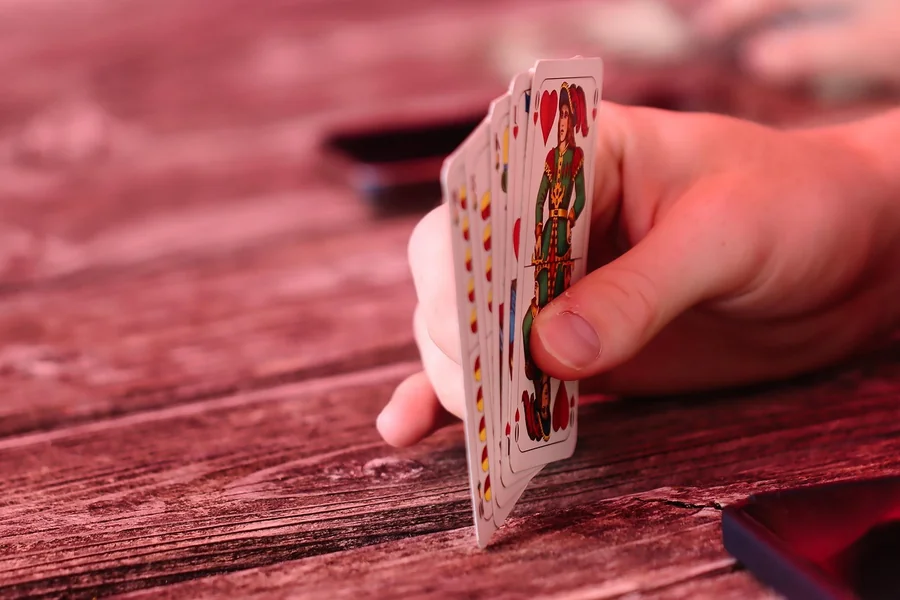

Card tables invented a language of cool, fast choices. Players weigh incomplete information, commit to a line, then live with the result. That pattern maps neatly to everyday life. We size up a meeting, choose whether to push or wait, and try to keep one last surprise in reserve. No wonder daily speech is full of idioms pulled from the felt. “Play your cards right” captures careful timing. “Call the bluff” names decisive testing. Even “double down” has left the pit and moved into boardrooms and headlines. Similar phrases and idioms come from vastly popular table games, including poker and blackjack.
Why is it important to understand the origin of these words, especially in the context of blackjack-like games? Because blackjack itself is not rooted into pop culture as much as poker, and many people wouldn’t even know that the game could transfer phrases into everyday conversations. So, understanding the origins is always the first clue.
Blackjack as a source, explained
At the heart of blackjack is a simple loop. You read your two cards and the visible dealer card, then choose to act. The action menu is short. Hit adds a card. Stand locks your total. Split turns a pair into two hands. Double commits more chips for exactly one card. Surrender, where available, is a graceful exit. That tight grammar of choices is why players trust the game as a training ground for quick, disciplined thinking. In blackjack online real money formats, the loop is even clearer: digital tables present the totals, the available actions, and a clean timer. The decisions are the show, not the side talk.
Two delivery modes reinforce the appeal. One uses certified random number generators so every draw mirrors hand-shuffled chance. The other streams a real dealer and physical shoes, so people can read pace and ritual while still tapping their screen. In both cases, the hand speaks in numbers and thresholds. That makes it easy to learn from feedback. You can track hands per hour, note which totals tempt you into weak hits, and refine when you double with soft hands. Because outcomes arrive fast, the brain builds strong links between a choice and its effect, which is the backbone of any good habit.

All of that explains why the game keeps lending words to daily talk. Each action is a crisp verb you can reuse outside the pit. To “stand” is to stop fiddling and let your prep work speak. To “hit” is to push for more. To “split” is to hedge. To “double down” is to back your read with new resources. The cycle rewards clear plans and calm timing, so it gives English a set of phrases that signal both. In short, blackjack online real money play turns decisions into muscle memory, and that memory supplies the idioms many of us use when the next choice comes due.
Ten idioms that carry the table into daily life
Here are ten well known idioms, each tied to a decision moment at the table and a plain sense in daily life.
| Idiom | Decision moment at the table | Everyday sense |
| Play your cards right | Choose the best line with the hand you have | Act wisely to reach a good result |
| Stack the deck | Order the deal before play begins | Set conditions so outcomes favor you |
| Call someone’s bluff | Decide to test a claim by forcing a reveal | Make someone prove what they say |
| Ace up your sleeve | Hold back a high card for the key moment | Keep a hidden advantage for later |
| Wild card | Use a card that can change rank or suit | An unpredictable factor that can change outcomes |
| Hold all the cards | Control scarce, high-value cards | Have the leverage others need |
| Dealt a bad hand | Receive weak cards at the start | Face tough conditions you did not choose |
| Raise the stakes | Increase the bet to pressure others | Increase risk or commitment to force a decision |
| Double down | Commit extra on a single, limited draw | Reinforce a choice with more resources |
| Reshuffle the deck | Mix the cards and start a fresh shoe | Reset the situation and start again |
A broader look backs this up. Global profiling data suggests that about 19% of people worldwide list board games or cards as a hobby, which helps explain why these phrases cross borders with ease.
Why these idioms stick: cognition, culture, and reach
Idioms endure when they match how minds work. As George Lakoff and Mark Johnson explained, “The heart of metaphor is understanding one thing by comparing it to another.” In other words, we use what we already know to help us understand something new — and that’s exactly what card-game words help us do. Besides, card games always had the perception of fun and social circles showed some interest over the time. Even today, social experiments come to prove that.
View this post on Instagram
Reach also matters. Digital play has expanded the audience for card decisions, keeping the imagery current. As experts estimated, the online gambling market reached around $78.7 billion in 2024, with about 11.9% yearly growth expected through 2030. Over time, that constant exposure helps turn those game elements into everyday comparisons.
There is a final reason these phrases carry weight. Card decisions are visible. Everyone at the table sees when you hit early, stand late, or push a stack into the circle. Visibility creates stories. Stories become shorthand. When a manager says “Let’s raise the stakes,” the team does not need a long briefing. When a friend says “I’m going to stand on that number,” you know they plan to stop tweaking. The idioms work because the actions behind them are clean, public, and rhythmic. That rhythm helps outside the game. It nudges us to set a plan, pick a threshold, and act on time. In a world full of noise, that is a handy habit.