
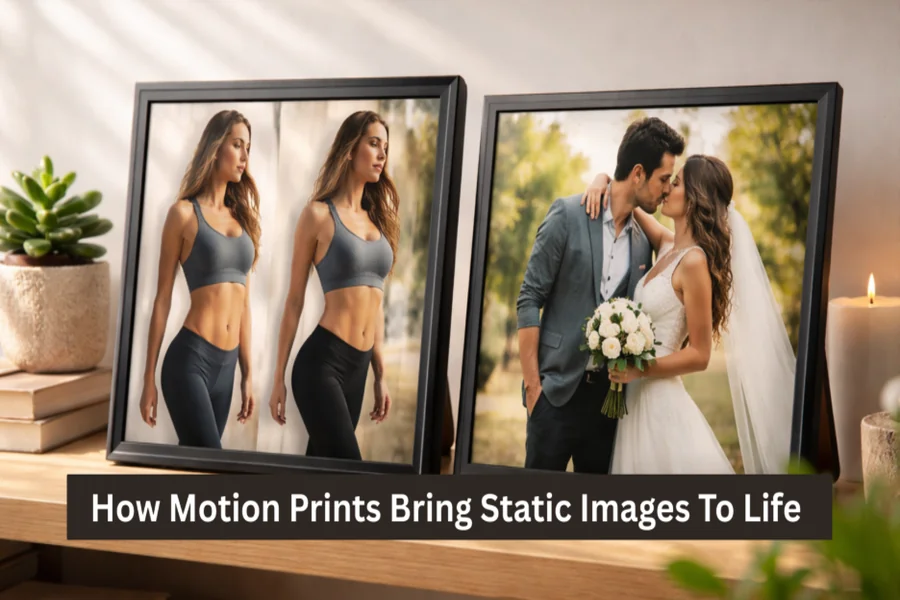

You have probably had this experience: you have a favorite photo that holds a memory, but it seems unfinished. The emotion, movement, or transformation of that image remains in your mind rather than in the frame. Traditional prints preserve the amount of detail, but often have a hard time demonstrating change, contrast, or progression. As a result, significant moments can tend to feel frozen rather than remembered.
This is where visual storytelling starts changing. Motion prints bring a depth, an interaction, and a transformation, without being dependent on screens or digital effects. They invite you to participate with an image, rather than merely viewing it.
This article describes how motion prints work, the reason why they feel so compelling, and how they transform static images into living visual experiences.
1. Understand How Motion Prints Work

At the heart of motion prints is a clever optical trick that combines multiple images into a single physical print. Instead of using a single still frame, the print intersects imagery with a specialized lens surface to produce movement as you shift your viewing angle. As a result, the image is seen to move, flip, or transform right before your eyes.
In many instances, these prints help to create a transition to show before and after or to show some meaningful changes over a period of time. This is why motion photos are more immersive than normal prints. They do not ask you to imagine the story; they show it through physical interaction.
Because the movement is based on perspective instead of electronics, the effect is natural and quasi-immediate. Each tilt reveals a different time, and thus the picture becomes alive rather than being static.
2. Why Motion Captures Attention Instantly?
Movement naturally attracts the human eye. Even slight variations in light or angle can alter focus, which is why motion prints are so engaging. Unlike flat images fading into the background, these prints generate curiosity from the moment someone walks past them.
As you move, the image responds. This interaction creates a loop of engagement where the viewer continuously alters their angle to explore what else there is to be revealed by the print. Consequently, the image tends to draw attention for a longer time and makes a stronger impression.
Moreover, this engagement does not feel strained. There are no buttons to press or screens to activate. Instead, the viewer becomes involved in the experience simply by standing in front of the image.
3. Turn Visual Transitions Into Stories

One of the most powerful things about motion prints is that they are able to tell a story through contrast. A single image can only depict one point in time. However, life is shaped by change, progress, and transformation. Motion prints fill that gap by enabling two moments to coexist in the same frame.
For example, a transformation can be revealed by a slight tilt, shifting from one version of an image to another. This creates a visual narrative that is intuitive and emotional. Rather than describing the story, the image allows you to experience it.
Because of this, motion prints tend to work well in terms of milestones, achievements, and personal journeys. Instead of documenting it, they display growth.
4. Role of Craft and Precision
Behind each motion print, there is a high level of craftsmanship. The image alignment has to be perfect, and the surface of the lens has to be perfectly designed. Even the slightest misalignment may disrupt the motion effect, which is why precision is important in every step.
This involves the process of carefully selecting the appropriate images that flow together from one to the next. Lighting, composition, and framing should all work in unison to ensure continuity. As a result, the final print feels seamless rather than fragmented.
In addition, the physical quality of the print plays an important role. Durable materials and a clean finish ensure that the motion effect is the same, time after time, and even after repeated viewing.
5. Why Motion Prints Feel More Personal
Static images are familiar, but they can feel distant. Motion prints, on the other hand, create a sense of participation. When you tip the image and watch it change, the experience has a personal and purposeful feel.
This interaction increases the strength of the emotional connection. The viewer is not looking at the moment anymore; they are activating it. The shifts each time strengthen the memory and meaning of an image to make it even more memorable.
Furthermore, because motion prints often showcase contrast or progression, they strike a deeper chord. They remind you not of just where you were, but of just how far you have come.
6. Where Motion Prints Fit in Modern Visual Culture
In a world dominated by screens, motion prints offer something refreshingly tangible. They bring movement into physical space without relying on digital devices. This balance between innovation and simplicity makes them especially appealing in modern environments.
Whether displayed in homes, studios, or shared as thoughtful keepsakes, motion prints stand out because they invite interaction. They do not compete with digital media; instead, they complement it by offering a tactile experience.
As visual storytelling continues to evolve, motion prints represent a shift toward more engaging, hands-on forms of expression. They prove that even in print, images can move, change, and tell deeper stories.
Final Thoughts
Motion prints redefine what a photograph can do by expanding it beyond a single, fixed moment. Through a careful balance of precision, interaction, and visual storytelling, they transform static images into experiences that feel active and engaging.
Instead of simply capturing what happened, these prints highlight change, contrast, and progression in a way that feels natural and intuitive. Each shift in perspective reveals another layer of the story, allowing the image to unfold gradually rather than all at once. In doing so, motion prints turn viewing into participation and memory into movement.