By the LFCarry team
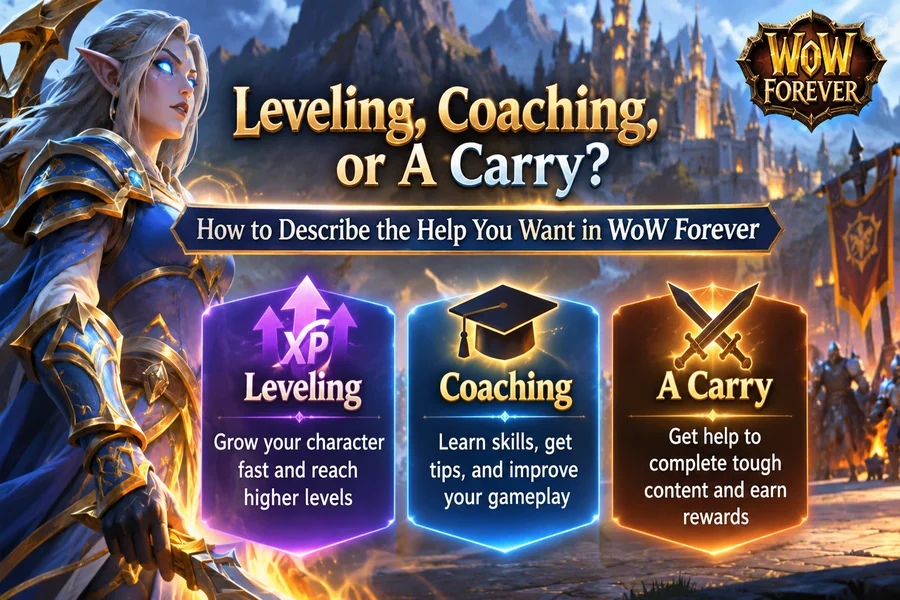
A player asking for “help with WoW Forever” may have several different outcomes in mind. They might want a character at a particular level, an explanation of a difficult decision, or company for a specific activity. Each request gives the person answering a different job.
The most useful starting point is a verb: reach, learn, complete, or practise. Choose the result you want before comparing services. That small wording change makes a discussion about help much easier to follow.
Reach a level: define the endpoint
A leveling request needs a starting point and a destination. State the game version, region, ruleset, class and current level. Then give the level you want to reach.
Consider this hypothetical request: “My character is level 20. I want to reach level 30, and I can discuss the plan on Saturday morning.” It establishes a measurable endpoint. The next conversation can cover the delivery method, timing, included work and total price.
Extra goals belong beside that endpoint. If you also want a profession developed or an equipment task completed, name it separately. Ask whether it is included in the proposed package. Reaching the requested level establishes 1 result; the other tasks need their own completion checks.
Players considering this route can review [WoW Forever leveling with LFCarry](https://lfcarry.com/wow-forever/leveling). The exact offer explains the available scope and delivery choices. Confirm the package for your own character before booking.
Learn a skill: describe a decision
A coaching request starts with something you want to understand or practise. “I want to improve” is an introduction. A particular decision gives the session a subject.
For example: “I lose track of what is happening when several enemies are active. I want to practise choosing what to pay attention to.” The coach can then ask about the activity, your role and what you have tried.
Agree how the session will work. Will you play while the coach watches? Will the coach join you? Will you review a recording together? The answer depends on the service being offered.
Also decide what you want to take away: a practice exercise, an explanation you can apply, or feedback on a particular habit. Ask how questions and follow-up notes are handled. Those details help you compare coaching offers that otherwise sound similar.
Complete an activity: identify your role
The word “carry” can leave important details unstated. Name the activity, the result you want and the part you expect to play.
Clarify attendance and participation. Ask whether you will join the group, which responsibilities remain yours, and what the provider will do. Any prerequisites should be agreed before the session is scheduled.
Completion also needs a shared definition. Ask which result the service includes and how it will be checked. Keep optional rewards, additional runs and other extras itemised in the quote.
Choose the delivery method separately
The goal and the method are separate parts of the request. A player may want a defined progression result while also having a strong preference about participation.
Self-play generally means you remain the player on your character. Piloted delivery means another person performs the agreed work on that character. Availability is offer-specific, so confirm the method for the package you choose.
Ask when you need to be available, how progress will be communicated and how changes are approved.
Use the conversation to finish the brief
LFCarry offers an AI gaming companion for questions and planning alongside optional coaching, carries, piloted boosting and in-game gold. A player can use the companion without purchasing a professional service.
That gives the conversation a useful preparation role. You can identify unfamiliar terms, organise your priorities and turn a broad request into a short list of questions. Confirm the actual service details with the provider before agreeing to the work.
Finish with a brief containing the goal, starting point, requested endpoint, delivery method, availability and included extras. Keep the agreed quote with it. If the scope changes later, record the revised result and price in the same conversation.
Clear wording helps both sides understand what success means. The player knows what they are asking for, and the provider has a concrete request to answer.