
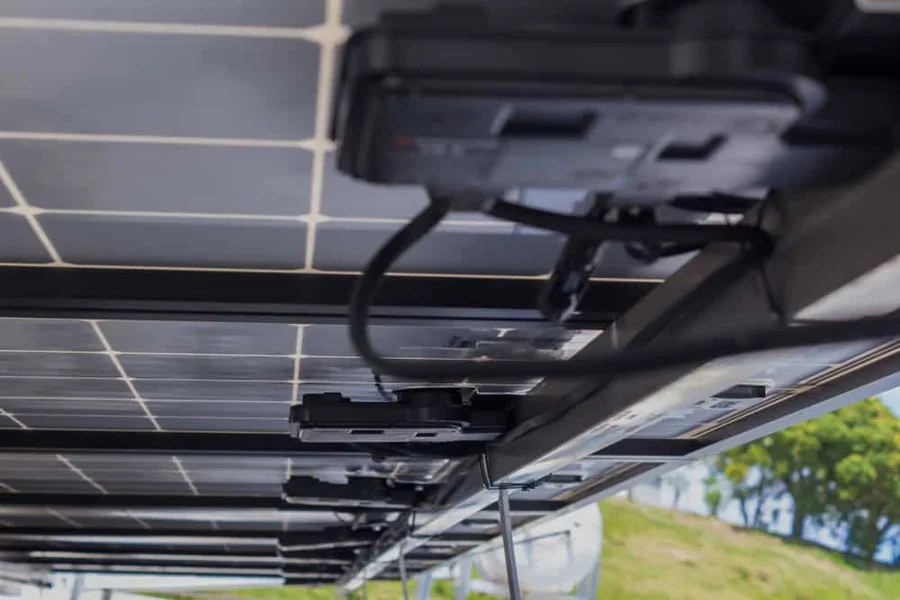

Microinverters Vs String Inverters: Which is Better For Balcony Solar? In terms of safety and efficiency, Microinverters enhance the safety and power generation efficiency of balcony PV systems through module-level shutdown and per-module MPPT, significantly outperforming traditional string inverters in low-power, shaded, and rental scenarios. This article provides a comprehensive analysis to compare microinverters and string inverters in all aspects, from electrical topology, grid-tied control, and thermal design to IRR calculation, and offers a checklist for selection, compliance, and risk control.
1. Key Terms and Glossary
Microinverter: A panel-level grid-tied inverter, with each unit typically serving 1–2 modules, performing per-module MPPT (Maximum Power Point Tracking) and grid-tied control.
Module-Level Rapid Shutdown, MLRS/RSD: In case of abnormality or power outage, quickly reduces the module/DC terminal to a safe voltage, mitigating electric shock and arc risks.
String Inverter: Connects multiple modules in series to form high DC voltage, then centrally inverts it; typically not prioritized for balcony scenarios due to power/wiring limitations.
Grid Code: Rules specifying control curves for voltage/frequency ranges, anti-islanding, reactive power response (Volt-Var), and frequency derating (Freq-Watt).
Availability: The proportion of time equipment is in an available state, a core indicator for measuring stability.
LCOE, Levelized Cost of Energy: Total lifetime discounted cost / total power generation, used to compare the economics of different solutions.
IRR, Internal Rate of Return: The discount rate at which the net present value of project cash flows is zero, measuring the level of investment return.
Arc Fault Detection(AFCI, Arc-Fault Circuit Interrupter): Identifies and disconnects series/parallel arcs to prevent fires.
Leakage Protection (RCD, Residual Current Device): A protective device that quickly disconnects current in case of electric shock to humans or ground faults.
Total Harmonic Current Distortion (THDi)/Power Factor (PF): Key indicators for measuring power quality and grid friendliness.
2. Why Microinverters are Preferred for Balcony Setups
2.1 Low-voltage DC, inherently safer
Microinverters confine DC to the low-voltage/low-energy range at the module end, with only the AC side visible indoors. Combined with an RCD, this creates an appliance-level safety boundary. In contrast, string inverters require longer DC wiring and higher DC voltage, which is less suitable for exposed wiring in balcony and rental environments.
2.2 Per-module MPPT, no drag from shading
Balconies often experience partial shading, varying incidence angles, and localized dust accumulation. Per-module MPPT with microinverters avoids the “weakest link” effect, typically yielding a power generation gain of +5% to +20% during low-light/shaded periods (depending on orientation, shading, and temperature).
2.3 Module-level shutdown, fire and maintenance friendly
Abnormalities or power outages trigger RSD, rapidly reducing the module-side voltage to a safe threshold, significantly lowering electric shock/arc and maintenance risks.
2.4 Low installation and relocation costs
The plug-and-play design and drill-free mounting brackets enable a simple “hang, plug in, and connect to the network” three-step installation process. Systems can be moved when relocating, which is ideal for the high proportion of apartments and rental properties in Europe.
3. Core Technology Profile: The Foundation for Safety and Efficiency
3.1 Electrical Topology and Control
Main Topology: Often features interleaved boost + full-bridge/half-bridge grid connection, emphasizing low ripple current and high-density magnetic component design.
MPPT Algorithm: Evolved from traditional Perturb and Observe (P&O) to adaptive step size/Model-Predictive strategies, improving tracking speed and stability under weak light and rapid irradiance changes.
Grid-tied Control: Current-mode control (PR/PI) superimposed with Volt-Var/Freq-Watt curves, balancing harmonic suppression and voltage support.
Anti-Islanding: A hybrid strategy of passive (frequency drift, voltage drift) + active disturbance injection, typically shutting down within 100–300 ms.
3.2 Thermal Design and Reliability
Encapsulation and Heat Dissipation: Thermally conductive potting compound + integrated heat dissipation casing, ensuring no or minimal derating at full load in summer.
Component Selection: High-temperature rated MOSFETs/SiC, long-life capacitors, and redundant protection (over-temperature/over-current/short circuit).
Protection and Weather Resistance: IP65–IP67 rating, UV/salt spray/damp-heat aging verification, suitable for coastal/high-humidity balconies.
Availability Target: Preferred ≥99% annual availability and 10–15 years product warranty, matching the module’s 25-year lifespan for better TCO.
3.3 Power Quality and EMC
Harmonics and PF: Rated operating condition PF ≥ 0.95, THDi ≤ 5% as an entry threshold.
EMI/EMC: In dense residential environments, must meet residential interference limits to reduce the probability of interference with routers/home appliances.
4. Microinverter vs. String Inverter: Key Differences for Balcony Applications
| Dimension | Microinverter | String Inverter |
| DC Voltage/Wiring | Low voltage at module side, short DC lines; AC only indoors | High DC voltage, long cables; exposed wiring on balconies is problematic |
| Shading and Orientation | Per-module MPPT, not limited by the weakest panel | Prone to the ‘weakest link’ effect in series |
| Safety/Fire | RSD rapidly lowers voltage, low electric shock/arc risk | High DC voltage and longer arc paths |
| Installation/Relocation | Plug & Play, drill-free brackets, easy to relocate | Requires fixed installation and professional wiring |
| Maintenance & Monitoring | Per-module monitoring, minimal impact from a single point of failure | Fault localization at the string level, leading to high localization and replacement costs |
| Cost Structure | Slightly higher initial cost per watt | More cost-effective initially, but difficult to fully utilize scale advantages in balcony scenarios |
| Adapting Power | Typically 600–800 W, 1–2 panels | More suitable for systems ≥ 1.5–2 kW |
| Appliance-like Experience | Strong (like installing a home appliance) | Weak (more like a small construction project) |
| Conclusion: In balcony scenarios characterized by low power, shading, and rental/relocatable needs, microinverters better suit an “appliance-like” user experience and safer operation. | ||
5. Advantages and drawbacks of a string inverter.
A string inverter is a commonly used piece of equipment in photovoltaic (PV) systems, primarily designed to convert the direct current (DC) generated by solar panel strings into alternating current (AC) for connection to the power grid or use by homes, businesses, etc. Follow us for more insights!
Simply put, in a solar power system, many solar panels are connected in series to form strings. A string inverter takes the DC power generated by these strings and, using a series of complex circuits and control technologies, converts it into grid-compliant AC power. It acts as a “power translator,” making the electricity from solar panels compatible with our appliances and the grid.
String PV inverters offer the following advantages:
Higher Power Generation Efficiency: String inverters perform independent Maximum Power Point Tracking (MPPT) for each solar panel string. Since each string of panels may experience varying conditions such as irradiance and temperature, independent MPPT ensures each string operates at its optimal state, thereby increasing overall power generation efficiency. For example, in the morning or evening, if some panels are shaded, string inverters can adjust for these shaded strings, allowing unshaded ones to continue generating power efficiently.
Flexible Configuration and Installation: They can be configured flexibly for various application scenarios and panel layouts. Whether for small residential balcony power plant or large commercial power plants, string inverters can be conveniently used. Moreover, their installation is relatively simple. They are compact and lightweight, unlike traditional inverters that demand significant space and complex setup. For instance, when installing a solar power system on a home rooftop, string inverters can be easily wall-mounted, saving space. Click here to power up your knowledge! ① How to Quickly Report Emergency Incidents? Photovoltaic Power Plant 1-Hour Reporting Template ② How to Choose Photovoltaic Cables? Key Points to Answer Your Questions ③ How to Quickly Report Emergency Incidents? Photovoltaic Power Plant 1-Hour Reporting Template
Good Reliability and Safety: Since string inverters are distributed, each inverter is only responsible for converting power from a portion of the PV strings. If one inverter fails, only the affected strings are impacted, preventing a complete system shutdown. Additionally, they typically include comprehensive protection functions such as overcurrent, overvoltage, and ground fault protection, ensuring the system’s safe operation.
Easy Maintenance and Management: String inverters typically feature smart monitoring capabilities, enabling real-time tracking of each inverter’s operational status—including power output, efficiency, and fault information—through mobile apps or computer software. This allows O&M personnel to promptly identify and resolve issues, thereby lowering maintenance costs and complexity.
However, string PV inverters also have some drawbacks:
Relatively Lower Power: Compared to central inverters, individual string inverters usually have lower power capacity. For large-scale PV projects, multiple string inverters might be needed to meet the total power demand, which increases the number of units and overall system complexity.
Higher Initial Investment Cost: Because string inverters utilize more advanced technology and complex circuit designs, their per-unit power cost is relatively higher. For projects with limited budgets, this can add considerable investment pressure.
6. Efficiency and Returns: Translating “Technical Advantages” into Numbers
Taking an 800 W balcony system (2×420 W modules, microinverter rated 800 W) as an example (for demonstration purposes):
Annual Equivalent Sunshine Hours: 900–1100 h;
Self-consumption Rate without Storage: 55–65%;
Microinverter Gain Relative to String Inverter: +5% to +20% under shaded/low-light conditions (primarily due to per-module MPPT and low mismatch);
Annual Power Generation: Approximately 720–880 kWh;
IRR Sensitivity: Most sensitive to electricity price, self-consumption rate, shading, and temperature rise derating.
If a 1–2 kWh small energy storage (AC coupled) is added, the self-consumption rate can further increase by +10–20 percentage points, leading to a further increase in IRR in regions with significant peak-to-off-peak price differences.
7. Selection and Compliance: A “Balcony Practical Checklist”
Grid-tied Capability: Supports local grid curves (voltage/frequency), Volt-Var, Freq-Watt; features passive + active anti-islanding dual protection.
Safety Protection: RSD, AFCI, real-time grounding/leakage monitoring; clear RCD type and tripping current (e.g., A/A-EV, IΔn 30 mA).
Thermal and Environmental: Continuous full load in 40–45 °C environment without triggering excessive derating; IP65–IP67 enclosure; anti-salt spray/UV.
Monitoring and OTA: Per-module data collection, remote upgrade, fault self-diagnosis; localized privacy and minimal data collection.
Power Quality: PF ≥ 0.95, THDi ≤ 5%; meets residential EMC limits.
Structure and Installation: Drill-free brackets, wind resistance and load-bearing verification; clear anti-loosening and flame retardant ratings for connectors.
O&M and Warranty: ≥10 years product warranty, spare parts pool strategy, availability service level agreement (SLA); on-site spot checks and full lifecycle traceability of serial numbers.
8. Risk Control and O&M: Containing Risks
8.1 Overheating and Derating:
Monitor module backsheet and casing temperature during full sun exposure in summer; adjust installation angle or rear ventilation distance if necessary.
8.2 Connectors and Wiring:
Regularly recheck insertion/extraction force, terminal contact resistance, and insulation; prevent poor contact, which can lead to local heating and eventual carbonization.8.3 Software Strategy:
Reasonably set injection limits and self-consumption priority strategies to avoid erroneous backflow and RCD nuisance tripping.8.4 Compliance Changes:
Pay attention to dynamic changes in national power thresholds and metering rules; quickly adapt through remote power limiting/firmware parameterization.
9. Economic Summary: The “Microinverter Effect” on LCOE and IRR
9.1 LCOE Dimension:
Per-module MPPT increases annual power generation and reduces mismatch, offsetting the microinverter’s relatively higher initial cost per watt.
9.2 IRR Dimension:
In small systems ≤ 1 kW, the comprehensive transaction costs (time + labor + approval) of installation, grid connection, and maintenance are critical factors. The appliance-like characteristics of microinverters lead to quicker cash flow generation, typically resulting in a shorter payback period and a more predictable IRR.
10. Conclusion
The true competition for balcony PV is not in the stacking of “peak wattage,” but in safety boundaries, power generation stability, and user experience. Microinverters, with module-level shutdown + per-module MPPT + appliance-like deployment, become the “cornerstone of safety and efficiency” for balcony scenarios. When technology, compliance, and user experience converge, balcony PV will become as widespread as a home appliance.