

Sports betting is often associated with predicting which team or player will win. Arbitrage betting takes a different approach. Instead of relying entirely on a correct prediction, bettors search for differences between bookmakers’ odds and use those discrepancies to cover every possible outcome of an event.
When the numbers are favourable, carefully distributing stakes across opposing selections can create a positive return regardless of which side eventually wins.
Understanding sports arbitrage
A sports arbitrage opportunity, often called an arb or surebet, appears when bookmakers offer sufficiently different odds on the same event.
The idea is simple: rather than placing all your money on one predicted result, you place separate wagers on opposing outcomes using the best available price for each selection.
This approach is particularly straightforward in sports such as tennis or volleyball, where a match ultimately produces one winner and there is no draw in the final result.
To understand the principle more clearly, consider a practical example.
A simple arbitrage example
Suppose China and the USA are playing a volleyball match. Two bookmakers publish different odds for the two possible winners.
For China:
- Bookmaker #1 offers odds of 1.25
- Bookmaker #2 offers odds of 1.43
For the USA:
- Bookmaker #1 offers odds of 3.90
- Bookmaker #2 offers odds of 2.85
The first step is to examine the implied probabilities behind these prices.
A simple calculation can be expressed as:
S = 1 / odd1 + 1 / odd2
Using the prices available within each bookmaker gives:
Bookmaker #1:
1 / 1.25 + 1 / 3.90 = 1.056
This corresponds to approximately a 5.6% margin.
Bookmaker #2:
1 / 1.43 + 1 / 2.85 = 1.051
This produces a margin of approximately 5.1%.
However, arbitrage bettors are interested in combining the strongest price from each bookmaker rather than using both odds from a single operator.
In this case, the best odds are:
- China at 1.43
- USA at 3.90
Now the calculation becomes:
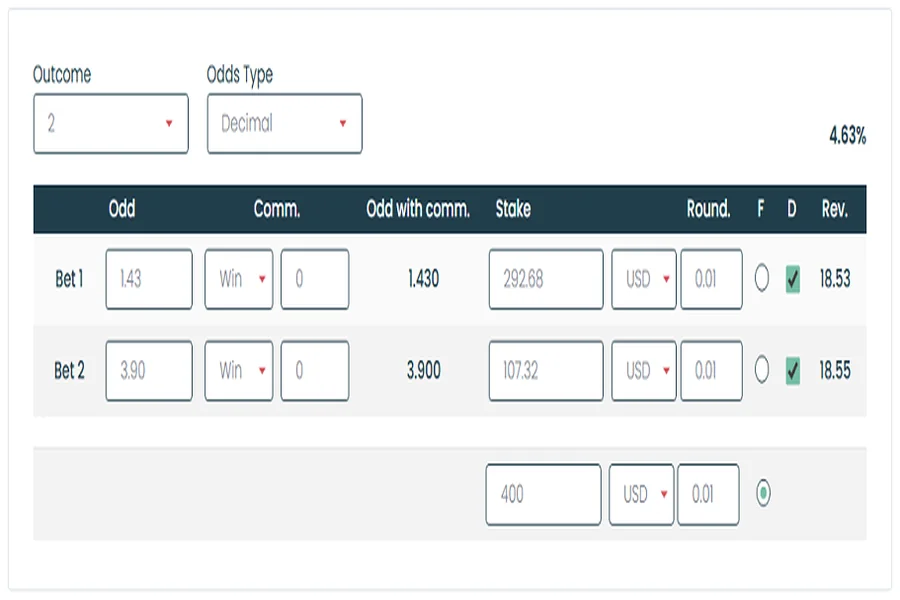
1 / 1.43 + 1 / 3.90 = 0.9557
Because the result is below 1, the combination represents an arbitrage opportunity. All these calculations can be easily made by a surebet calculator, built into some surebet services. Such services also often have a matched betting or ev calculator to help you operate with other strategies.
How to distribute the stakes
Finding an arb is only part of the process. The next step is to divide the available bankroll correctly between the two outcomes.
Assume the total amount available for the bets is $1,000.
The stake on the USA at odds of 3.90 would be:
1000 / (3.90 × 0.9557) = $268.30
The stake on China at odds of 1.43 would be:
1000 / (1.43 × 0.9557) = $731.70
Together, the two wagers use the entire $1,000 bankroll.
If the USA wins:
$268.30 × 3.90 − $1,000 = $46.33
If China wins:
$731.70 × 1.43 − $1,000 = $46.33
Therefore, both possible results produce approximately the same return.
In this example, the bettor earns a little more than 4% on the total amount invested.
How are arbitrage opportunities found?
In theory, bettors can search for surebets manually.
This would involve opening multiple bookmaker websites, comparing prices for the same events and markets, calculating implied probabilities, and identifying combinations where the total falls below 1.
The difficulty is that bookmakers continuously update their betting lines. By the time a bettor manually checks several platforms and completes the calculations, the profitable combination may already have disappeared.
For this reason, specialised arbitrage and valuebet software are commonly used to automate the search process.
These services monitor odds across many bookmakers simultaneously and identify potential surebets whenever suitable price differences appear.
Using BetBurger to search for surebets
BetBurger is a specialised platform designed to help bettors find sports arbitrage opportunities.

The service analyses odds offered by hundreds of bookmakers across dozens of sports, allowing users to identify potentially profitable combinations without comparing every betting platform manually.
One of the main advantages of using an arbitrage scanner is speed. Since profitable discrepancies between bookmakers can be short-lived, receiving updated information quickly can be important.
BetBurger also offers additional functionality intended to make the betting process more convenient.
Users can access tools for navigating directly to bookmaker websites, managing available opportunities, and calculating bets using calculators (advanced dutching calculator, surebet calculator, no-vig calculator, and others). The platform also provides educational materials explaining how sports arbitrage works, which can be particularly useful for people who are only beginning to explore this betting strategy.
Conclusion
Sports arbitrage differs from conventional betting because the primary objective is not to predict the winner of an event. Instead, the strategy focuses on finding pricing differences between bookmakers and combining their best available odds.
As the China–USA example demonstrates, when the implied probabilities of the selected outcomes add up to less than 1, it becomes possible to distribute stakes in a way that produces a positive return under either result.
Although such opportunities can be found manually, monitoring large numbers of bookmakers is time-consuming. Arbitrage scanners such as BetBurger simplify this process by automatically comparing odds and highlighting potential surebets.
For newcomers, understanding the mathematics behind arbitrage and learning how to calculate stakes correctly are important first steps before moving on to faster and more complex betting situations.