

Organize every business invoice automatically
| Important: This article provides general educational information, not individualized tax, legal, or accounting advice. Tax treatment depends on entity type, income, elections, timing, employees, and state law. Confirm any strategy with a qualified tax professional before claiming it. |
Small-business “tax loopholes” are usually not secret tricks. They are deductions, elections, credits, reimbursement structures, and timing rules written into the tax code. Used correctly, they can reduce taxable income or accelerate deductions. Used carelessly, they can create penalties, amended returns, or an expensive audit problem.
The safest approach is to treat tax planning as a documentation system. The IRS generally requires a business expense to be ordinary and necessary, and mixed personal expenses must be divided between business and personal use. Receipts, invoices, mileage logs, payroll records, written reimbursement policies, and proof of payment turn a possible deduction into a supportable one.
Quick Answer
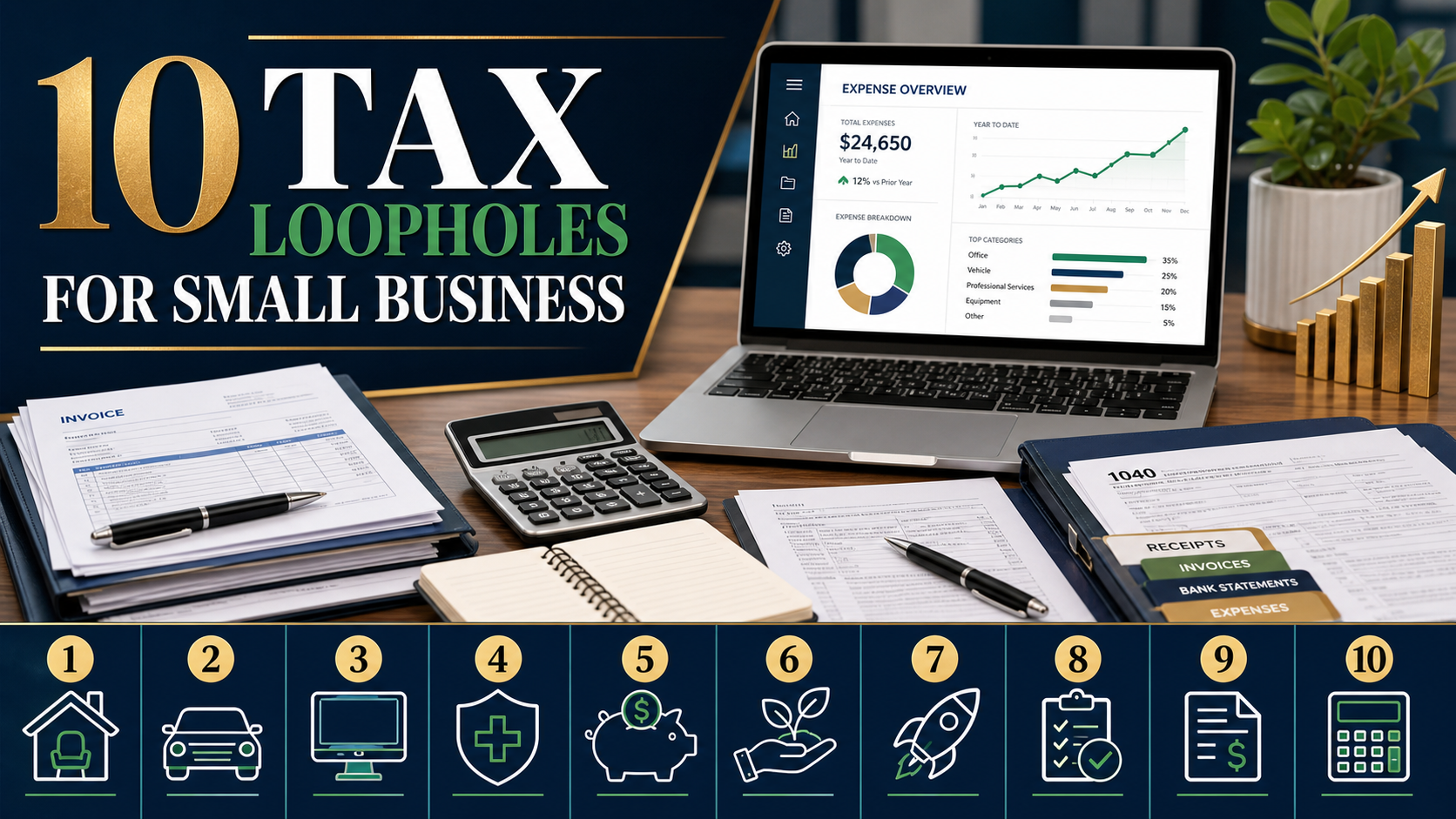
The most valuable small-business tax strategies often include capturing every ordinary business expense, claiming a qualifying home office, tracking business vehicle use, deducting eligible startup costs, using the de minimis safe harbor for smaller equipment, accelerating qualified asset deductions, funding a business retirement plan, taking the self-employed health insurance deduction, reimbursing employee-owner expenses through an accountable plan, and calculating the qualified business income deduction. Not every strategy applies to every owner.
Why Recordkeeping Comes First
A deduction is only useful when the business can substantiate it. IRS recordkeeping guidance says business books should show gross income, deductions, and credits. Supporting documents should identify the payee, amount, proof of payment, date, and a description showing the business purpose. Electronic systems are acceptable when they preserve the same information required from paper records.
Separate business and personal bank accounts make this easier. An owner who pays personal expenses from a business account does not convert those purchases into deductions. For mixed-use items such as vehicles, phones, internet service, or property, only the properly allocated business portion is generally deductible.
1. Capture Every Ordinary and Necessary Business Expense
The broadest legal “loophole” is also the most frequently missed: deducting the ordinary and necessary costs of operating the business. Ordinary means common and accepted in the trade. Necessary means helpful and appropriate, not necessarily indispensable. Common examples include software, payment-processing fees, advertising, professional services, business insurance, office supplies, web hosting, education tied to the existing business, and the business portion of communications costs.
Small deductions become meaningful when recorded consistently across a full year. The risk comes from vague categories and mixed personal spending. “Miscellaneous” is not a business purpose. Each transaction should have enough detail to show what was purchased, who was paid, and how the expense related to revenue-producing activity.
How to use it correctly
Create a chart of accounts that matches the business, reconcile it monthly, and attach invoices or receipts to transactions. Review recurring subscriptions at year-end. Canceling unused tools saves cash, while properly classifying necessary tools can prevent legitimate deductions from being overlooked.
2. Claim a Qualifying Home Office
Business owners may be able to deduct costs tied to a home office when the space is used regularly and, in most cases, exclusively for business. The home must generally be the principal place of business, although a qualifying administrative or management office can count when there is no other fixed location for those activities. Separate structures may qualify under their own rules.
Eligible taxpayers can generally compare the simplified method with the regular method. The simplified method uses a prescribed rate for qualifying square footage, up to the allowed maximum. The regular method allocates direct and indirect costs such as rent, mortgage interest, utilities, insurance, repairs, and depreciation based on business use. The better method depends on actual expenses and the effect of depreciation.
Common mistake
A kitchen table used by the family usually fails the exclusive-use test. Photograph the workspace, measure it, keep a floor plan, and document why it serves as the principal business location. Special exceptions can apply to inventory storage and qualifying daycare operations, so those businesses should review the detailed rules.
3. Choose the Right Vehicle Deduction Method
A vehicle used for business can produce a deduction through the standard mileage method or the actual-expense method, subject to eligibility and timing rules. For 2026, the IRS standard business mileage rate is 72.5 cents per mile. Actual expenses can include the business share of fuel, insurance, repairs, registration, lease costs, and depreciation.
The correct choice is not always obvious. A fuel-efficient vehicle driven many business miles may favor the standard rate. A more expensive vehicle with high operating costs may favor actual expenses. The method used in the first year can affect future options, particularly for an owned vehicle, so model both approaches before filing.
Documentation that matters
Keep a contemporaneous mileage log showing date, destination, business purpose, and miles. Commuting between home and a regular workplace is generally personal, while travel between business locations may qualify. A year-end estimate created from memory is much weaker than a consistent log supported by calendar entries and receipts.
4. Deduct Eligible Startup and Organizational Costs
Costs incurred before a business begins operations are not always immediately deductible as normal operating expenses. Federal rules generally allow an election to deduct up to $5,000 of qualifying startup costs and up to $5,000 of organizational costs, with each deduction reduced when the relevant category exceeds $50,000. Remaining qualifying costs are generally amortized over 180 months.
Startup costs can include market research, pre-opening advertising, training, travel, and professional services connected with investigating or creating an active business. Organizational costs relate to forming certain entities. Asset purchases follow different capitalization and depreciation rules, and costs associated with acquiring an existing business may require separate treatment.
Timing issue
The active-business start date matters because it determines when amortization begins. Keep pre-opening expenses in a separate ledger and document the date operations actually started. Do not mix startup costs with equipment, inventory, or personal spending.
5. Use the De Minimis Safe Harbor for Smaller Property
The tangible-property regulations include a de minimis safe harbor that can allow qualifying lower-cost items to be deducted rather than capitalized and depreciated. Businesses without an applicable financial statement may generally use a threshold of up to $2,500 per invoice or item when their books follow a consistent expense policy. Businesses with an applicable financial statement may qualify for a higher threshold of up to $5,000.
This election can simplify treatment of computers, monitors, tools, furniture, and other lower-cost property. It is not automatic. The business needs appropriate accounting treatment, must satisfy the requirements, and generally makes the election annually with a timely filed return.
Planning opportunity
Adopt a written capitalization policy at the beginning of the year and apply it consistently for book and tax purposes. Keep invoices detailed enough to identify separate items. Artificially splitting one integrated asset into pieces to fit a threshold can create problems.
6. Accelerate Equipment Deductions
Businesses purchasing qualified equipment may be able to accelerate deductions through Section 179 or bonus depreciation instead of recovering the cost over the normal depreciation schedule. For tax years beginning in 2026, the Section 179 maximum is $2.56 million, with a phaseout beginning when qualifying property placed in service exceeds $4.09 million. A separate cap applies to certain sport utility vehicles.
Current law also provides permanent 100% bonus depreciation for qualifying property acquired and placed in service after January 19, 2025. Eligibility depends on the property, acquisition date, placed-in-service date, business use, and other elections. Section 179 is also limited by taxable business income, while unused amounts may carry forward.
Do not buy equipment solely for a deduction
A deduction reduces taxable income; it does not make an unnecessary purchase free. Compare the tax benefit with cash flow, financing cost, useful life, and actual business need. Preserve purchase invoices and records showing when the asset was ready and available for use.
7. Fund a Small-Business Retirement Plan
Self-employed owners and small employers can use tax-favored retirement plans such as a SEP IRA, SIMPLE IRA, one-participant 401(k), or other qualified plan. Depending on the plan, contributions may be deductible and earnings generally grow tax-deferred. A one-participant 401(k) can allow an eligible owner to contribute in both employee and employer capacities.
The best plan depends on employees, compensation, desired contribution level, administrative cost, and timing. Owners with employees must follow eligibility, contribution, notice, nondiscrimination, filing, and operational rules. Self-employed contribution calculations are more complex than multiplying Schedule C profit by a headline percentage because net earnings require adjustments.
Additional credit opportunity
Eligible small employers may qualify for credits related to retirement-plan startup costs and automatic enrollment. Credits and contribution deductions are separate provisions, so coordinate plan setup with a benefits professional and tax adviser before deadlines pass.
8. Review the Self-Employed Health Insurance Deduction
Eligible self-employed individuals may be able to deduct premiums paid for medical, dental, vision, and qualified long-term care coverage for themselves, a spouse, and dependents. The deduction is generally claimed as an adjustment to income rather than as a Schedule C operating expense, and Form 7206 may be required to calculate it.
The deduction is subject to earned-income and coverage-eligibility rules. A person generally cannot claim it for months when eligible to participate in a subsidized employer plan, including certain plans available through a spouse. Marketplace coverage and the premium tax credit can create additional calculations.
Entity structure matters
S corporation shareholder-employees face specific payment and reporting requirements. The policy ownership, reimbursement method, and W-2 treatment can determine whether the deduction is available. Do not simply pay personal premiums from a corporate account and assume the tax treatment is correct.
9. Reimburse Owner-Employees Through an Accountable Plan
An accountable plan can allow a corporation or other employer to reimburse employees, including qualifying owner-employees, for legitimate business expenses without treating properly substantiated reimbursements as taxable wages. This can be especially useful for home-office costs, mileage, travel, supplies, and communications expenses initially paid personally.
To qualify, expenses must have a business connection, the employee must adequately account for them within a reasonable period, and excess advances must be returned. Payments that fail these tests are generally treated under a nonaccountable plan and included in wages subject to employment taxes.
Best practice
Adopt a written policy, submit regular expense reports, attach receipts and mileage logs, document business purpose, and reimburse exact substantiated amounts. An accountable plan cannot be used to relabel wages or convert personal expenses into business deductions.
10. Calculate the Qualified Business Income Deduction
Section 199A can allow eligible owners of sole proprietorships, partnerships, S corporations, and certain trusts or estates to deduct up to 20% of qualified business income. The 2025 tax legislation made the QBI deduction permanent and changed certain phase-in rules. Beginning in 2026, current law also includes a minimum deduction framework for qualifying active businesses that meet the applicable requirements.
The deduction is not simply 20% of every dollar received. W-2 wages, property, taxable income, business type, aggregation decisions, prior losses, reasonable compensation, guaranteed payments, and specified-service-business rules can limit or change the result. C corporation income and employee wages do not qualify as QBI.
Planning opportunity
Entity choice, owner compensation, retirement contributions, and health insurance deductions can interact with QBI. Run projections before year-end rather than waiting until the return is prepared. Any restructuring should have a genuine business purpose and account for payroll, state taxes, legal obligations, and administrative cost.
Tax Strategies That Are Not Loopholes
Personal expenses do not become deductible because they are paid through the company. A vehicle wrap does not automatically convert every mile into business mileage. Hiring a child does not eliminate payroll and recordkeeping rules. Calling someone an independent contractor does not override the facts of the working relationship. Creating an S corporation does not eliminate the requirement to pay reasonable compensation for services.
Aggressive advice often isolates one favorable rule while ignoring its limitations. A legitimate strategy considers the complete transaction, keeps records, follows required elections, and reports income consistently. If a tactic depends on hiding the personal benefit or using an inaccurate description, it is not responsible tax planning.
Year-End Small-Business Tax Checklist
- Reconcile bank and credit-card accounts and investigate uncategorized transactions.
- Collect missing receipts, invoices, mileage logs, and proof of payment.
- Review accounts receivable, bad debts, inventory, and prepaid expenses.
- Confirm asset purchase dates, business-use percentages, and placed-in-service dates.
- Compare retirement-plan options and contribution deadlines.
- Review owner health insurance, reimbursements, and payroll reporting.
- Project taxable income, QBI, depreciation elections, and estimated taxes.
- Ask a tax professional which federal, state, and local credits apply.
Frequently Asked Questions
Are small-business tax loopholes legal?
Deductions, credits, elections, and reimbursement rules are legal when the taxpayer satisfies the requirements and reports them accurately. Concealing income, fabricating expenses, or misclassifying personal costs is not a legitimate loophole.
What is the biggest deduction most businesses miss?
There is no universal answer, but incomplete expense records are a common problem. Home-office costs, mileage, software subscriptions, professional fees, merchant fees, retirement-plan opportunities, and owner reimbursements are often worth reviewing.
Should every business use an S corporation?
No. An S corporation can be useful in some situations, but it adds payroll, reasonable-compensation, filing, state-law, and administrative obligations. Savings should be modeled against the full cost and risk of the structure.
How long should business records be kept?
Retention periods depend on the record and tax issue. Employment tax records generally have a specific minimum period, while asset records may be needed through the ownership period and after disposition. Follow current IRS guidance and advice from the business’s tax professional.
Final Takeaway
The best tax loopholes for small business are not tricks. They are well-documented choices made before deadlines: separating business spending, tracking mixed-use assets, selecting available elections, using the right benefit and reimbursement structures, and calculating owner deductions correctly.
Start with complete books and organized invoices, then ask a qualified professional to model the strategies that fit the entity and the owner’s full tax picture. Good documentation makes tax planning repeatable, defensible, and far more valuable than a last-minute search for write-offs.