
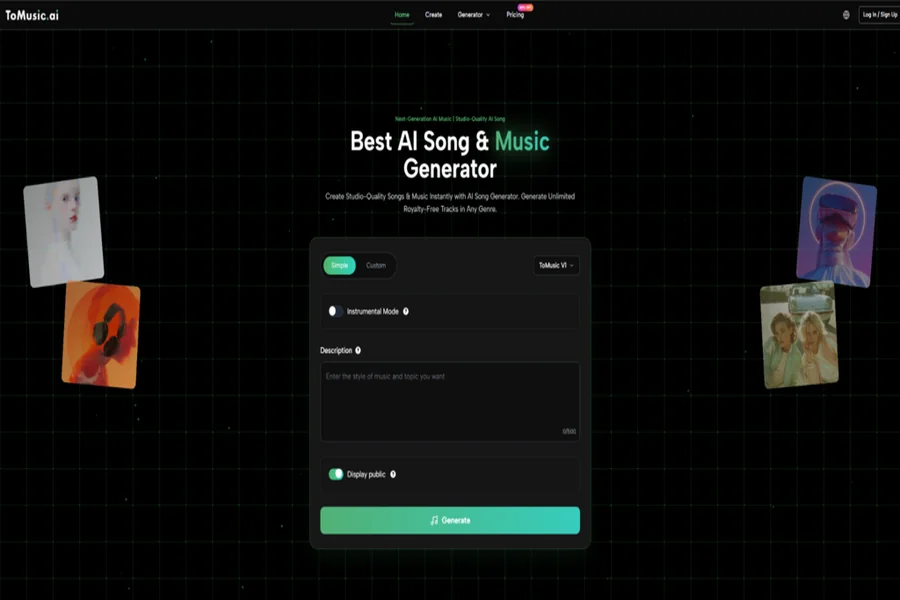

You know the feeling: you finally have a concept, but the “music part” turns into tabs, plugins, half-finished loops, and compromises. In 2026, the most useful tools are the ones that help you move from intention to usable audio fast—without pretending the craft is effortless. My most “repeatable” starting point lately has been ToMusic.ai, especially when I need an AI Music Generator that can turn plain language into something I can actually publish or iterate on.
What Changed In 2026: Speed Matters, But Control Matters More
The AI music space is no longer just about novelty. The best tools now compete on: prompt clarity, consistency across generations, export options, and whether you can take the result into a real workflow. The question is not “Can it make music?” but “Can it make music you can finish?”
A Simple Filter I Use Before I Try Any Tool
I judge AI music generators by three “creator truths”:
Truth One: You Need A Track, Not A Demo
A good generator produces audio that survives context—voiceover, montage, game ambience, brand intro.
Truth Two: Exports Are The Difference Between Play And Publish
MP3 is nice; WAV is better. Stems or vocal removal changes everything if you edit.
Truth Three: You Will Regenerate, So Iteration Must Be Cheap
If it takes too long—or feels random—you stop exploring.
Why ToMusic.ai Often Feels Like A Practical Choice
In my testing, ToMusic.ai is unusually oriented toward “finishable” output: multiple model options, longer song capability (including up to 8 minutes), WAV/MP3 downloads, and workflow-friendly features like stem extraction and vocal removal on supported plans.
Where It Still Requires Real Judgment
Results depend heavily on prompt quality, and some ideas need multiple generations to land. That’s not a flaw so much as the current reality of generative audio.
The Best AI Music Generators In 2026: A Curated Shortlist
Below is a practical shortlist of tools that consistently show up in real creator workflows:
1. ToMusic.ai: Best For Fast Drafts You Can Actually Edit
If you want quick creation plus practical exports, it’s a strong first stop—especially when you value long-form songs and post-processing options.
2. Suno: Best For “Instant Song” Moments
Great for quick full-song generations and surprising hooks. It can be magical, but you may need more rerolls to hit something specific.
3. Udio: Best For Producers Who Like Iteration
Often favored when you want a more “studio-like” feel. The tradeoff is spending more time exploring variations.
4. Soundraw: Best For Video Background Consistency
Useful when you want structured, safe background music that sits under content cleanly.
5. Mubert: Best For Functional, Royalty-Friendly Background Audio
Great for streams, apps, and continuous music needs where “fit” matters more than artistry.
6. AIVA: Best For Instrumental Composition Styles
Often chosen for cinematic and structured instrumental writing, depending on your use case.
7. Boomy: Best For Beginners Who Want Simple Publishing
Easy onboarding and fast results, though deeper control can feel limited.
A Comparison Table That Matches Real Creator Needs
| Tool (2026) | Best For | Typical Input | Output Focus | Editing Friendliness | Practical Note |
| ToMusic.ai | Finishable drafts | Text or lyrics | Songs up to long form | Strong (WAV/MP3, stems options) | Good balance of speed and export control |
| Suno | Viral-ready songs | Text prompt | Full songs fast | Medium | Expect rerolls for precision |
| Udio | Producer iteration | Text prompt | Detailed song generations | Medium | Best when you like exploring variants |
| Soundraw | Video background | Style + structure | Safe, consistent beds | Medium | Reliable under voiceover |
| Mubert | Functional music | Mood/use-case | Continuous backgrounds | Medium | Great for “always-on” music needs |
| AIVA | Instrumental structure | Style guidance | Composed instrumentals | Medium | Better for certain genres than others |
| Boomy | Beginner simplicity | Minimal input | Quick tracks | Low–Medium | Great onboarding, lighter control |
How I Actually Use These Tools Without Wasting Hours
Start With A “Use Case Prompt,” Not A Genre Prompt
Instead of “lofi hip hop,” I write: “soft rhythm, clean bass, no busy lead, supports calm narration.” That tends to generate more usable audio.
Then Lock One Variable At A Time
If a tool allows model choices or multiple generations, change one thing per reroll: tempo feel, instrumentation, vocal presence, or arrangement density.
Where Lyrics Enter The Workflow
When the project is song-first rather than background-first, I shift to a lyrics-driven workflow. ToMusic.ai is built for that too, so I often move from a vibe draft to a more intentional lyric run using Lyrics to Song after I understand the musical direction.
A Realistic Expectation For 2026 AI Music
Even the best systems can drift: vocals can surprise you, structure can get repetitive, and emotional tone sometimes misses on first pass. The advantage is speed—so you can iterate until it’s right.
A Calm Conclusion: The Best Tool Is The One You Finish With
In 2026, the “best AI music generator” is rarely the one with the most hype. It’s the one that lets you ship—clean exports, repeatable results, and enough control to match your intent. If you want a dependable starting point that supports both quick drafts and editable outputs, ToMusic.ai is worth making your first click.