
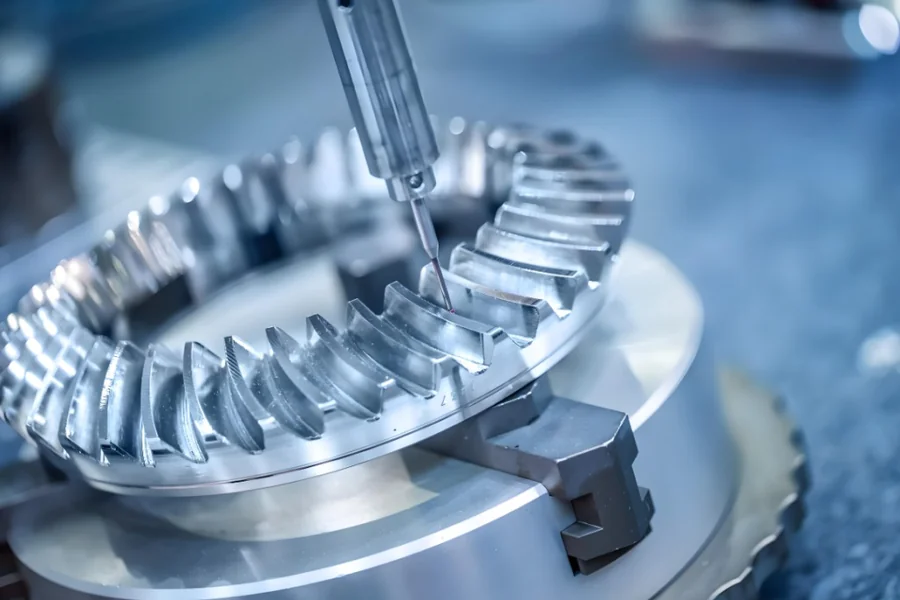

When you’re designing aerospace components, weight is more than a performance factor – it’s a mission-critical constraint. That’s why you rely on lightweight alloys like aluminum, titanium and magnesium to achieve structural integrity without burdening payload capacity. But as you’ve likely discovered, machining these materials isn’t as simple as swapping out your standard feed rates or end mills.
Lightweight alloys behave differently under stress. They conduct heat unevenly, tend to gum up tools and are often more reactive than traditional steels. If your team doesn’t approach machining with an understanding of the unique physical and chemical properties of each alloy, you could end up with warping, tolerance failures, surface defects or worse – parts that fail inspection entirely.
If you’re scaling aerospace production, launching a new prototype or trying to reduce turnaround times without compromising quality, you’ll need more than just a 5-axis CNC machine. You’ll need expertise. Learn more about aerospace CNC machining requirements and capabilities.
Why Lightweight Alloys Are Essential to Aerospace
You already know the aerospace sector pushes material science to its limits. Lightweight metals allow aircraft and spacecraft to fly farther, consume less fuel and operate at higher efficiencies. Reducing just 1 kg of mass in orbit can save thousands in fuel costs.
Aluminum alloys, especially 7075 and 6061, are prized for their strength-to-weight ratio and corrosion resistance. Titanium grades like Ti-6Al-4V offer even higher strength with superior temperature stability, essential for jet engines or heat-exposed structures. And while magnesium alloys are notoriously difficult to machine, their ultra-light profile makes them attractive for non-critical structural parts.
But the benefits come with complexity. These materials often demand tighter tolerances, special tooling and slower production cycles. Without precise planning, what you gain in performance can be lost in production costs.
Machinability Challenges: What You’re Up Against
Aluminum might sound like an “easy” alloy until you try to achieve sub-20-micron tolerances on a high-speed rotating part. Titanium, while strong, has poor thermal conductivity – causing heat to build at the tool-workpiece interface, accelerating tool wear and risking part distortion. Magnesium? It’s flammable when finely divided. Sparks on the floor are a non-starter.
Here’s what you must account for:
- Thermal expansion: Lightweight alloys expand faster than steel under heat. Without compensation, your part could be out of spec before it leaves the mill.
- Tool wear: Titanium dulls cutters fast and aluminum can stick to tools, reducing edge sharpness.
- Chip control: Soft alloys often produce long, stringy chips that clog machines and impair surface finish.
- Vibration and chatter: Lighter materials amplify vibration during high-speed operations – unless your setup is perfectly rigid.
Addressing these challenges requires machine tuning, custom fixturing, coolant optimization and often, iterative toolpath programming.
Tool Selection and Process Parameters Matter
You can’t machine aerospace alloys with generic tooling and expect consistent results. Tool geometry, coatings and material selection directly affect finish quality and tool life. Consider investing in carbide tools with DLC or TiAlN coatings, which reduce friction and improve heat resistance.
Feeds and speeds should be dialed in per material. With titanium, lower RPMs and higher feed rates help preserve tools and prevent heat buildup. For aluminum, higher RPMs with fine-tuned lubrication can avoid chip welding.
Your CAM programming must reflect the material’s behavior. Trochoidal milling strategies for hard alloys can reduce radial tool engagement and extend tool life. Controlling step-down depths and minimizing retraction also helps with thin-walled parts.
Controlling Heat: Not Just Coolant
You might be tempted to flood your parts with coolant and call it a day – but thermal control is more nuanced than that. While high-pressure coolant can evacuate chips and regulate temperature, overcooling some alloys introduces thermal shock.
For titanium, you’ll often benefit from through-tool coolant with targeted delivery. For aluminum, mist-based or cryogenic cooling might work better, especially when cutting speed is a priority.
But coolant delivery is only one piece of the puzzle. You also need to manage:
- Machine dwell time: Reducing pause durations between tool engagement avoids localized overheating.
- Part sequencing: In multi-feature parts, spreading heat-intensive operations across cycles can allow for material recovery.
- Toolpath logic: Even a 5% change in entry angle or ramp strategy can reduce thermal hotspots.
Thermal compensation inside your CNC controller can help too, but your results will only be as good as your initial process design.
Fixtures and Workholding for Thin-Walled or Delicate Parts
Lightweight alloys, especially in aerospace housings and enclosures, often involve thin-walled geometries. Without proper clamping and support, you’re at risk of part deformation, vibration or chatter that kills your tolerance targets.
Your fixturing strategy should accommodate:
- Uniform clamping pressure to prevent distortion
- Custom soft jaws or vacuum fixtures for delicate surfaces
- Indexing and multi-axis holding systems that eliminate the need for multiple re-setups
You’ll also need to validate fixture repeatability. Even a 0.001″ misalignment between setups can force you to scrap a part after multiple hours of machining.
The Certification and Traceability Piece
Aerospace isn’t just about machining quality – it’s about documented consistency. If you’re supplying flight-critical parts, you’re likely already dealing with AS9100, NADCAP or ITAR compliance. Even for non-flight applications, traceability and batch consistency are often contractually required.
Precision machining shops that understand this will offer:
- Full material lot traceability
- Tool calibration records
- SPC and first article inspection (FAI) reporting
- Controlled document revision protocols
It’s not enough to hit tolerance; you need to prove it with data. That means integrating inspection right into the process flow – whether that’s CMM scanning, in-process probing or statistical trend monitoring across batches.
Design Tips: Making Lightweight Parts Easier to Machine
Not every part needs to be as hard to machine as a jet turbine blade. If you’re working with designers upstream, a few adjustments can improve manufacturability and reduce cost:
- Avoid ultra-thin ribs or walls where possible; maintain at least 2:1 aspect ratio for rigidity.
- Minimize deep pockets unless necessary. Consider webbing to reduce material volume.
- Use standard radii where corner relief is required – tight internal corners mean custom micro tools.
- Plan for tool access. If a feature can’t be reached from a practical angle, it’s going to require multiple setups – or worse, 5-axis with micro tooling.
Working collaboratively with your machining partner can turn a complex CAD model into a manufacturable reality without compromising function.
Surface Finishes and Post-Processing
Don’t overlook surface specs. Aerospace parts often need to meet roughness average (Ra) thresholds for aerodynamics, sealing or mating components. Achieving these with lightweight alloys may require more than just a final pass.
Aluminum is prone to galling, so plan on chemical surface treatments like anodizing for added hardness and corrosion resistance. Titanium can benefit from bead blasting or tumbling, but care must be taken to avoid introducing microfractures.
Always document post-processing requirements clearly. Vague notes like “polish” or “smooth finish” aren’t enough when parts are destined for altitude.
Tapping Into Machining Expertise Early
If you wait until the prototype phase to involve your machining partner, you’re likely leaving time and money on the table. Instead, bring them in during the DFM (design for manufacturability) stage.
A precision machining shop with aerospace experience can help you:
- Identify features that might challenge tolerances
- Recommend alternative materials or treatments
- Validate design assumptions before metal is cut
- Plan production workflows that scale from prototype to low-volume production
This isn’t just a procurement issue – it’s a design advantage. Your best suppliers will act as an extension of your engineering team, helping you turn bold ideas into buildable realities.