


Competitive gaming creates too many variables for players to manage alone. Why do esports players need a coach? Because elite play is built on preparation, structure, and review. In top-level play, small edges decide matches. Side selection, timing windows, resource use, communication patterns, and adaptation between games all matter. Coaches not only overtake the main strategic leadership but also help teams find those edges before a match starts and fix them after a loss.
No doubt about this, but why has this profession become so popular in competitive gaming, where platforms look for analysts? This is actually a familiar picture from traditional sports, where coaches or retired athletes are hired as commentators and columnists. But what exactly do esports coaches bring to competitive gaming besides coaching?
The coach’s eye is the most valuable lens in esports, inside teams and in betting circles
At the highest level, the coach’s value comes from one thing: context discipline. Most people can read outcomes. Fewer can read causes. Coaches are trained to separate scoreboard truth from game truth, and that gap is where their edge sits. A clean 2-0 can hide bad spacing, unstable defaults, weak retake structure, or a draft that only worked because the opponent misread a timing window. A close loss can still reveal a team with stronger underlying habits, better information flow, and more repeatable win conditions. That difference matters inside teams, and it matters equally in esports betting.
Without a doubt, betting is a major part of esports, and many fans are drawn to this category because of the availability of various betting options. Besides, the abundance of esports betting platforms may indicate another direction for the demand for esports coaches. In fact, they may be hired as analysts, commentary writers, and so forth, to provide valuable information to the visitors of these websites.
The value comes from connecting the macro and the micro
What makes the coach’s lens so useful is that it works at several levels at once. First, there is the macro layer: patch incentives, map pool pressure, side value, role compression, objective timing, and how a team’s identity changes across formats. Then there is the micro layer: utility discipline, pathing, target selection, trade spacing, tempo control, and how players behave when the script breaks.
Public analysis often isolates one of those layers and treats it as the whole match. Coaches do the opposite. They connect layers, asking whether a draft priority actually survives contact with lane states, whether a strong map record was built against the right level of opposition, whether a high conversion rate came from system quality or from unsustainably sharp individual form.
Here is an analytical clip by an esports platform. Once you look more closely, what stands out is the level of professional perspective brought to two different games. The clip breaks down structure, decision-making, and the logic behind the action in a way that feels closer to coaching analysis than ordinary content.
That is why people with coaching-level understanding are so valued around esports betting. Serious interpretation is not about pulling a number and calling it insight. It is about building weighted context.
In modern esports, the most valuable analyst is usually the person closest to the review room. Coaches see the game as a chain of decisions, constraints, and adaptations. That view is useful to teams because it sharpens performance. It is useful in esports betting because it sharpens probability. And it is useful in media because it turns complexity into something precise and worth listening to.
The wider business around competition now rewards analytical depth
As competitive gaming has grown, analytical skill has become more valuable.
Teams still need people who can review matches and prepare players. But that same skill now matters in other areas too, such as:
- event coverage,
- creator content,
- audience education,
- and brand strategy.
As the market gets bigger, people who can explain performance clearly become more important. They help teams, viewers, and brands understand what is really happening in the game.
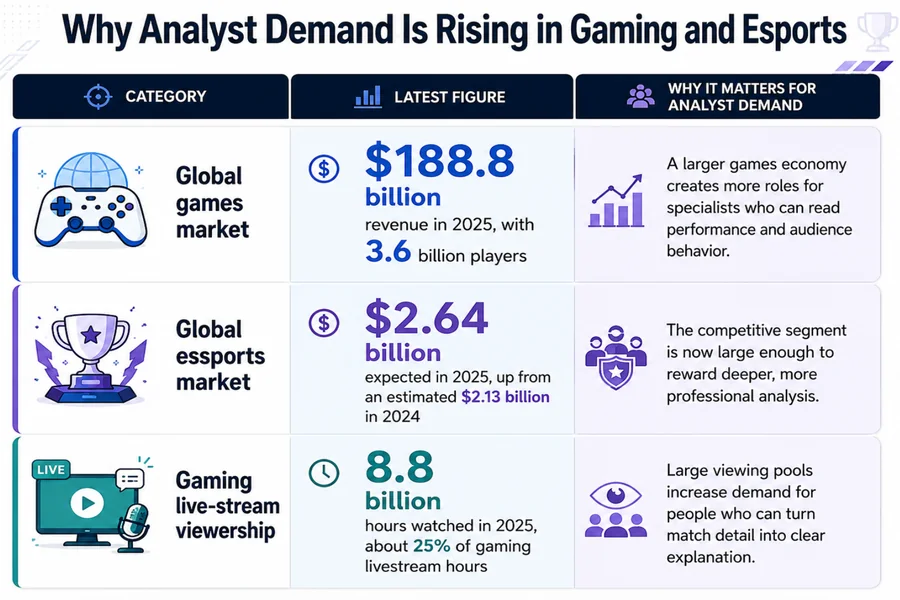
What matters here is the overlap between competition, media, and audience behavior. Analytical talent now has several paths to relevance. A coach can help a team prepare for a patch, help a broadcast desk explain a draft, help a creator turn VOD review into strong educational content, and help commercial teams understand which stories actually hold viewer attention. That range makes coaching knowledge more portable than before.
Broadcasts and creator media now need the same habits coaches already use
Esports coverage has become too large for shallow commentary to carry it. Esports Charts reported 3.3 billion hours watched for live esports content in 2025, excluding mainland China. That amount of viewing creates constant demand for people who can explain turning points, draft priorities, and small decisions before they look obvious in replay. In a 2024 ACM paper on esports narratives, the authors wrote, “Data analytics is commonly used to enable storytelling and enhance esport coverage.”
YouTube Gaming, where esports has a significant share of viewership, is driven mainly by viewers in their 20s, with a strong male majority, which makes it a large and focused audience for esports content. This demand explains why platforms want coaches and other deep game experts who can turn complex matches into clear analysis for the people watching most closely.
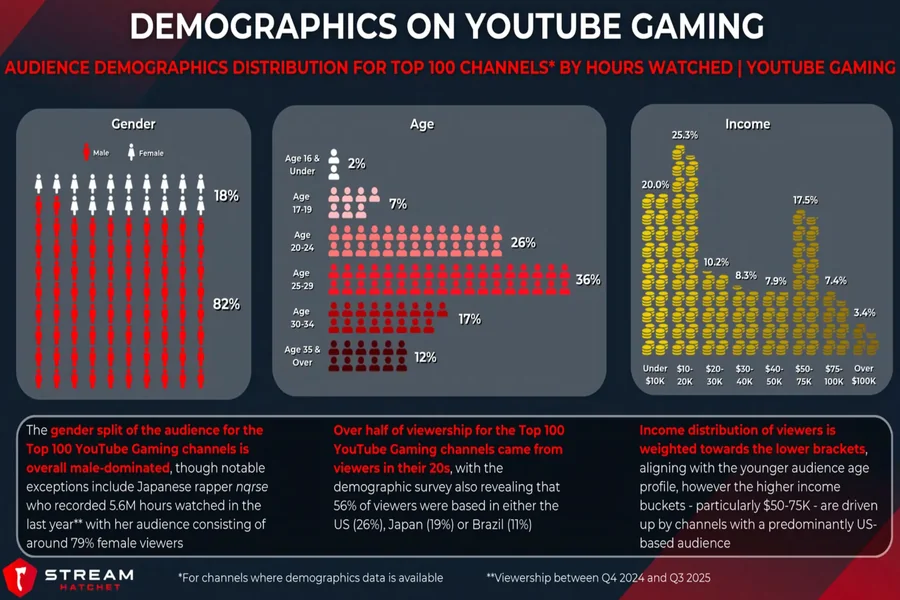
Analysis is no longer only an internal team function. It shapes how broadcasts keep viewers engaged, how fans learn a game, and how creator-led media builds trust. The best public analysts do more than react. They show why a lane setup failed, why a utility cycle opened space, or why a slower round created the winning condition.
Coaches already work this way. They build explanations from evidence, not instinct alone. They are used to defending a read, adjusting when the patch changes, and speaking in a way players can use. That makes them valuable on camera and in long-form commentary. As esports keeps growing, those habits make coaches some of the clearest fits for analyst roles across the whole ecosystem.
Coaches are in demand because they explain the game at the level where wins are made. In modern esports, that is the kind of analysis people keep coming back for.