
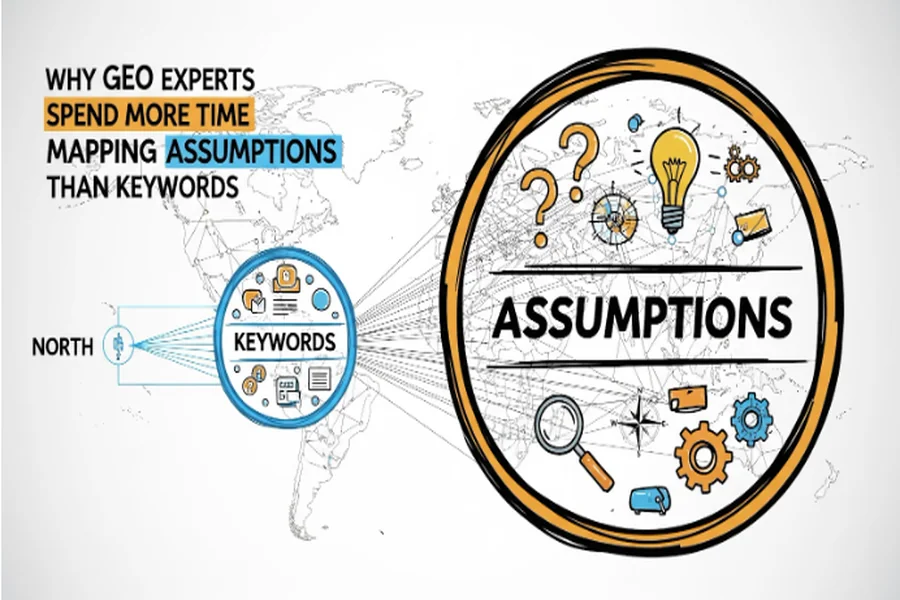

Keyword research still dominates most SEO workflows. Spreadsheets fill with search volumes, difficulty scores, and long lists of phrases competing for attention.
Yet many pages built this way struggle to rank or convert. Traffic arrives without engagement. Rankings fluctuate despite optimization. Content answers questions nobody was truly asking.
This disconnect explains why GEO Experts are shifting their focus away from keywords themselves and toward something less visible but far more predictive: user assumptions.
Search behavior is not driven solely by words. It is shaped by beliefs, expectations, fears, and shortcuts people carry before they ever type a query. GEO, or Google Entity Optimization, treats those assumptions as the real starting point of search strategy.
Keywords describe language. Assumptions explain intent.
GEO vs. Traditional SEO: A Different Starting Point
Traditional SEO begins with measurable demand. Tools surface keywords based on volume and competition, and content is created to match those phrases as closely as possible.
GEO approaches the problem differently. Instead of asking, “What are people searching?” it asks, “What do people already believe when they search?”
That distinction changes everything.
Traditional SEO typically focuses on:
- ranking for large keyword sets
- optimizing exact phrasing
- scaling pages around variations of similar queries
GEO focuses on:
- entity relationships within topics
- mental models behind searches
- gaps between what users assume and what the content explains
Google’s evolution toward entity understanding, reinforced through systems like BERT and MUM, rewards contextual completeness rather than keyword repetition. Pages succeed when they resolve uncertainty, not when they repeat phrases.
As a result, GEO Experts spend less time expanding keyword lists and more time understanding how users interpret a topic before clicking.
Why Keyword Research Alone Misses Intent
Keyword tools measure popularity, not motivation.
A search such as “best running shoes” appears straightforward. Volume is high, competition predictable. Yet the query hides multiple assumptions:
- injury prevention concerns
- budget expectations
- performance goals
- confusion about technical terminology
Traditional keyword research groups these motivations together. Search engines do not.
Content optimized purely for volume often fails because it addresses the surface request while ignoring the underlying belief driving it.
This is why many high-volume pages attract impressions but low engagement. They match wording without matching reasoning.
GEO Experts treat keyword data as directional, not definitive.
What Search Assumptions Actually Are
Search assumptions are unstated beliefs influencing a query.
A user searching for “keto meal plan” may assume rapid weight loss. Someone searching for “VPN speed” may assume all VPNs have significantly slower connections. These expectations shape how results are evaluated long before reading begins.
Assumptions operate at multiple levels:
- Surface assumptions: obvious expectations inferred from query wording
- Contextual assumptions: needs implied by situation or experience
- Core assumptions: fears or biases guiding decision-making
Content that addresses only the surface layer competes on keywords. Content that resolves deeper assumptions earns trust signals that Google increasingly prioritizes.
This explains why shorter, clearer pages sometimes outperform longer keyword-heavy guides. They answer the real question hidden beneath the query.
The GEO Workflow: From Query to Understanding
Assumption mapping follows a structured progression, even if it looks less mechanical than keyword research.
GEO Experts typically move through four stages:
- Entity extraction — identifying concepts connected to the topic
- Assumption discovery — analyzing forums, PAA results, and discussion platforms
- Intent validation — confirming patterns through SERP behavior
- Content alignment — building pages that resolve uncertainty, not just describe topics
Instead of producing dozens of loosely related articles, GEO builds interconnected topic clusters shaped by shared assumptions.
The result is topical authority that grows organically rather than solely through scale.
At NetReputation, this approach often reveals why certain reputation-related queries underperform despite strong keyword targeting. Users searching reputation services are rarely comparing features first; they are trying to confirm whether a problem is fixable at all. Content succeeds only when that assumption is addressed directly.
Mapping Mental Models Changes Content Outcomes
Assumption mapping exposes patterns invisible in keyword reports.
Forum discussions, review threads, and Q&A platforms reveal how people actually think about problems. GEO Experts analyze these environments because users speak without the benefit of optimization filters.
Common discovery methods include:
- clustering People Also Ask questions into intent themes
- analyzing recurring misconceptions across Reddit or Quora discussions
- identifying emotional language tied to decision-making
- mapping entity relationships across competing pages
These signals reveal gaps between what content creators publish and what audiences need clarified.
When those gaps close, engagement metrics shift quickly. Dwell time increases. Bounce rates stabilize. Featured snippets appear more frequently because answers align with conversational intent.
Why Assumption Mapping Produces Better ROI
Keyword-driven strategies distribute effort widely across hundreds or thousands of phrases. Each page competes independently.
Assumption-driven GEO concentrates effort around fewer, higher-impact angles.
The difference shows in outcomes:
- stronger topical authority from interconnected content
- higher engagement because intent matches expectations
- reduced keyword cannibalization
- faster ranking stability
GEO Experts invest more time upfront in understanding assumptions because corrections later cost far more. Content built on shallow intent often requires repeated rewrites, while assumption-driven content compounds value over time.
The investment shifts from quantity toward accuracy.
Real-World Impact of Assumption-First GEO
Organizations applying GEO strategies often see improvements not from publishing more content, but from reframing existing topics.
Examples commonly include:
- financial sites reframing credit card comparisons around risk assumptions rather than reward categories
- health publishers addressing myths directly instead of repeating general advice
- ecommerce brands challenging pricing assumptions that block conversions
- reputation management firms explaining outcome expectations before service details
NetReputation’s content strategy often prioritizes clarifying assumptions, especially around sensitive reputation issues. Users often search cautiously, unsure whether solutions exist or whether the situation is permanent. Content that acknowledges uncertainty earns trust faster than pages optimized solely around service keywords.
Search visibility improves because clarity aligns with user evaluation behavior.
The Shift Toward Assumption-First Search
Search engines increasingly evaluate completeness instead of keyword density. Passage indexing rewards sections that resolve specific concerns. Voice search favors conversational clarity. AI-driven results prioritize contextual accuracy.
These changes reinforce the GEO philosophy.
GEO Experts are not abandoning keywords entirely. Keywords still signal entry points. But they no longer define strategy.
Assumptions do.
Future search optimization increasingly depends on understanding:
- what users believe before searching
- what uncertainty prevents action
- what explanation changes confidence
Content that answers those questions is resilient across algorithm updates because it mirrors human reasoning rather than platform mechanics.
Why GEO Experts Spend More Time Mapping Assumptions Than Keywords
Keywords describe language patterns. Assumptions reveal decision patterns.
One predicts searches. The other predicts outcomes.
GEO Experts focus on assumptions because search engines now evaluate meaning, context, and trust together. Pages succeed when they resolve confusion, not when they repeat terminology.
The shift may look subtle from the outside. Fewer keyword spreadsheets. More research into conversations and behaviors. Less emphasis on ranking for everything, more emphasis on being understood correctly.
But the results explain the change.
When assumptions are mapped correctly, keywords begin working on their own.