
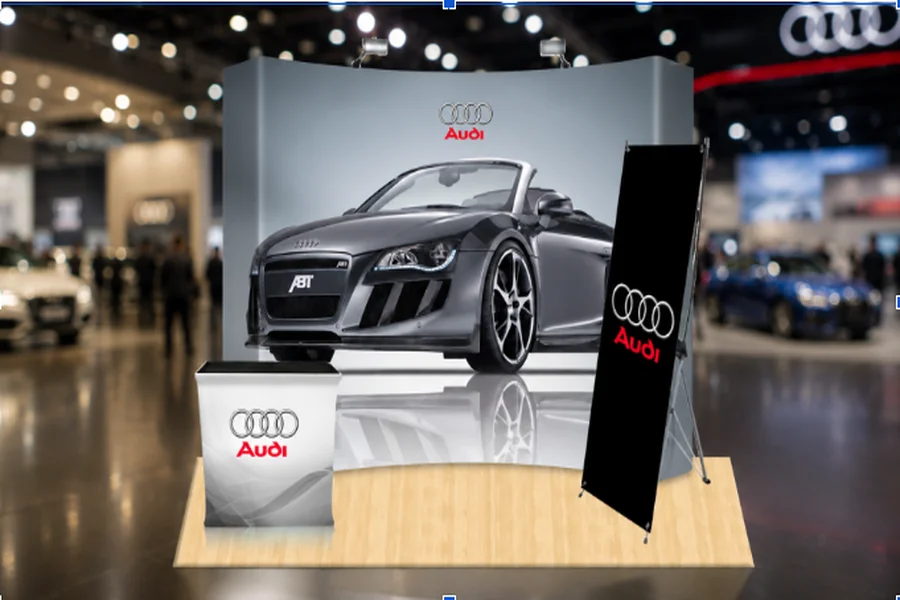

Trade Show Booth Printing Services
Searching for trade show booth printing services near you is a reasonable starting point, but it is worth understanding what that search is actually trying to solve before committing to the nearest option. The question underneath the search is almost always about timing and reliability. You need materials that look professional, arrive before the show opens, and hold up through multiple days of use. Location is one way to manage those variables. It is not the only way, and for most exhibitors, it is not the primary factor.
When Local Printing Services Actually Make Sense
There are specific circumstances where working with a local printer adds genuine value over ordering online.
The first is last-minute correction. When a graphic error is identified after approval, or a panel arrives with a color shift that needs addressing before the show opens, a local printer who can reprint and have the replacement ready for pickup the same day resolves the problem in hours rather than days. For exhibitors at the Javits Center in New York, the MTCC in Toronto, or the BCEC in Boston, having a printer within the same city as the venue removes the freight risk entirely.
The second is in-person proofing. For first-time exhibitors or businesses with complex graphic setups, reviewing a physical proof at the print facility before full production begins catches alignment and color issues that digital proofs sometimes miss. A local relationship makes that possible without adding shipping time to the proofing cycle.
The third is same-day or next-day turnaround on qualifying products. Retractable banners, table covers, and smaller print pieces can often be produced locally within 24 to 48 hours. For exhibitors who need supplementary materials quickly, local printing beats any online shipping window.
What Online Ordering Covers That Local Often Cannot
For the core display system, including the tent canopy, backdrop, and sidewalls, online specialist suppliers have significant advantages over local general print shops.
Commercial-grade event displays require specific hardware, specific fabric substrates, and production processes calibrated for large-format outdoor printing. Most local commercial print shops do not carry event-grade aluminum frame hardware, do not stock the 500D to 600D denier polyester fabrics used in professional canopy production, and do not have the production infrastructure for full-canopy dye-sublimation printing at the denier weights that hold up outdoors.
A custom canopy with a commercial-grade frame is not something a local sign shop can produce. The frame hardware is manufactured separately from the fabric, assembled and tested together, and shipped as a complete system. That supply chain exists in specialist suppliers, not general local print operations
For the full display system, the choice is not really local vs online. It is a general print vs event display specialist, and that distinction is more than geography.1
File Preparation: Where Most Printing Problems Start
Whether working with a local printer or an online supplier, graphic file quality is the most common source of production delays and quality problems.
Trade show display printing operates at large format, where file resolution requirements are different from standard commercial printing. A logo file pulled from a website at 72 DPI that looks sharp on a laptop screen will print blurry at banner stand or canopy scale.
Vector files for all typography and logos, with raster images submitted at a minimum of 150 DPI at display size, are the baseline requirement for professional print output. Most suppliers also require images in CMYK color mode rather than RGB, because screen colors and printed colors are produced through different processes, and an RGB file approved on screen will often print with shifted colors on fabric.
Catching these issues before production begins is the job of the proof approval step. A supplier who moves to production without a proof approval process is a risk, regardless of how competitive their pricing looks.
Lead Times and the Show Deadline Reality
Most trade show booth printing services operate on a 7 to 10 business day standard production window for custom canopies and display systems. Rush options at 24 to 48 hours are available at most specialist suppliers and carry a pricing premium.
The show deadline is not the event date. It is the advance warehouse deadline, which most major convention venues publish months in advance. Materials must arrive at the advance warehouse by a specific cutoff date for guaranteed handling and placement before the show floor opens. Missing that deadline means materials go through the show warehouse at a higher handling rate, are often delivered late to the booth space, and sometimes miss the first day of setup entirely.
Building the order timeline backward from the advance warehouse deadline, rather than from the event open date, is the correct approach. Most exhibitors who encounter printing problems at shows ordered against the event date and discovered the advance warehouse deadline too late.
Choosing the Right Printing Partner
Custom tents and full booth printing systems ordered through specialist event display suppliers come with the production infrastructure, material specifications, and logistics coordination that general local printers cannot match for large-format event display work.
The evaluation criteria for any printing partner come down to four things. Production quality backed by commercial-grade materials and dye-sublimation printing for canopy and fabric components. Clear lead times stated upfront, not estimated at order. A proof approval process that confirms every graphic before production begins. And a track record with event-specific logistics, including advance warehouse shipping and rush turnaround when deadlines are tight.
Local printers serve an important role in the event toolkit, particularly for supplementary materials and last-minute corrections. For the core display system that represents the brand in front of hundreds or thousands of event attendees, the specialist supplier with event-grade production capability is the right choice regardless of where they are located.