

Language learners often reach a point where textbooks feel too controlled. Real-world PDFs—magazines, reports, newsletters, essays and professional guides—offer richer vocabulary and more natural sentence patterns. They also contain idioms, cultural references and implied meanings that rarely appear in beginner exercises.
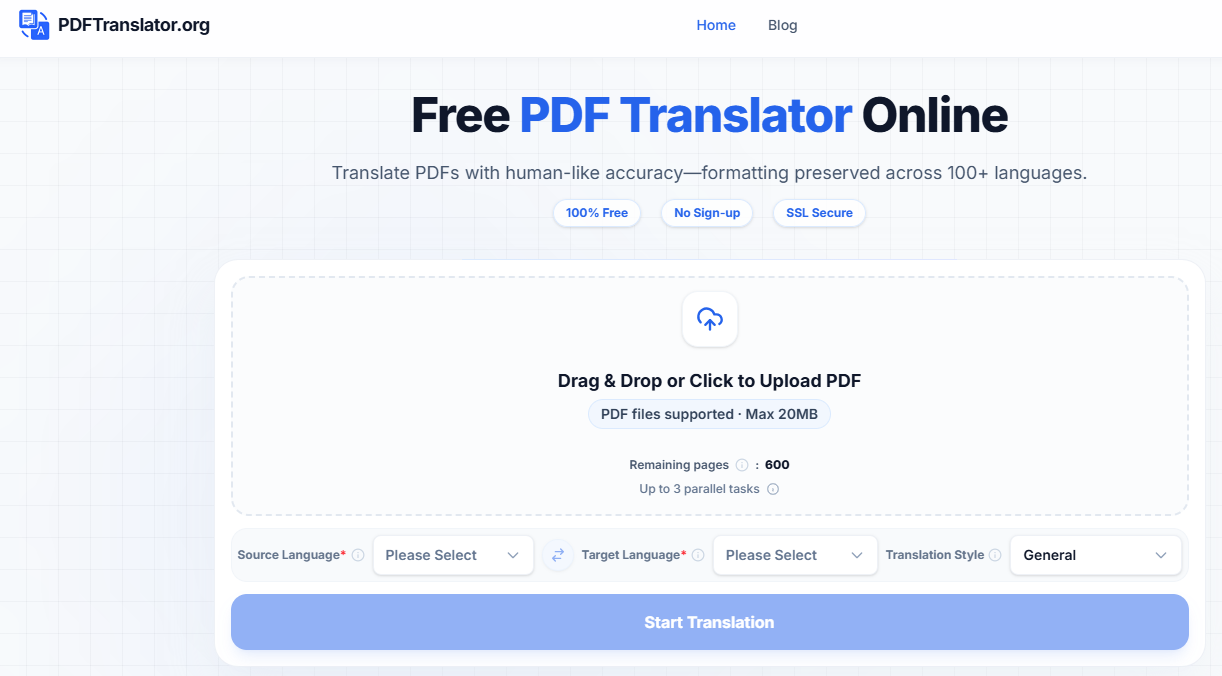
A PDF translation tool can make these materials more accessible while retaining much of the original document structure. PDFTranslator.org processes complete text-based PDFs and attempts to preserve headings, tables, images, fonts and the general page layout, making side-by-side comparison easier.
Learners can use the translated version to screen unfamiliar material before committing to a close reading. PDFTranslator.org supports more than 100 languages, accepts files up to 20MB and provides up to 1,000 free pages per calendar month without requiring registration or a credit card.
Why Foreign-Language PDFs Are Useful Learning Materials
Authentic documents show how language works outside lessons and vocabulary lists. Readers see how ideas are introduced, connected and qualified across complete paragraphs.
They Show Vocabulary in Real Context
A dictionary can define a word, but a document shows what tends to appear around it. Learners can observe common prepositions, verb patterns and adjective-noun combinations.
For example, learning the word “agreement” becomes more useful when a report also shows phrases such as “reach an agreement,” “under the agreement” and “mutual agreement.” These combinations help learners produce language that sounds natural.
They Expose Learners to Different Registers
A travel brochure, academic article and company report may discuss similar subjects using very different language. Reading across formats helps learners recognise whether an expression is conversational, formal, technical or persuasive.
This matters when deciding whether a phrase belongs in an email, essay, presentation or casual conversation.
They Include Cultural and Figurative Language
Authentic writing often contains metaphors, references and idioms whose meanings extend beyond their individual words. A literal translation may communicate the surface meaning while missing the tone or cultural association.
These moments are valuable learning opportunities. They encourage readers to examine the surrounding situation and ask why the writer selected that particular expression.
Build a Context-Based PDF Reading Routine
Translation works best when it supports careful reading. A simple routine can help learners use the translated document without becoming dependent on it.
Preview the Original Document
Before opening the translation, spend a few minutes with the original PDF. Look at:
- The title and subtitle
- Headings and subheadings
- Images and captions
- Repeated words
- Names and places
- Tables or diagrams
- Opening and closing paragraphs
Use these clues to predict the subject and purpose. This creates a mental framework for the text and makes later vocabulary easier to place.
Confirm That the PDF Contains Selectable Text
Try highlighting a sentence or searching for a word. PDFTranslator.org currently supports PDFs with selectable text. It does not provide OCR or directly translate scanned and image-only files.
A scanned document needs to be converted into a searchable PDF through a separate OCR process before translation. Learners should also check that the pages are complete, correctly ordered and readable.
Compare the Translation With the Source
Keep both versions open. Read a short section in the target language, check the translation and then return to the original.
Pay attention to:
- Paragraph order
- Heading structure
- Table labels
- Image captions
- Repeated terminology
- Sentence boundaries
- Pronouns and their references
- Words omitted or added for clarity
The comparison often reveals patterns that disappear when a translated text is read by itself.
Pay Special Attention to Idioms and Fixed Expressions
Idioms create one of the hardest challenges in cross-language reading. Their meanings depend on context, register and cultural knowledge.
Separate Literal and Figurative Meaning
When an expression sounds strange, write down its literal meaning first. Then examine what is happening in the paragraph.
If a business article says a company “weathered the storm,” the sentence probably concerns surviving a difficult period rather than experiencing severe weather. The surrounding details help reveal the figurative meaning.
Check Register and Tone
Two phrases can communicate a similar idea while carrying different levels of formality. “Get the ball rolling” may work in conversation or an informal meeting, while “initiate the process” fits more formal writing.
Record where the expression appeared and who the intended reader seems to be. This information is often as important as the basic definition.
Record the Whole Expression
Save idioms and collocations as complete units. A useful record might include:
- Original expression
- Literal meaning
- Contextual meaning
- Natural equivalent in your language
- Level of formality
- Original example sentence
- A new sentence you created
Recording only one unfamiliar word can hide the pattern that gives the phrase its meaning.
Turn Translated Reading Into Active Practice
After learners translate a PDF online, the resulting document can become the starting point for active language practice. Reading becomes more effective when they retrieve, reorganise and use the expressions they have encountered.
Create a Personal Phrase Bank
Choose a small number of expressions from each document. Five useful phrases reviewed repeatedly will usually provide more value than fifty items copied once.
Group them by topic or function, such as:
- Expressing agreement
- Describing change
- Explaining causes
- Showing uncertainty
- Comparing ideas
- Introducing examples
This organisation makes the phrases easier to retrieve during writing or conversation.
Summarise Without Looking at the Translation
After reading a section, close the translated version and explain the main idea in your own words. The summary can be written or spoken.
Return to the source afterward and check whether you missed an important qualification, misunderstood a relationship or relied too heavily on familiar vocabulary.
Write Original Sentences
Create a new sentence for each useful expression. Change the subject, setting or tense so that you have to understand the pattern rather than copy it.
If possible, ask a fluent speaker, teacher or reliable language reference to check expressions that you plan to use actively. This is especially helpful for idioms, where technically correct wording can still sound unnatural in the wrong situation.
Use PDFTranslator.org Within Its Limits
Understanding the tool’s boundaries helps learners build a more reliable reading process.
Review Important Meanings
A translated PDF can support comprehension and vocabulary discovery. It cannot confirm by itself that every idiom, technical term or cultural reference has been interpreted correctly.
Review expressions that affect the central meaning of the document. For academic, legal, medical or technical material, consult appropriate subject references or qualified readers before relying on critical information.
Use the Free Allowance Selectively
PDFTranslator.org provides up to 600 free pages per calendar month. Learners can make better use of this allowance by:
- Removing blank pages
- Translating relevant chapters first
- Avoiding duplicate versions
- Screening introductions before full documents
- Dividing large files by topic
- Saving completed translations locally
This approach also prevents a reading folder from filling with documents that never receive meaningful attention.
Protect Sensitive Information
PDFTranslator.org states that it uses SSL-secured processing and automatically deletes uploaded files within 24 hours. Learners still need to follow copyright rules, workplace policies, institutional requirements and confidentiality agreements.
Personal records, restricted course materials, unpublished research and confidential business documents may require an approved internal process.
Keep the Source and Translation Together
Clear file management makes review easier and reduces confusion.
Use Descriptive File Names
A simple naming pattern can show the subject, language and document type:
- Climate_Report_FR_Source.pdf
- Climate_Report_EN_Translation.pdf
- Climate_Report_Phrase_Notes.docx
This makes the relationship between the files immediately visible.
Retain Page References
When adding a phrase to your notes, record the original page number. You can then return to the complete paragraph when reviewing its meaning or usage.
Context is especially important for idioms because the same expression may carry a different tone in another situation.
Frequently Asked Questions
Can PDFTranslator.org Translate Scanned PDFs?
PDFTranslator.org currently supports text-based PDFs with selectable text. It does not provide OCR for scans, photographs or image-only PDFs. These files require a separate OCR process first.
Should Language Learners Trust Translated Idioms?
Translated idioms should be checked against the original context and a reliable language reference. Consider the speaker, audience, tone and purpose before adding an expression to your active vocabulary.
How Many Pages Can Be Translated for Free?
PDFTranslator.org provides up to 600 free pages per calendar month. It does not require registration, a credit card or a paid subscription.
Should Learners Read the Translation First?
Previewing the original document first encourages prediction and close observation. The translation can then clarify difficult passages and help confirm the overall meaning.
Turn Translation Into Language Practice
Foreign-language PDFs can introduce learners to vocabulary, sentence patterns and cultural expressions that structured lessons may overlook. PDFTranslator.org helps make these documents easier to approach while keeping their visual structure available for comparison.
The learning happens through the work that follows: checking the source, investigating idioms, recording useful phrases, recalling the main ideas and applying new language in original sentences. With that routine, translated PDFs become active study materials rather than files that are read once and forgotten.