
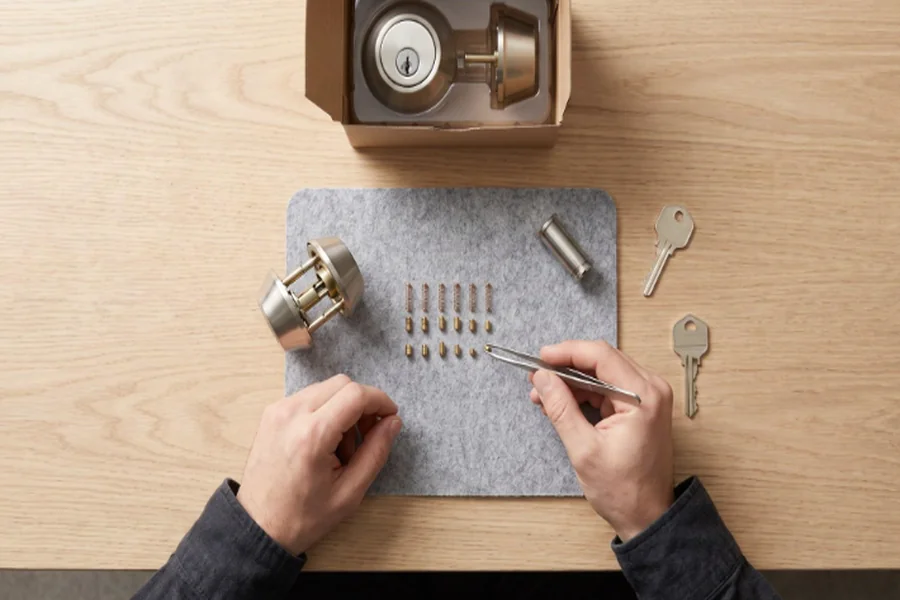

Some pairs of words survive side by side for decades without anyone quite pinning down the difference. Rekey and replace are one of them. They get used interchangeably in conversation, in listings, and in the note a real estate agent hands over at closing. They describe two entirely different jobs, at two very different prices, and the confusion has a predictable cost.
The distinction is worth ten minutes, because almost every household faces the question at least once: after a move, after a break-up, after a contractor finishes, after a set of keys goes missing.
What Each Word Actually Means
To replace a lock is to remove the entire device from the door and install a new one: new cylinder, new bolt, new exterior and interior trim, new keys. To rekey is to keep the lock exactly where it is and change only what is inside the cylinder.
That interior is simpler than most people expect. A standard pin tumbler cylinder contains a short stack of small brass pins in each of five or six chambers. The cut of a key lifts each stack to a precise height, and when every stack aligns at the same shear line the plug turns. Rekeying means swapping those bottom pins for a set of different lengths, so a new key alignment works and the old one no longer does. The lock is unchanged. Its combination is not.
Why the Mix-Up Costs Money
The confusion runs in both directions. One household replaces every exterior lock after buying a house, spending several hundred dollars on hardware that was perfectly good, when rekeying all of them to a single new key would have cost a fraction of that and taken an hour. The trade-offs at the point of moving in are laid out in detail here for anyone facing that exact decision.
Another household does the opposite. It asks for a rekey on a thirty-year-old lock with a worn cylinder and a bolt that already sticks, gets exactly what it asked for, and is unhappy three months later when the lock fails in a way rekeying was never going to prevent. A Palm Coast, Florida locksmith asked to quote either job will usually start by asking which problem is actually being solved: control over who holds a working key, or the condition of the hardware itself. Those are different questions.
A Simple Way to Choose
Rekeying is the right call when the hardware is sound and the concern is access. New house, previous owner’s keys unaccounted for. A tenant moving out. A cleaner, a dog walker or a builder who held a key for a while. A key lost somewhere in town. In all of those, the lock is not the issue. The number of working copies is.
Replacement is the right call when the hardware itself is the problem. A cylinder that has to be jiggled. A bolt that no longer throws its full length. Corrosion at the fixings. A lock several grades below what the door warrants. Or a deliberate upgrade: moving to a keypad, adding a smart deadbolt, bringing a back door up to the standard of the front.
The Option Most People Don’t Know to Ask For
There is a third answer that suits the majority of homes and rarely gets offered because nobody knows the word for it. Several separate locks can be rekeyed to a single matching key, covering the front door, the back door, the garage side door and the gate, so one key opens all of them without replacing a single unit.
For a household currently carrying four keys on one ring, that is a meaningful daily improvement for less than the cost of one new lock. Installers such as Lockey Locksmith LLC will normally price it as one visit rather than four, since the cylinders come out together and go back together.
Two words, one letter of difference in how casually they are used, and a real gap between them. Knowing which one to ask for is the whole saving.