
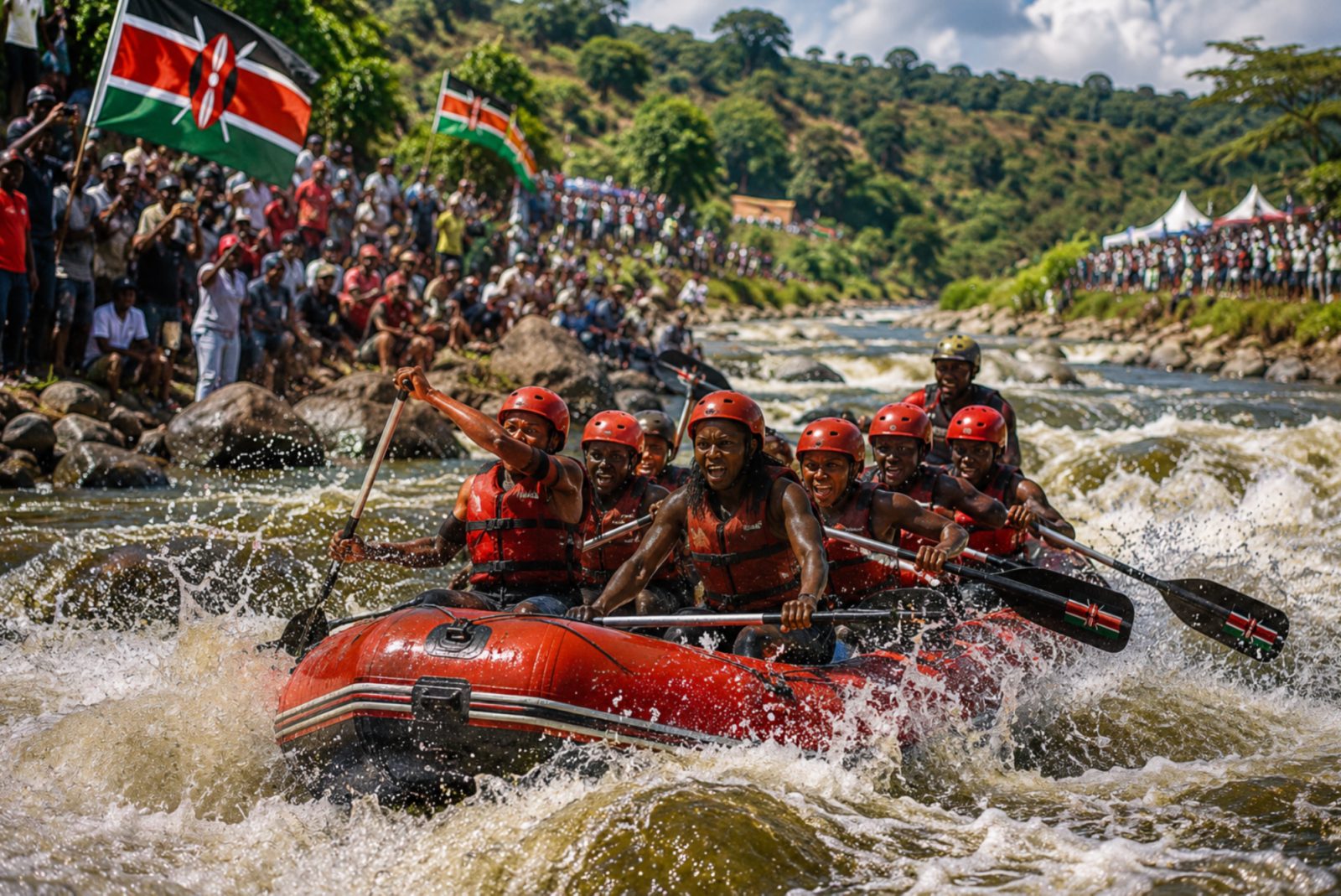

For three days straight, its raging waters were carved by rafts from 18 countries around the world. 35 teams. Hundreds of athletes. Thousands of spectators on the riverbanks. And the Kenyan women swept up almost all the medals – gold and bronze across multiple categories.
I stood on the bridge, watching as another eight-person raft plunged into a rapid. The water churned, paddles flashed, the captain’s shouts cut through the roar of the river. Beside me, a crowd of locals who were seeing something like this for the first time. Some filmed on their phones, others just stared with their mouths open. And some were already discussing the results in fan chats and on platforms like 888 starz casino – this tournament became the weekend’s main talking point.
And this is only the beginning.
How Kenya Secured the World Cup
The story began last year. The Kenya Rafting Federation submitted a bid to host a World Cup stage. The competition was fierce – New Zealand, Chile, and Indonesia were also in the running. But the International Rafting Federation chose Kenya.
Why? The Sagana River is one of the few in Africa that meets world‑class competition standards. Its rapids are rated from Class III to V on the international scale. That’s serious. Professionals call such routes “extreme.”
And so, from 10 to 13 July 2026, Sagana became the centre of world rafting.
The Kenyan Women Left No Chance
The Kenya women’s rafting team is a story of its own. They didn’t just participate – they dominated.
In the sprint discipline, the Kenyans took gold, leaving teams from the USA and Australia behind. In the slalom – another gold. In the long-distance race – bronze, losing only to New Zealand and Canada.
The tally: two golds, one bronze. Plus team silver in the overall standings.
Team captain Samantha Achienge said simply after the finish: “We’ve been preparing for two years. Every day – the river, the paddles, the cold water. We knew we could win. But to do it at home – in front of our own people – it’s indescribable.”
Her team had trained on the very same Sagana. They knew every rock, every bend. That’s what gave them the edge.
What Is Rafting and Why Is It So Hard?
For those who’ve never sat in a raft, let me explain.
Rafting is navigating a mountain river in an inflatable boat. Eight people. Paddles. A captain shouting commands. And a river trying to flip you over.
Difficulty categories:
- I–II – calm water, for beginners
- III – medium waves, simple manoeuvres
- IV – powerful rapids, requires experience
- V – extreme, high risk of capsizing
- VI – nearly impassable, only for the fearless
On the Sagana, athletes tackled Class IV and V rapids. That means three‑metre waves, sharp rocks, and currents of up to 20 km/h.
One mistake – and the boat flips. Then comes the hardest part: getting out of the water, avoiding the rocks, and swimming to shore.
On the first day of competition, three rafts capsized. Everyone was rescued. But the adrenaline was off the charts.
The Crowd Surprised the Organisers
The organisers expected two to three thousand spectators. More than ten thousand showed up.
People came from Nairobi (two hours by matatu), from Nyeri, from Nakuru. Some pitched tents right on the riverbank. Locals sold nyama choma and cold yoghurt drinks. It was loud, dusty, and incredibly atmospheric.
“We didn’t expect this kind of excitement,” admitted Kenya Rafting Federation president David Ochieng. “This is our first international tournament of this level, and people came. It means rafting in Kenya can live and grow.”
What This Means for Kenya
First, tourism. Teams from 18 countries brought coaches, doctors, managers, and journalists. Hotels in Murang’a were fully booked. Local restaurants earned more over the weekend than in a month.
Second, image. Kenya has long been associated with running and football. Now there’s another item on the list – extreme sports.
Third, legacy. The Sagana River is now on the world rafting map. Future World Cup stages are already being eyed for a return here.
“We want to make this tournament annual,” says Ochieng. “The infrastructure is there. The river is there. The interest is there. We just need to tidy everything up and invite the world again.”
International Stars on the Sagana
Among the participants were legends of world rafting. The team from New Zealand – reigning World Cup champions. The team from Canada – silver medallists at the Olympic Games (rafting isn’t an Olympic sport yet, but it could be in the future). The USA, Australia, Brazil, Japan – all the top nations were present.
And not one of them left without respect for the Kenyan team. Especially the women.
US team captain Jennifer Brown walked up to Samantha Achienge after the finish and embraced her: “You were faster. Honestly. We didn’t expect that power. You deserve that gold.”
What’s Next
The competition is over. But the work has only just begun.
The federation plans to open a rafting school in Murang’a. To teach local children how to handle a raft, read the river, and work as a team. This is not just sport – it’s discipline, character, and new opportunities.
“We want Kenya to be in the world’s top three teams in five years,” says Ochieng. “And it’s realistic. We have the water. We have the talent. We have the will.”
Why This Matters
In a country where sport is almost always running or football, the emergence of a new direction is a breath of fresh air.
Rafting doesn’t require huge stadiums. Doesn’t require billion‑shilling transfers. It only needs a river, a boat, and people willing to row against the current.
That’s exactly what the Kenyan women did on the Sagana. They rowed. They didn’t give up. They won.
As I left the riverbank, the sun was setting behind the hills of Murang’a. The river still roared. And on the bridge, people still stood – watching, photographing, discussing.
The next World Rafting Cup will be held in Indonesia. But Kenya is now on the map. And no one is erasing it.