
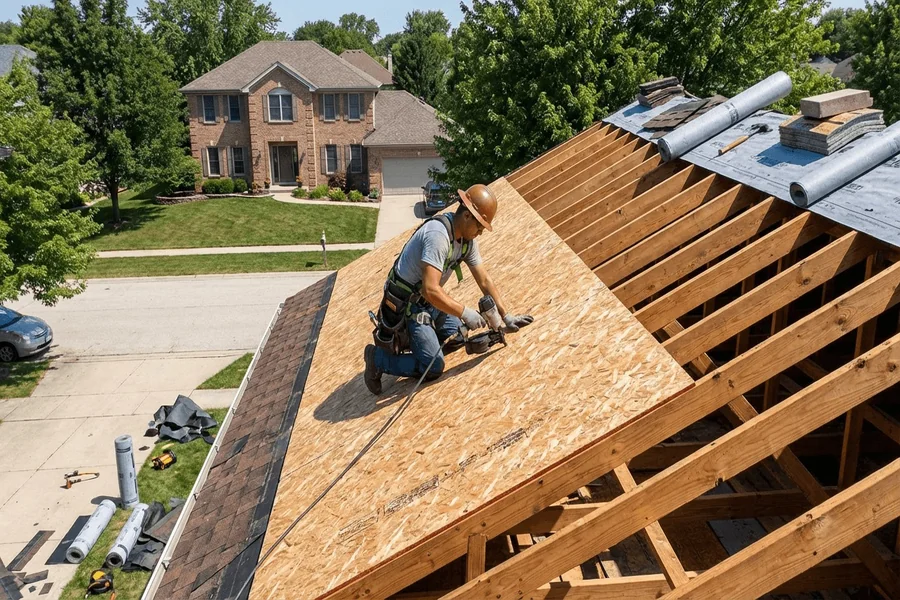

Most homeowners judge a roof by what they can see from outside. Shingles, flashing, ridge caps, and gutters naturally receive the most attention because they form the visible surface. Yet one of the most important parts of the roofing system sits underneath all of them: the roof deck.
The deck provides the solid surface that supports the roofing materials and transfers loads to the framing below. Once new shingles are installed, the deck becomes almost completely hidden again. That makes roof replacement one of the few opportunities to see whether the underlying surface is still sound.
Covering weak, deteriorated, or uneven decking with new roofing materials does not correct the original problem. In some cases, it can hide damage until the next leak, repair, or replacement exposes it again. Understanding what the deck does and why its condition matters can help homeowners make better sense of discoveries that occur after an old roof is removed.
What Is the Roof Deck?
The roof deck, sometimes called roof sheathing, is the structural surface installed over the roof framing.
Modern homes commonly use sheet materials such as plywood or oriented strand board, though the material and construction method can vary depending on the age of the building.
Underlayment and roofing materials are installed over this surface.
The deck serves several functions. It creates a continuous base for roofing materials, provides locations for fasteners, helps distribute loads, and ties portions of the roof framing together.
Because it is covered during normal roof use, homeowners rarely think about it unless a problem develops.
Why Decking Problems Often Remain Hidden
A roof can look reasonably normal from outside even when isolated sections of the deck underneath have deteriorated.
Shingles may bridge a softened area without immediately collapsing. Underlayment can temporarily conceal staining. Previous repairs may also cover evidence of old leaks.
Damage often becomes easier to identify only after tear-off begins.
Once the old roofing is removed, workers can directly inspect the surface for deterioration, unusual movement, staining, openings, or sections that no longer provide reliable support.
This is one reason it can be difficult to determine the exact amount of decking work required before a roof replacement starts.
Past Leaks Can Damage the Surface Below
Water intrusion is one of the common reasons decking deteriorates.
A leak does not need to create a dramatic ceiling stain to affect the materials above the living space.
Small amounts of moisture may repeatedly reach the same section during rain. If the area does not dry adequately, the sheathing can gradually weaken.
Potential entry points include damaged flashing, roof penetrations, valleys, improperly sealed transitions, missing roofing materials, and worn areas near edges.
Once the visible roof is removed, discoloration can provide clues about where water traveled.
Not every stain means the decking must be replaced, but suspicious areas should be checked rather than automatically covered again.
Poor Attic Conditions Can Affect Roof Decking Too
Roof deck problems do not always begin with rain coming through the exterior roofing.
Moisture can also reach the underside of the sheathing from inside the building.
Warm, moisture-containing indoor air that enters an attic may condense against colder surfaces under certain conditions. Repeated moisture exposure can contribute to staining or deterioration.
Bathrooms, kitchens, and other moisture-producing areas therefore need appropriate ventilation arrangements.
Blocked or poorly functioning attic ventilation may also contribute to moisture-management problems depending on the roof design.
If deterioration is discovered across a broad section of decking rather than directly beneath an obvious exterior leak, it may be worth considering what was happening on the underside of the roof as well.
New Shingles Cannot Strengthen Weak Decking
Roofing shingles are designed to shed water and protect the roof assembly. They are not intended to repair damaged structural sheathing.
If the surface underneath is soft or deteriorated, installing new shingles over it does not make the deck solid again.
The problem simply becomes hidden under new materials.
This can affect both the performance and appearance of the new roof.
A solid surface gives shingles and other roofing components a consistent base. If the deck moves excessively or lacks enough strength to hold fasteners properly, the materials installed above it may not perform as intended.
Why Nail Holding Matters
Roofing materials rely on fasteners.
Those fasteners need a suitable surface to grip.
When sheathing has deteriorated, a nail driven into the affected area may not hold as securely as it would in sound material.
This problem is particularly important because the weakness may not be obvious once the roof has been completed.
A homeowner working with a Roofing Company in Eugene, OR should expect questionable decking to be evaluated before new roofing permanently covers the area.
The goal is not to replace every sheet automatically. It is to provide a suitable base wherever new materials need to be fastened.
Soft Spots Deserve Investigation
Roofers may notice soft or spongy areas while walking on an exposed deck.
A soft spot can indicate several conditions.
The sheathing may have deteriorated from moisture, a panel edge may lack adequate support, or the material could have been damaged during earlier work.
It is difficult to determine the cause based on feeling alone.
Once a questionable section is located, closer inspection can reveal whether the problem is limited to a small area or extends farther than expected.
A visibly damaged section should not simply disappear beneath underlayment without understanding what caused it.
Uneven Decking Can Affect the Finished Roof
Not every roof-deck problem involves rot or severe deterioration.
Some surfaces become uneven.
Panels can shift, edges can rise, old repairs can create inconsistent levels, or framing conditions may produce dips and waves.
New roofing materials tend to follow the surface underneath them.
If the deck is noticeably irregular, those imperfections may remain visible after installation.
A small amount of variation does not necessarily mean the entire deck has failed. Roofs are rarely perfectly flat. However, pronounced dips or raised areas deserve attention before the finished surface is installed.
Visible Roof Waves Can Have Several Causes
Homeowners sometimes notice sections of roofing that appear wavy when viewed from the ground.
The cause is not always the shingles themselves.
Possible contributors include uneven decking, framing movement, installation issues, or changes where older repairs were performed.
Because several conditions can produce a similar appearance, diagnosing waves from photographs alone may be difficult.
A roofing professional may need to inspect the surface and, in some cases, the attic or underlying framing to determine whether the issue is cosmetic or connected to a deeper problem.
Damaged Sections and Widespread Problems Are Different
Finding one compromised piece of sheathing does not automatically mean the entire roof deck needs replacement.
Localized damage may occur around a leak, chimney, skylight, valley, plumbing vent, or roof edge.
If the surrounding material remains sound, only the affected section may need attention.
Widespread deterioration is different.
If many areas show similar weakness, staining, or poor fastener holding, the cause may be broader than a single leak.
The scope of work should follow the actual condition of the deck rather than assuming every roof requires the same solution.
Why Roof Edges Need Close Inspection
The perimeter of a roof can experience conditions that differ from the middle of the roof plane.
Water from gutters, damaged edge flashing, ice or debris in some climates, and repeated wetting can affect sheathing near the eaves.
Fascia problems may also allow moisture to reach nearby materials.
During tear-off, the edge of the roof is exposed clearly enough to inspect areas that may have been difficult to see beforehand.
If deterioration is present, repairs should be coordinated with the edge details so the source of moisture is not left unchanged.
Valleys Can Hide Concentrated Deck Damage
Roof valleys collect water from two adjoining slopes.
If a valley has leaked, the deck below it may show more significant deterioration than surrounding roof areas because runoff is concentrated there.
Previous surface repairs can make this harder to recognize before tear-off.
Layers of sealant or replacement shingles may temporarily cover the visible symptoms while moisture continues to reach the sheathing underneath.
When valley materials are removed during roof replacement, the underlying deck deserves careful inspection before the new valley system is installed.
Roof Penetrations Can Create Small but Serious Problem Areas
Plumbing vents, exhaust vents, skylights, chimneys, and other roof penetrations interrupt the continuous roofing surface.
Each interruption requires detailing that keeps water outside.
If flashing around a penetration fails, damage may remain concentrated within a relatively small section of deck.
That can make the problem easy to miss from outside.
During replacement, checking the sheathing around penetrations can reveal damage that did not produce obvious interior symptoms.
What Happens If Bad Decking Is Found Mid-Project?
Homeowners can be surprised when decking repairs are added after tear-off begins.
The important thing to understand is that some problems genuinely cannot be seen until the old roofing is removed.
The discovery should still be explained clearly.
A contractor should be able to show the affected area and describe why it does not provide a suitable surface for the new roof.
Photos can be useful when the homeowner cannot safely view the exposed roof directly.
The amount of replacement should be based on what is actually damaged or unsuitable, not simply on the fact that the old roofing has been removed.
Why Covering Damage Can Create Future Costs
Ignoring compromised sheathing may save a small amount during the immediate project, but it can make later repairs more disruptive.
Once new underlayment and shingles cover the roof, accessing the deck again requires removing portions of those materials.
If a weak section later contributes to a roofing problem, otherwise serviceable new materials may need to be disturbed just to reach it.
Correcting known deck issues during replacement avoids building a new roof over a problem that is already visible.
Roof Deck Repairs Should Address the Cause Too
Replacing damaged sheathing solves only part of the issue if the source of the damage remains.
If a leaking flashing detail caused the problem, that detail needs correction.
If moisture came from an improperly terminated exhaust duct, simply installing new wood above it leaves the same conditions in place.
If repeated gutter overflow soaked the eave area, the drainage problem may also need attention.
Roof repairs work best when both the damaged material and the reason it became damaged are addressed.
Otherwise, new decking can eventually experience the same problem.
The Deck Should Be Checked Before Underlayment Covers It
Timing matters during roof replacement.
Once the underlayment is installed, much of the deck is hidden again.
Inspection therefore needs to happen after tear-off and before the new roofing system progresses too far.
Workers should have an opportunity to identify questionable sections, make necessary repairs, and confirm that the surface is suitable for the next layers.
Photographs taken during this stage can also provide homeowners with a useful record of what was found and corrected.
A New Roof Needs a Reliable Foundation
The most attractive shingles cannot compensate for a weak surface underneath them.
Roof decking is easy to overlook precisely because homeowners rarely see it. Yet it provides the foundation that allows underlayment, flashing, shingles, and fasteners to work together as intended.
Roof replacement creates a short window when that hidden surface becomes fully accessible.
Using that opportunity to identify soft areas, moisture damage, uneven sections, and weak fastener locations can prevent known defects from being sealed beneath new materials.
A finished roof may be judged by what is visible from the street, but much of its performance depends on the parts that disappear as soon as installation is complete.