

Idioms can make writing lively, memorable and natural. They can also create some of the most difficult translation problems in a document. A phrase such as “break the ice” or “read between the lines” communicates an idea that cannot be reconstructed reliably from the ordinary meanings of its individual words.
A Word document translator can produce an initial translation while retaining much of the structure of a DOCX file. This saves teams from copying paragraphs, tables and headings into a separate text box. However, idioms, fixed expressions and culture-specific references still need contextual review before the translated document is shared.
The difficulty lies in deciding what the writer intended, how the target audience would express the same idea and whether the document’s tone permits an idiomatic alternative.
Why Literal Translation Fails With Idioms
An idiom functions as a complete expression. Translating each word separately may create a sentence that sounds strange or communicates the wrong meaning.
Consider “the ball is in your court.” In a business email, it means that the next decision or action belongs to the recipient. A literal translation about a ball and a court may confuse readers in another language, especially when the target culture does not use the same sporting metaphor.
The same problem applies to phrases such as:
- Get the green light
- Go back to the drawing board
- Cut corners
- Keep someone in the loop
- Learn the ropes
- A grey area
The appropriate translation depends on context. “Cut corners” may describe unsafe cost reduction in a compliance document, while “learn the ropes” may appear as friendly language in an employee handbook. Both meaning and register have to be considered.
Where Idioms Create the Greatest Risk
Idioms appear in more documents than teams often expect. They are common in training manuals, internal communications, presentations, educational materials, marketing copy and customer-facing guides.
Business Documents
Business English frequently uses figurative language to make abstract ideas feel concrete. Phrases such as “move the needle,” “low-hanging fruit” and “on the same page” may be familiar to English-speaking teams but unclear when translated literally.
The reviewer should determine whether the target language has a natural equivalent. In a formal report, direct wording may be safer. “We need to move the needle on retention” could become “We need to improve customer retention measurably.”
Educational Materials
A language-learning worksheet may use an idiom as the subject of the lesson. Replacing it entirely with a plain explanation would remove the material being taught.
In this situation, the translated version may need to retain the original English expression, add a natural target-language explanation and provide an example that clarifies its use.
Marketing and Informal Writing
Marketing copy often depends on wordplay, rhythm and cultural associations. An equivalent expression may communicate the intended emotion more effectively than a literal rendering.
The reviewer also needs to confirm that the alternative suits the brand. A playful idiom may work in a social campaign and feel out of place in a financial or medical document.
Mark Difficult Expressions Before Translation
A short preparation stage can make the review more efficient.
Read through the document and highlight expressions whose meaning extends beyond their individual words. Include phrasal verbs, slang, metaphors, proverbs, humour and references that depend on local knowledge.
Add a comment explaining the intended meaning where the context could be ambiguous. For example, a reviewer could annotate “get the ball rolling” with “begin the project or process.”
Treat these comments, highlights and terminology notes as references for the people reviewing the translated document. Do not assume that Doc-Translator.org will automatically identify, interpret or apply source-file annotations during translation. Keep the annotated source available and compare it with the translated DOCX during human review.
Translate the Complete DOCX Before Reviewing Individual Phrases
Context is often spread across a paragraph, section or entire document. Reviewing isolated sentences too early can lead to inconsistent decisions.
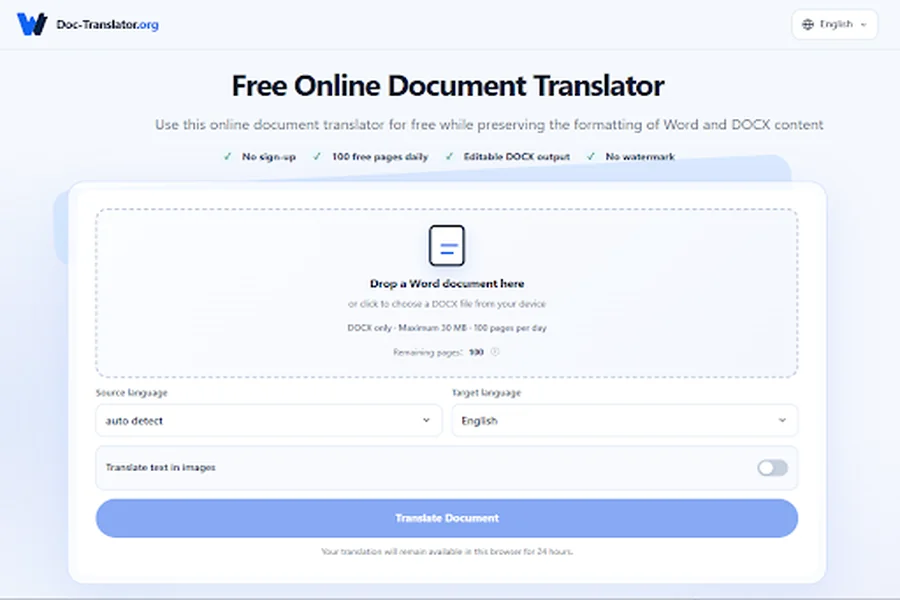
Teams can use Doc-Translator.org to translate Word document while preserving formatting, with common structural elements such as paragraphs, tables, lists, images, headers and footers retained where possible. The service accepts DOCX files up to 30 MB, supports more than 100 target languages and returns an editable DOCX. Its free allowance covers up to 100 pages per day, and registration is not required.
The service aims to retain common document structure, although text expansion, font availability and writing direction may change the final layout. The translated file should therefore be treated as an editable draft requiring language and formatting review.
Choose the Right Treatment for Each Idiom
There is no single method that suits every expression. Reviewers generally have three practical options.
Use a Natural Equivalent
Choose an established expression in the target language when it communicates the same meaning, tone and level of formality.
This method works well in dialogue, informal guidance and marketing copy. The target-language phrase may use completely different imagery, which is acceptable when the intended effect remains clear.
Replace It With Direct Language
Plain wording is often better for policies, instructions, contracts and technical materials. Readers should not have to interpret a metaphor before understanding an important requirement.
For example, “Do not cut corners during the inspection” could become “Do not skip any required inspection steps.”
Retain and Explain the Original
The original idiom may matter in educational, literary or intercultural material. Retaining it with a short explanation allows readers to see the source expression while understanding its meaning.
This approach should be used selectively. Explaining every familiar expression can make the translated document cumbersome.
Review Meaning and Tone Separately
A translation can express the basic meaning correctly while changing the writer’s tone.
“Get your act together” communicates criticism and urgency. Translating it as “please organise your work” softens the message. A stronger alternative may preserve the intention more accurately, although it should still be appropriate for the relationship between writer and reader.
Reviewers should ask two questions:
- Does the translated phrase communicate the intended action or idea?
- Does it preserve the level of humour, urgency, politeness or criticism?
Answering both prevents a grammatically correct translation from changing the document’s interpersonal meaning.
Check the Word Layout After Language Review
Replacing an idiom with an explanation can make a sentence considerably longer. This may affect table cells, headings, captions and page breaks.
Open the translated DOCX in a compatible word processor and inspect the entire file. Pay particular attention to narrow table columns, numbered lists, text boxes and headers. Confirm that fonts support every target-language character and that paragraphs remain in the correct reading order.
Document structure and language quality should be reviewed together because a layout problem can separate a phrase from the example or image that explains it.
Frequently Asked Questions
Should every idiom be replaced with plain language?
No. The decision depends on the document’s purpose and audience. Direct language is usually appropriate for technical or procedural content, while a natural equivalent may work better in marketing, dialogue or informal education.
Can software identify every idiom automatically?
No tool should be assumed to identify every idiom correctly. Some expressions have both literal and figurative meanings, so the surrounding context and the writer’s intention require human judgement.
What should be checked after translating a DOCX?
Review idioms, terminology, names, numbers, tables, headings, lists, fonts, page breaks and text direction. High-risk content such as legal terms, safety instructions and technical specifications should be checked by a qualified reviewer.
Treat Idioms as Meaning, Not Individual Words
Idioms reveal why document translation requires more than sentence-level substitution. Their meaning depends on context, audience, tone and culture.
Doc-Translator.org can help produce an editable translated DOCX while retaining common structural elements. A deliberate second review then allows writers, teachers and language professionals to decide whether each idiom should be replaced, adapted or explained. That combination produces a document that reads naturally while remaining faithful to its intended message.